Explore our network of country and industry based websites to access localized information, product offerings, and business services across our group.
Log in to start sending quotation requests for any product.
Don't have an account? Sign Up Here
Home Strategic Industry Report: Agar as a Phosphate-Free Stabilizer in High-Performance Surimi
Trade Insights | Applications and Buyers | 30 December 2025
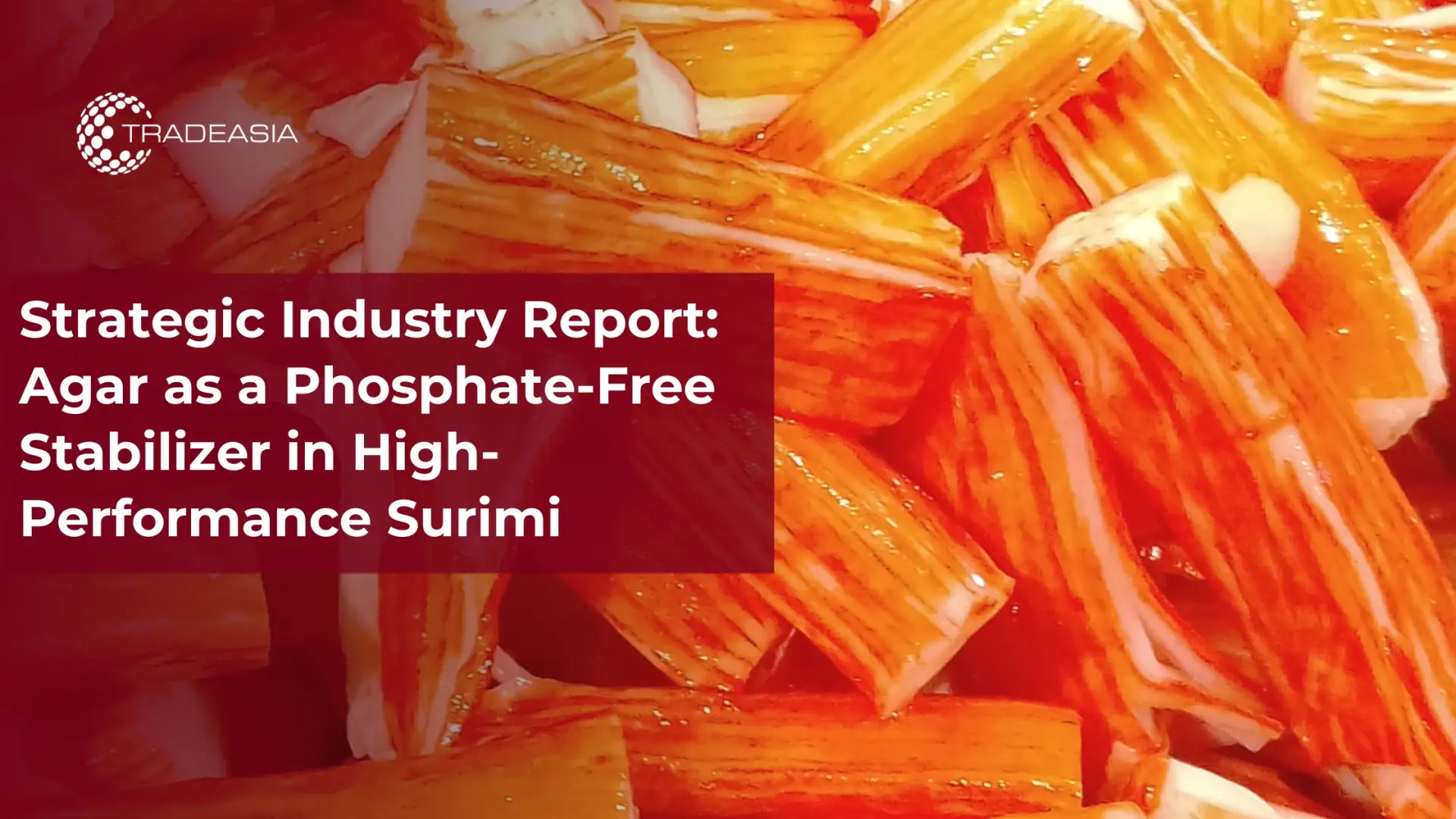
The global surimi industry faces a persistent dual challenge: maintaining the delicate gel strength of myofibrillar proteins during frozen storage while simultaneously reducing sodium and phosphate additives to meet clean-label demands. While phosphates have long been the industry standard for solubilizing actomyosin and binding water, regulatory pressure and consumer sentiment are driving the search for natural alternatives. Agar (E406) has emerged as a scientifically viable solution, capable of enhancing gel strength and Water Holding Capacity (WHC) through physical entrapment rather than chemical modification.
The Mechanism: Physical Entrapment vs. Chemical Binding
Unlike phosphates, which chemically alter the ionic environment to unfold proteins, Agar functions through structural reinforcement. When added to the surimi paste during the comminution (chopping) phase, Agar dissolves and subsequently gels upon cooling. It forms an independent, reversible hydrogel network that interlaces with the fibrous myofibrillar protein network.
This "interpenetrating network" acts as a physical barrier to water migration. Technical studies indicate that a specific dosage of 0.1% to 0.2% is often the "Goldilocks zone." At this level, Agar enhances the "Suwari" (setting) process, trapping free water within its helix structure preventing it from forming large ice crystals during freezing. This significantly reduces syneresis (drip loss) upon thawing—a critical quality metric for commercial crab sticks and fish balls. However, precision is key; exceeding 0.5% can physically disrupt the protein-protein crosslinks, leading to a weaker, paste-like texture.
Texture Modification: Creating the Premium "Snap"
Surimi quality is judged by its "ashi"—the unique combination of elasticity and cohesiveness. Standard surimi grades (like Grade A or AA) have natural springiness, but lower grades (Grade B or C) often suffer from softness. Agar is unique among hydrocolloids because of its high gel strength and brittleness. When used in lower-grade surimi, it provides a firm "skeleton" that mimics the bite of higher-grade fish protein. Unlike starch, which can make surimi feel doughy or sticky, Agar contributes to a clean, "snappy" texture that closely resembles the bite of natural shrimp or lobster meat. This allows manufacturers to utilize cost-effective lower-grade surimi paste while achieving a premium mouthfeel in the final analog product.
Thermal Stability in Hot Pot Applications
A growing segment for surimi is the "Hot Pot" or soup application, where balls and sticks are boiled for extended periods. Surimi stabilized with starch or gelatin can become mushy or disintegrate under prolonged boiling. Agar possesses high thermal hysteresis. Once set, an Agar gel does not melt until it reaches temperatures near 85°C-90°C. In a boiling soup context, while the surimi heats up, the Agar network remains largely intact, providing structural support that prevents the fish ball from swelling excessively and losing its shape. This thermal resilience is a distinct competitive advantage for premium surimi brands targeting the Asian foodservice market.
Sources
We're committed to your privacy. Tradeasia uses the information you provide to us to contact you about our relevant content, products, and services. For more information, check out our privacy policy.


 English
 Indonesian
 简体字
简体字
 العربية
 Español
 Français
 Português
 日本語
日本語
 한국어
한국어
 Tiếng Việt



















