Explore our network of country and industry based websites to access localized information, product offerings, and business services across our group.
Log in to start sending quotation requests for any product.
Don't have an account? Sign Up Here
Home A Technical Comparison of Agar and Gelatin Gels
Trade Insights | Applications and Buyers | 30 December 2025
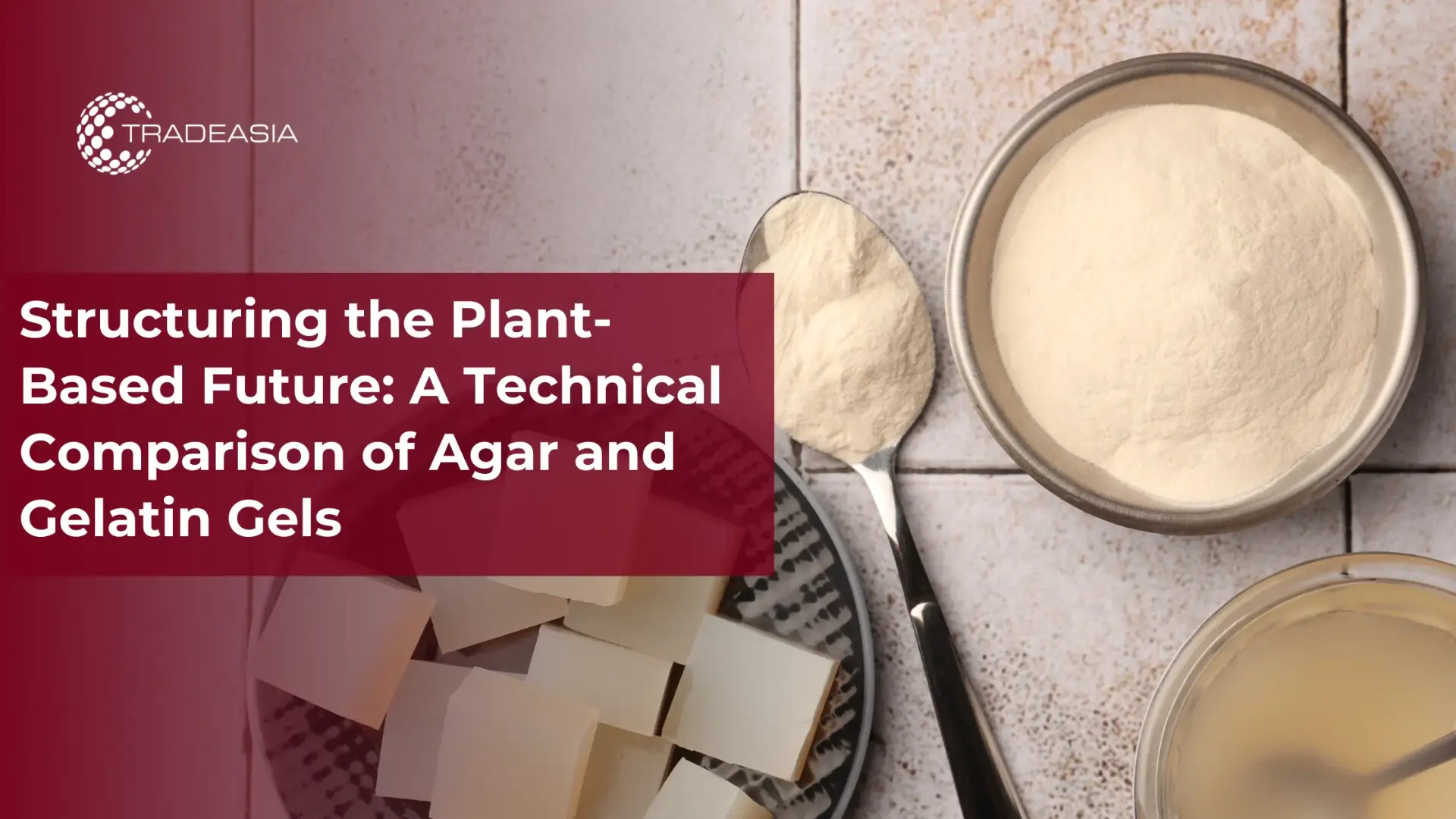
As the demand for plant-based and Halal-certified desserts accelerates, food formulators are frequently tasked with replacing the industry standard—Gelatin—with a suitable vegan alternative. While there are many hydrocolloids available, Agar (Agar-Agar) remains the primary candidate due to its high gelling strength and hysteresis. However, simply swapping Agar for Gelatin in a 1:1 ratio is a recipe for failure. To successfully formulate vegan panna cottas, jellies, and mousses, R&D teams must understand the fundamental physical chemistry that differentiates these two distinct gelling agents.
Source and Molecular Architecture
The most obvious difference lies in their origin. Gelatin is a protein derived from the partial hydrolysis of collagen (animal connective tissue). It forms a gel via the formation of triple helices that entrap water. Because it is a protein, it is sensitive to proteolytic enzymes (like those found in fresh pineapple or kiwi), which can destroy the gel structure.
Agar, conversely, is a polysaccharide extracted from Red Algae (Rhodophyta), specifically species like Gracilaria and Gelidium. It consists of two fractions: agarose (the gelling fraction) and agaropectin. Unlike gelatin, Agar is a carbohydrate, making it immune to enzymatic breakdown by fresh fruits. This allows manufacturers to create stable fruit jellies using raw papaya or pineapple purees—formulations that are impossible with standard gelatin.
Thermal Hysteresis: The Melting Point Gap
The defining technical characteristic of Agar is its extreme thermal hysteresis—the difference between its melting and setting temperatures.
This thermal gap is a double-edged sword. On the positive side, Agar desserts are heat-stable. A vegan Agar jelly will not melt sitting on a warm buffet table or during transport in a tropical climate, whereas a Gelatin dessert would collapse. On the negative side, Agar does not melt in the mouth. It must be chewed. This rheological difference is why Agar desserts feel "firm" rather than "creamy," requiring formulators to adjust sugar and fat ratios to soften the gel network.
Texture Profile Analysis (TPA): Brittle vs. Elastic
In sensory terms, the texture of an Agar gel is described as "short" or "brittle." When pressure is applied (like a spoon cutting through a jelly), the gel breaks cleanly with a sharp fracture. It has very low elasticity. If you shake an Agar jelly, it jiggles less than a Gelatin one. Gelatin, by contrast, is highly elastic and cohesive. It stretches before it breaks and has a "bouncy" or "rubbery" quality. To mimic the elasticity of Gelatin in a vegan formulation, Agar is rarely used alone. It is often synergized with other hydrocolloids. Adding Locust Bean Gum (LBG) or Xanthan Gum to an Agar formulation disrupts the rigid agarose helix formation, increasing elasticity and reducing syneresis (weeping of water), bringing the final texture much closer to the traditional Gelatin experience.
Dosage and Activation Requirements
From a processing standpoint, Agar is significantly more potent. A standard 250 Bloom Gelatin might be used at 1.5% to 2.0% in a recipe. High-quality Agar typically provides a firm gel at 0.5% to 0.8%. This high yield makes Agar cost-effective despite its higher price per kilogram. However, activation protocols differ. Gelatin can be hydrated in warm water (blooming). Agar must be boiled. The solution must reach 95°C - 100°C for several minutes to fully dissolve the polysaccharide chains. If an industrial kitchen simply warms the Agar mix, it will not set. This requirement impacts production workflows, necessitating heating steps that might not be required for instant gelatin mixes.
Sources
We're committed to your privacy. Tradeasia uses the information you provide to us to contact you about our relevant content, products, and services. For more information, check out our privacy policy.


 English
 Indonesian
 简体字
简体字
 العربية
 Español
 Français
 Português
 日本語
日本語
 한국어
한국어
 Tiếng Việt



















