Explore our network of country and industry based websites to access localized information, product offerings, and business services across our group.
Log in to start sending quotation requests for any product.
Don't have an account? Sign Up Here
Home Antioxidant Science: How Ascorbic Acid Prevents Oxidation in Food Systems
Trade Insights | Applications and Buyers | 03 February 2026
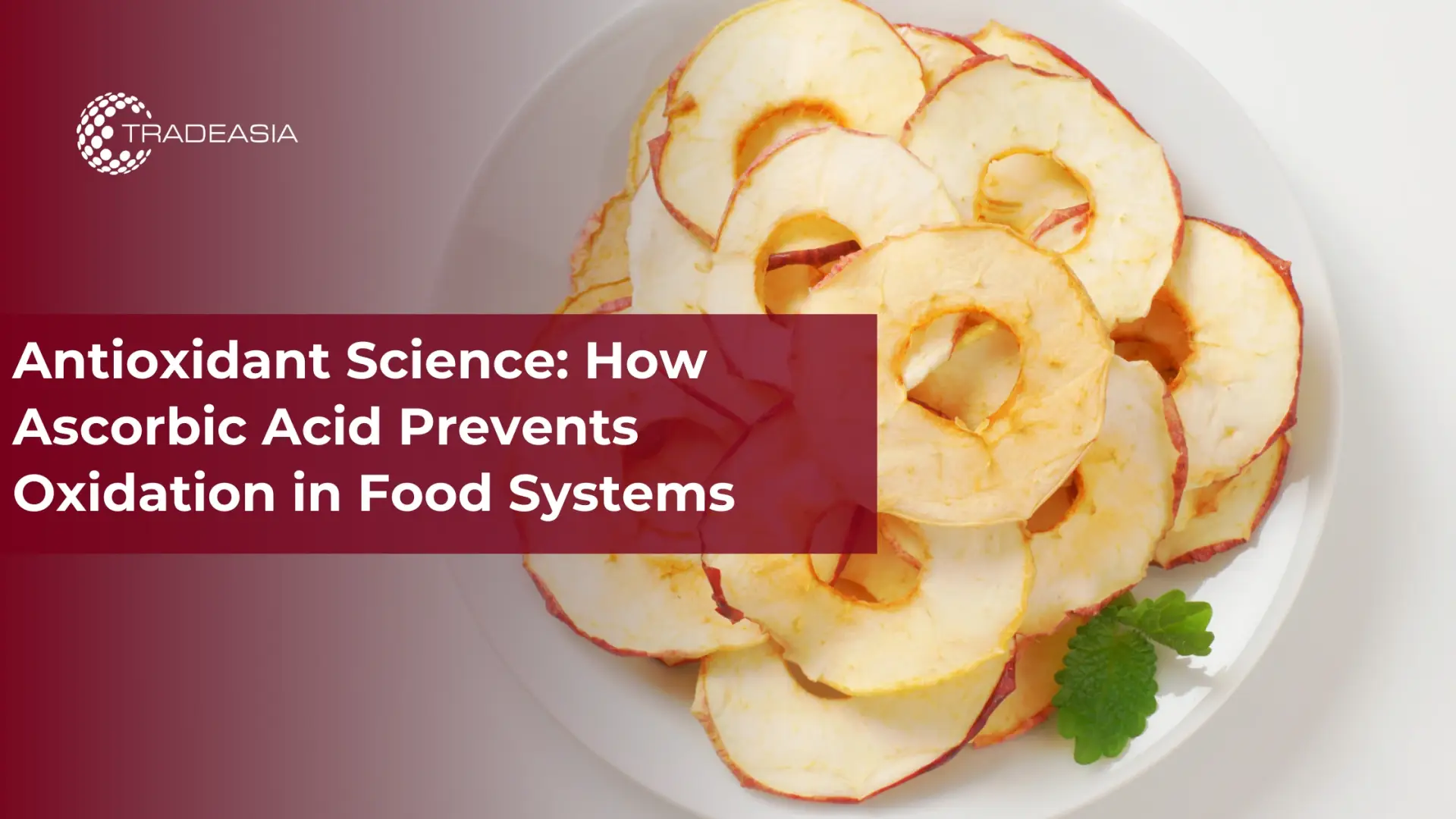
In the food and beverage industry, oxidation is enemy number one. It is the silent chemical reaction that degrades quality long before microbial spoilage sets in. It is responsible for the rancid smell in old potato chips, the brown discoloration of a sliced apple, the loss of red color in cured meats, and the "cardboard" flavor in aged beer.
Oxidation is essentially the theft of electrons. Oxygen, light, or metal ions steal electrons from the molecules that make up our food—fats, pigments, and flavor compounds. Once these molecules lose electrons, they become unstable "free radicals" that trigger a destructive chain reaction.
To combat this, food technologists rely on Antioxidants. Among these, Ascorbic Acid (Vitamin C) is arguably the most versatile and widely used. While consumers know it as an immune booster, for the food scientist, it is a highly efficient chemical scavenger that sacrifices itself to protect the integrity of the product. This guide explores the sophisticated chemistry behind how Ascorbic Acid prevents oxidation and extends the commercial life of food products.
Ascorbic Acid (C6H8O6) is a water-soluble organic compound naturally found in citrus fruits, berries, and leafy vegetables. In the food industry, it is labeled as E300.
Commercially, it is produced through a fermentation process (similar to Citric Acid) followed by chemical synthesis, ensuring a high-purity, nature-identical white powder. Its primary value lies in its chemical structure: it is an "enepolyol" (a specific arrangement of double bonds and hydroxyl groups). This structure makes it an excellent reducing agent. In chemical terms, a Reducing Agent is a substance that is eager to donate electrons.
This willingness to donate electrons is the core of its antioxidant power. It does not just "block" oxygen; it actively interacts with the oxidative threats, neutralizing them before they can damage the food matrix.
How exactly does Ascorbic Acid stop oxidation? It operates through two primary mechanisms: Oxygen Scavenging and Free Radical Quenching.
The "Sacrificial" Scavenger
Think of oxidation as a fire, and oxygen as the fuel. Ascorbic Acid acts as a firefighter that throws itself onto the fire. When oxygen is present in a liquid (like a fruit juice), it wants to react with the delicate flavor oils. Ascorbic Acid intervenes by reacting with the oxygen first.
It donates two electrons to the oxygen (or the oxidizing agent). In doing so, the Ascorbic Acid itself becomes oxidized, converting into Dehydroascorbic Acid (DHAA). This new compound is harmless and flavorless. By "taking the bullet," the Ascorbic Acid is consumed, but the sensory qualities of the juice remain untouched. This is why you will often see Vitamin C levels drop in a product over its shelf life—it is being used up to protect the product.
Free Radical Quenching (Terminating the Chain)
Oxidation is often a chain reaction. One unstable molecule steals an electron from its neighbor, making the neighbor unstable, and so on. This is called the "propagation phase." Ascorbic Acid stops this dominance. It donates a hydrogen atom (and an electron) to the free radical. This stabilizes the radical, effectively turning it back into a stable molecule.
Crucially, the resulting "Ascorbyl Radical" is chemically stable and does not continue the chain reaction. It simply waits to be recycled or broken down, effectively ending the destruction cycle.
Metal Chelation (The Indirect Route)
Trace metals like copper and iron are catalysts for oxidation—they speed up the process aggressively. While Ascorbic Acid is primarily a scavenger, it can also influence the oxidative state of these metals, although it is often paired with Citric Acid or EDTA to fully lock these metals away.
The way Ascorbic Acid works changes depending on what it is protecting.
A. Beverage Industry: Protecting Flavor and Color
In soft drinks, iced teas, and fruit juices, the primary threat is dissolved oxygen in the water and oxygen in the "headspace" (the air gap at the top of the bottle).
The Action: Ascorbic Acid effectively scrubs this oxygen from the solution. This is vital for preserving natural colors. For example, the red anthocyanin pigments in berry juices turn brown when oxidized. By removing the oxygen, Ascorbic Acid locks in the vibrant red color.
Flavor Protection: It also protects citral (lemon flavor) and other terpenes from oxidizing into "off-notes" that taste like turpentine or damp cardboard.
B. Meat Processing: Curing Accelerator & Color Stability
In the production of ham, bacon, and sausages, manufacturers use Nitrites (E250) to create the pink "cured" color and protect against Botulism.
The Action: The reaction that turns Nitrite into the pink pigment (Nitric Oxide) is slow. Ascorbic Acid acts as a Curing Accelerator. It chemically reduces the Nitrite to Nitric Oxide instantly.
The Benefit: This speeds up production, ensures a uniform pink color, and crucially, prevents the formation of Nitrosamines (carcinogenic compounds) by ensuring the nitrite reacts with the meat rather than other amines.
C. Fresh-Cut Fruits: Enzyme Inhibition
When you slice an apple or avocado, it turns brown. This is Enzymatic Browning caused by the enzyme Polyphenol Oxidase (PPO).
The Action: PPO uses oxygen to turn phenolic compounds in the fruit into brown melanin pigments. Ascorbic Acid reverses this process. Even if the enzyme creates a brown pigment precursor (quinone), Ascorbic Acid chemically reduces it back to its colorless state (diphenol). As long as active Ascorbic Acid remains on the surface of the fruit, the apple will stay white.
D. Bakery: Dough Conditioning
Surprisingly, in bread making, Ascorbic Acid acts as an Oxidizing Agent (improver), not an antioxidant.
The Action: During mixing, an enzyme in the flour converts Ascorbic Acid into Dehydroascorbic Acid. This compound helps form disulfide bonds between gluten proteins.
The Benefit: This tightens the gluten network, allowing the dough to hold more gas, resulting in a loaf with better volume and finer texture.
There is a significant limitation to standard Ascorbic Acid: it is water-soluble. It cannot protect pure fats, oils, or margarine, because it simply will not dissolve in them.
To solve this, chemists created Ascorbyl Palmitate.
The Chemistry: This is an "ester" formed by combining Ascorbic Acid with Palmitic Acid (a fatty acid derived from palm oil).
The Function: The Palmitic Acid tail acts as a lipid-friendly anchor, allowing the molecule to dissolve in oil. The Ascorbic Acid head remains active to fight oxidation.
The Synergy: In high-fat systems (like potato chips or frying oils), Ascorbyl Palmitate is often used in combination with Tocopherols (Vitamin E).
The "Recycling" Effect: Vitamin E is the primary defender of fat. When Vitamin E neutralizes a free radical, it becomes inactive. Ascorbyl Palmitate can donate an electron to the "spent" Vitamin E, regenerating it so it can go back to work. This synergy makes the preservative system significantly more potent than using either ingredient alone.
When browsing our catalog, you will often see Erythorbic Acid (E315) or Sodium Erythorbate (E316) listed alongside Ascorbic Acid. What is the difference?
Stereoisomers: Erythorbic Acid is the "mirror image" (stereoisomer) of Ascorbic Acid. Chemically, they are almost identical in their reducing power (antioxidant capacity).
Biological Activity: The key difference is that Erythorbic Acid has zero Vitamin C activity in the human body. It is not a vitamin.
The Choice:
Use Ascorbic Acid if you want to fortify your product and claim "High in Vitamin C" on the label.
Use Erythorbic Acid if you only care about the technical preservative function (e.g., in meat processing). It is typically cheaper than Ascorbic Acid, making it the preferred choice for cost-sensitive meat applications where vitamin fortification is not a marketing goal.
While Ascorbic Acid is a powerful protector, it is chemically fragile itself. It is sensitive to:
Heat: Prolonged heating degrades it.
Moisture: In high-humidity environments, the powder can degrade.
Metals: Contact with iron or copper equipment speeds up its destruction.
Formulation Best Practices:
Overage: Because Ascorbic Acid sacrifices itself over time, formulators must add an "overage" (extra amount) to ensure there is enough left at the end of the shelf life, especially if making a Vitamin C label claim. Typically, a 20-50% overage is standard depending on the packaging.
Dissolution: Always dissolve it in water that is free of iron/copper. Using deionized water is recommended.
Packaging: It works best in products packaged in oxygen-barrier materials (glass, aluminum cans, or EVOH plastic). In permeable plastic bottles, the Vitamin C will degrade faster as fresh oxygen enters the bottle.
Ascorbic Acid is more than just a vitamin; it is a sophisticated chemical tool that extends the commercial viability of food products. By understanding its role as a sacrificial electron donor, formulators can effectively prevent the discoloration of juices, the rancidity of meats, and the browning of fresh fruit.
Whether you need the water-soluble protection of standard Ascorbic Acid (E300), the fat-soluble power of Ascorbyl Palmitate for oils, or the cost-effectiveness of Erythorbic Acid for cured meats, selecting the right antioxidant is the key to maintaining freshness.
Oxidation is complex, but your solution doesn't have to be. At Food Additives Asia, we supply the full spectrum of antioxidants, including Ascorbic Acid (Fine Powder/Granular), Ascorbyl Palmitate, and Sodium Erythorbate.
Our technical team can assist you in calculating the correct overage and selecting the optimal synergistic blends for your specific food matrix.
Protect your product quality today.
Contact us for samples, pricing, and Technical Data Sheets (TDS) at foodadditivesasia.com.
We're committed to your privacy. Tradeasia uses the information you provide to us to contact you about our relevant content, products, and services. For more information, check out our privacy policy.


 English
 Indonesian
 简体字
简体字
 العربية
 Español
 Français
 Português
 日本語
日本語
 한국어
한국어
 Tiếng Việt



















