Explore our network of country and industry based websites to access localized information, product offerings, and business services across our group.
Log in to start sending quotation requests for any product.
Don't have an account? Sign Up Here
Home The "Lock and Key" Mechanisms: A Deep Dive into Carrageenan Rheology, Synergy, and Protein Interactions
Trade Insights | Applications and Buyers | 31 December 2025
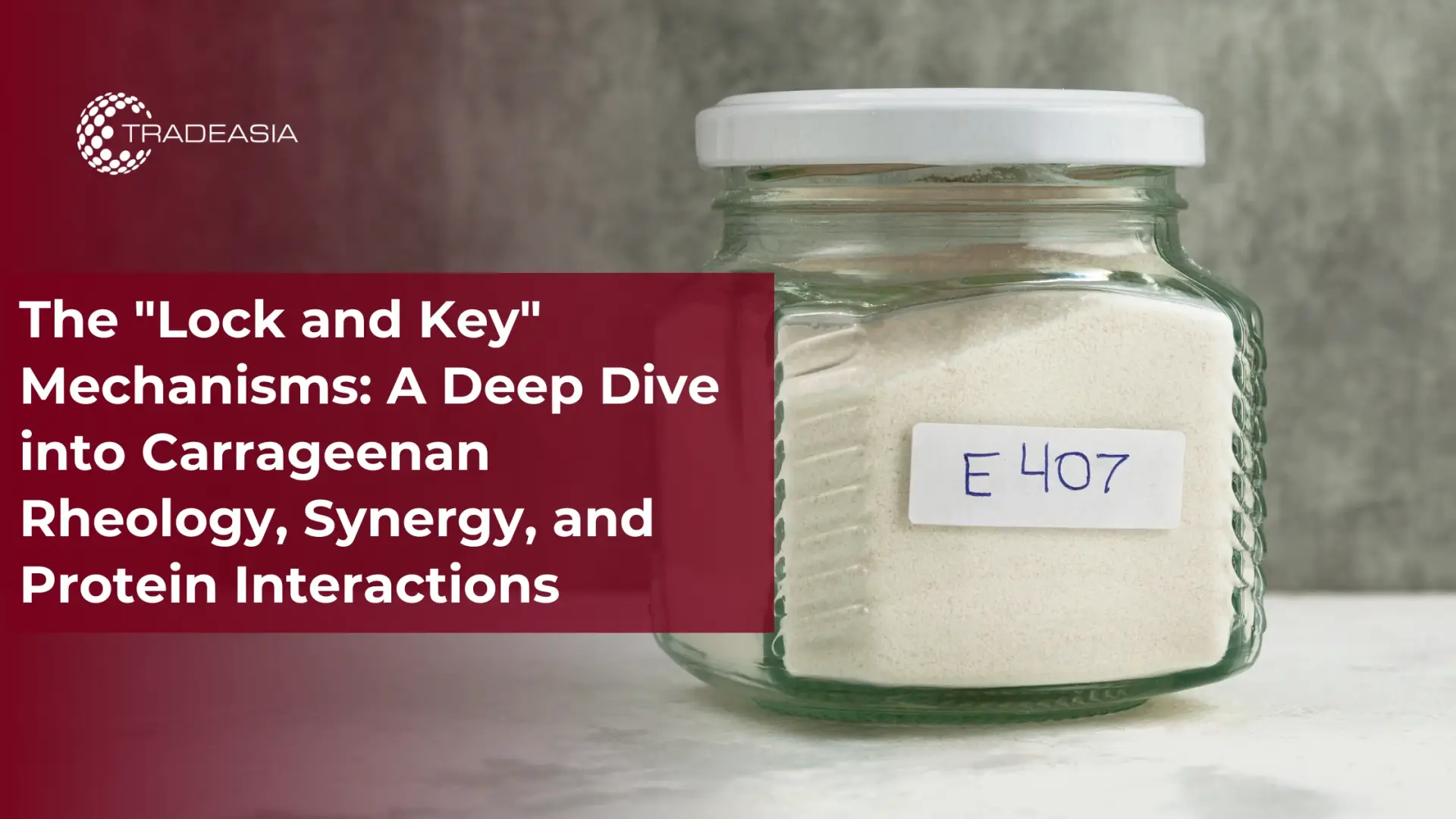
The functionality of commercial carrageenan (E407) is not a static property; it is a dynamic, ion-dependent phenomenon governed by molecular architecture. For food formulators, the difference between a brittle jelly, a creamy sauce, and a stable chocolate milk lies in understanding the precise "Lock and Key" mechanisms that drive these behaviors. This report analyzes the three major carrageenan classes—Kappa, Iota, and Lambda—and explores how their chemical structures dictate their interactions with ions, proteins, and other hydrocolloids.
Kappa Carrageenan: Potassium (K+) and the "Brittle" Network
Kappa carrageenan is the workhorse of the processed meat and dairy industries, prized for its high gel strength. Its functionality is driven by a two-step "Coil-to-Helix" transition.
Chemically, Kappa chains exist as random coils in hot solution. Upon cooling, specifically in the presence of Potassium ions (K+), these coils twist into rigid double helices. The K+ ion acts as a specific binding agent that slots into the helix, neutralizing electrostatic repulsion and allowing the helices to aggregate into large, tightly packed "junction zones."
The rheological outcome of this tight packing is a rigid, brittle gel. While it offers excellent sliceability (crucial for turkey deli meat or firm cheese analogs), this rigidity comes with a cost: syneresis. The network contracts so tightly that it squeezes water out, leading to weeping. Consequently, Kappa is rarely used as a standalone gelling agent in dessert applications where moisture retention is key, necessitating the use of synergistic partners.
Iota Carrageenan: Calcium (Ca²+) and the "Elastic" Bridge
Iota carrageenan offers a contrasting textural profile: soft, elastic, and cohesive. While it also forms helical structures, its higher sulfate content (two per disaccharide) alters its interaction mechanism.
Iota gelation is triggered by Calcium ions (Ca²+). Unlike Potassium, which binds internally to the helix, divalent Calcium ions act as "bridges" between the sulfate groups on the exterior of adjacent helices. Because of the higher negative charge density, the helices repel each other slightly, preventing the tight, brittle aggregation seen in Kappa.
The result is a compliant, elastic gel that holds water effectively (no syneresis). A defining characteristic of Iota is Thixotropy (shear-thinning) and Self-Healing. If an Iota gel is broken by shear force (e.g., pumping or chewing), it flows like a liquid. When the shear stops, the Calcium bridges re-form, and the gel "heals" instantly. This makes Iota the standard for suspension applications like salad dressings, where it must hold herbs in suspension but pour smoothly from the bottle.
Lambda Carrageenan: The Non-Gelling Viscosifier
Lambda represents the functional outlier. Chemically, it lacks the 3,6-anhydrogalactose bridge required to form a helix. Without this structural kink, the molecule remains flat and extended.
Because there is no helical structure for ions to stabilize, Lambda does not gel, regardless of temperature or ion concentration. Instead, its three sulfate groups per disaccharide create strong electrostatic repulsion, keeping the polymer chains fully extended and hydrated. This behavior makes Lambda a pure viscosifier. It builds body through chain entanglement and friction. Notably, it is the only major carrageenan that is cold soluble, meaning it can hydrate and thicken liquids without a heating step. This makes it indispensable for instant dry-mix beverages and cold-process dairy desserts where "creaminess" is required without a gel structure.
Synergistic Interactions: The "LBG Effect"
In industrial formulation, Kappa carrageenan is frequently paired with Locust Bean Gum (LBG) or Konjac Gum to modify its texture. This is known as the "Synergistic Effect."
LBG is a galactomannan with a smooth, unsubstituted mannose backbone. In a mixed system, these smooth regions of the LBG molecule interact directly with the Kappa helices. They act as "spacers" or "shock absorbers" within the rigid Kappa network. This interaction disrupts the excessive aggregation of the Kappa helices, reducing brittleness and preventing syneresis. The result is a gel that retains the strength of Kappa but acquires the elasticity and water-holding capacity of the gum. This synergy is critical for manufacturing dessert jellies, gummy candies, and pet foods, where a rubbery, non-weeping texture is preferred over a brittle one.
Protein Reactivity: The Casein Stabilization Mechanism
One of the most valuable properties of carrageenan is its specific reactivity with milk proteins, particularly Casein. This is the mechanism that keeps cocoa particles suspended in chocolate milk.
At the pH of milk, casein micelles are negatively charged, but they possess a specific positively charged region on the kappa-casein surface (residues 97–112). The negatively charged sulfate groups of the carrageenan molecule bind electrostatically to this positive patch. Even at very low concentrations (0.02% - 0.05%), this interaction forms a weak, thixotropic network that traps casein micelles and suspended particles (like cocoa or calcium) in a 3D matrix. This network is strong enough to prevent sedimentation during shelf life but weak enough to break instantly upon pouring. This unique "pourable gel" behavior is why carrageenan remains the industry standard stabilizer for neutral-pH dairy beverages.
Sources
We're committed to your privacy. Tradeasia uses the information you provide to us to contact you about our relevant content, products, and services. For more information, check out our privacy policy.


 English
 Indonesian
 简体字
简体字
 العربية
 Español
 Français
 Português
 日本語
日本語
 한국어
한국어
 Tiếng Việt



















