Explore our network of country and industry based websites to access localized information, product offerings, and business services across our group.
Log in to start sending quotation requests for any product.
Don't have an account? Sign Up Here
Home Bold Warmth Without Complexity, Cassia Defines Familiar Cinnamon Flavor
Trade Insights | Applications and Buyers | 06 January 2026
Introduction
Botanical Origin and Differentiation of Cassia
Chemical Composition and Flavor Characteristics
Sensory Simplicity and Consumer Familiarity
Functional Advantages in Industrial Food Processing
Application Across Major Food Categories
Processing Stability and Shelf-Life Performance
Regulatory and Clean-Label Considerations
Conclusion
Cassia cinnamon has long defined what most global consumers recognize as “cinnamon flavor.” Characterized by bold warmth, direct sweetness, and a straightforward aromatic profile, cassia delivers immediate sensory impact without the layered complexity found in other cinnamon varieties. This clarity of flavor has made cassia the dominant form of cinnamon used in industrial food production, particularly in applications where consistency, cost efficiency, and strong consumer recognition are essential.
In modern food systems, cassia is not simply a traditional spice but a strategic ingredient that supports standardized flavor delivery across diverse product categories. Its ability to withstand processing stress, integrate easily into formulations, and deliver a familiar taste profile makes it highly valuable for large-scale manufacturing. As food producers continue to prioritize efficiency and global scalability, cassia remains central to the creation of cinnamon-flavored products worldwide.
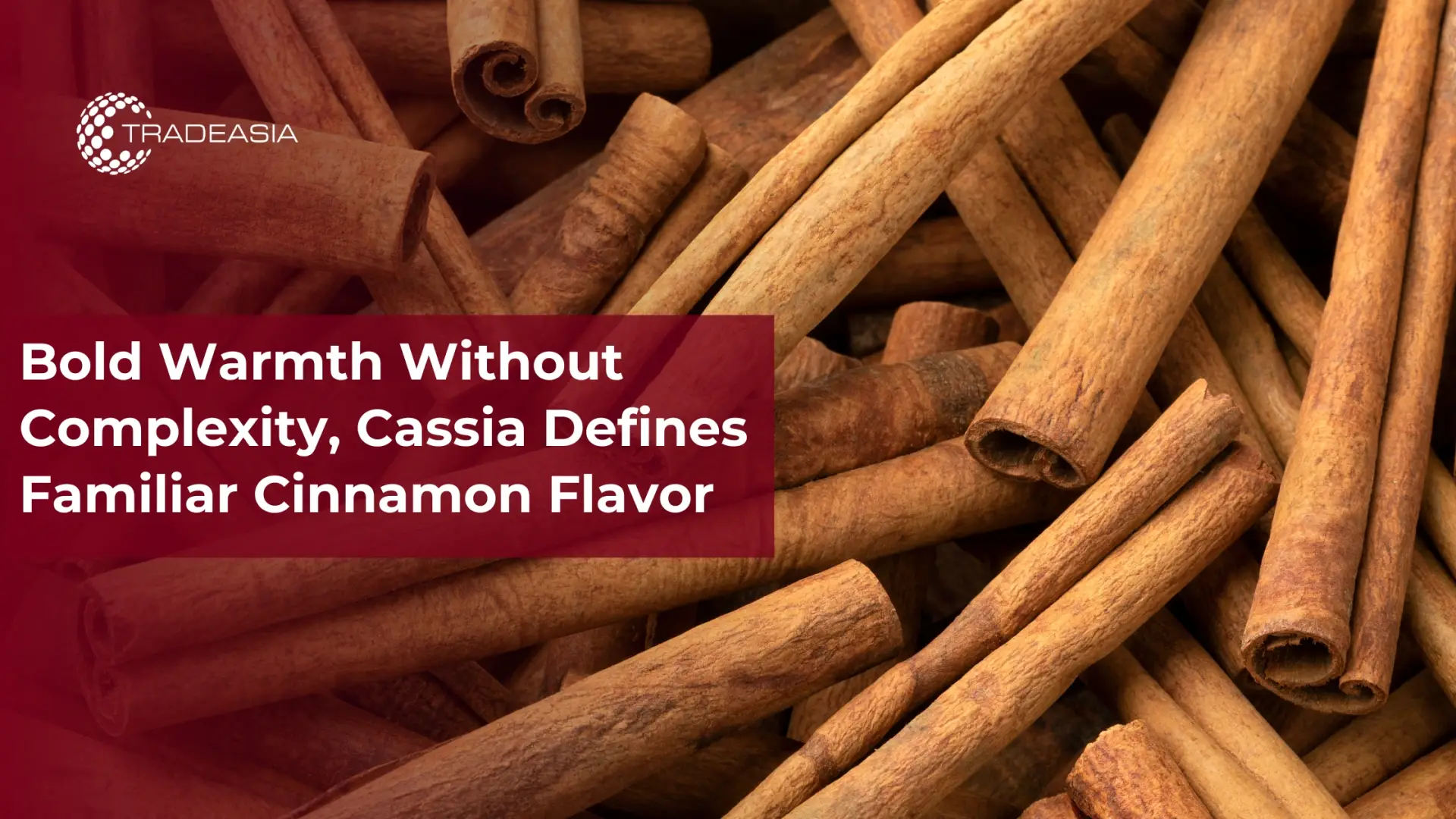
Cassia refers to several species within the Cinnamomum genus, most commonly Cinnamomum cassia, Cinnamomum burmannii, and Cinnamomum loureiroi. Unlike Ceylon cinnamon, which is known for its delicate and complex profile, cassia is derived from thicker bark and contains higher concentrations of aromatic compounds responsible for its robust character. This botanical distinction underpins cassia’s stronger flavor intensity and darker color.
The physical structure of cassia bark contributes to its industrial suitability. Its thicker bark yields higher extractable flavor compounds, making it more efficient for grinding, extraction, and incorporation into dry mixes and liquid systems. These attributes have positioned cassia as the preferred cinnamon variety for mass-market food applications where bold flavor delivery and cost-effectiveness are prioritized.
Cassia’s dominant flavor is driven primarily by cinnamaldehyde, which typically constitutes a higher percentage of its volatile oil content compared to other cinnamon types. Cinnamaldehyde delivers the signature warm, sweet, and slightly spicy notes that consumers associate with cinnamon-flavored foods. This compound provides immediate aroma release and a lingering warmth that enhances sweetness perception without requiring additional flavor modifiers.
From a functional perspective, cassia’s chemical simplicity is an advantage rather than a limitation. Its flavor profile is predictable and consistent, allowing food manufacturers to achieve reliable results across batches and production sites. This predictability is critical in industrial environments where flavor variation can lead to quality inconsistencies and consumer dissatisfaction.
One of cassia’s most valuable attributes is its alignment with consumer expectations. Across many global markets, cassia defines the baseline sensory reference for cinnamon. Its bold warmth and direct sweetness are instantly recognizable, making it particularly effective in products targeting broad consumer segments. Unlike more nuanced spices, cassia does not require consumer education or acclimatization, reducing the risk of rejection.
This familiarity allows cassia to function as a comfort flavor, evoking associations with baked goods, warm beverages, and traditional desserts. In savory applications, it contributes warmth and depth without introducing unfamiliar complexity. This dual compatibility across sweet and savory profiles further reinforces cassia’s versatility in food formulation.
Cassia performs exceptionally well under industrial processing conditions. Its primary flavor compounds demonstrate good thermal stability, retaining potency through baking, extrusion, boiling, and retorting. This resilience ensures that finished products maintain their intended flavor intensity even after exposure to high temperatures and extended processing times.
In addition, cassia integrates effectively into a wide range of food matrices, including dry powders, fat-based systems, and aqueous solutions. Its compatibility with sugars, fats, and starches allows it to be used across diverse formulations without causing flavor imbalance or degradation. These functional advantages make cassia a reliable component in large-scale production environments where efficiency and repeatability are critical.
Cassia is widely applied across bakery, confectionery, beverages, dairy, and savory food categories. In baked goods such as breads, pastries, and cookies, cassia provides the characteristic cinnamon aroma that defines product identity. Its robust flavor withstands oven temperatures and interacts positively with sugars and fats, enhancing overall sensory appeal.
In confectionery, cassia delivers warmth and sweetness that complement chocolate, caramel, and fruit flavors. In beverages, including flavored teas and spiced drinks, it contributes aromatic intensity that remains perceptible even at low inclusion levels. In savory products, cassia is used selectively to add warmth and depth to sauces, marinades, and spice blends, demonstrating its broad functional range.
Cassia exhibits strong stability throughout product shelf-life when properly handled and stored. Its key flavor compounds remain active over time, ensuring consistent sensory performance in packaged foods. While prolonged exposure to light and moisture can affect volatile oils, appropriate packaging and formulation strategies mitigate these risks effectively.
This stability supports cassia’s use in shelf-stable products, frozen foods, and long-distribution supply chains. Manufacturers benefit from reduced reformulation needs and predictable flavor retention, which contributes to overall product quality and cost control.
As a naturally derived spice with a long history of culinary use, cassia aligns well with clean-label and transparency-driven formulation strategies. It is widely accepted across regulatory frameworks for food use, supporting global distribution. However, formulation teams must consider dosage and sourcing to ensure compliance with applicable standards related to naturally occurring compounds.
From a labeling perspective, cassia supports simple ingredient declarations that resonate with consumers seeking recognizable and trustworthy components. This clean-label compatibility enhances its appeal in both traditional and modern food products.
Cassia’s bold warmth and straightforward flavor profile have cemented its role as the defining cinnamon flavor in global food systems. Its sensory familiarity, processing resilience, and formulation versatility make it an indispensable ingredient across a wide range of food applications. By delivering consistent warmth without unnecessary complexity, cassia enables food manufacturers to meet consumer expectations while maintaining efficiency and scalability.
For food manufacturers seeking reliable, food-grade cassia tailored for industrial applications, Tradeasia International offers consistent sourcing and technical support to meet diverse formulation requirements. For inquiries and supply information, please contact food@chemtradeasia.com or visit foodadditivesasia.com to explore available products and solutions.
We're committed to your privacy. Tradeasia uses the information you provide to us to contact you about our relevant content, products, and services. For more information, check out our privacy policy.


 English
 Indonesian
 简体字
简体字
 العربية
 Español
 Français
 Português
 日本語
日本語
 한국어
한국어
 Tiếng Việt



















