Explore our network of country and industry based websites to access localized information, product offerings, and business services across our group.
Log in to start sending quotation requests for any product.
Don't have an account? Sign Up Here
Home Konjac Gum’s Heat Stability in Ready Meals
Trade Insights | Applications and Buyers | 29 December 2025
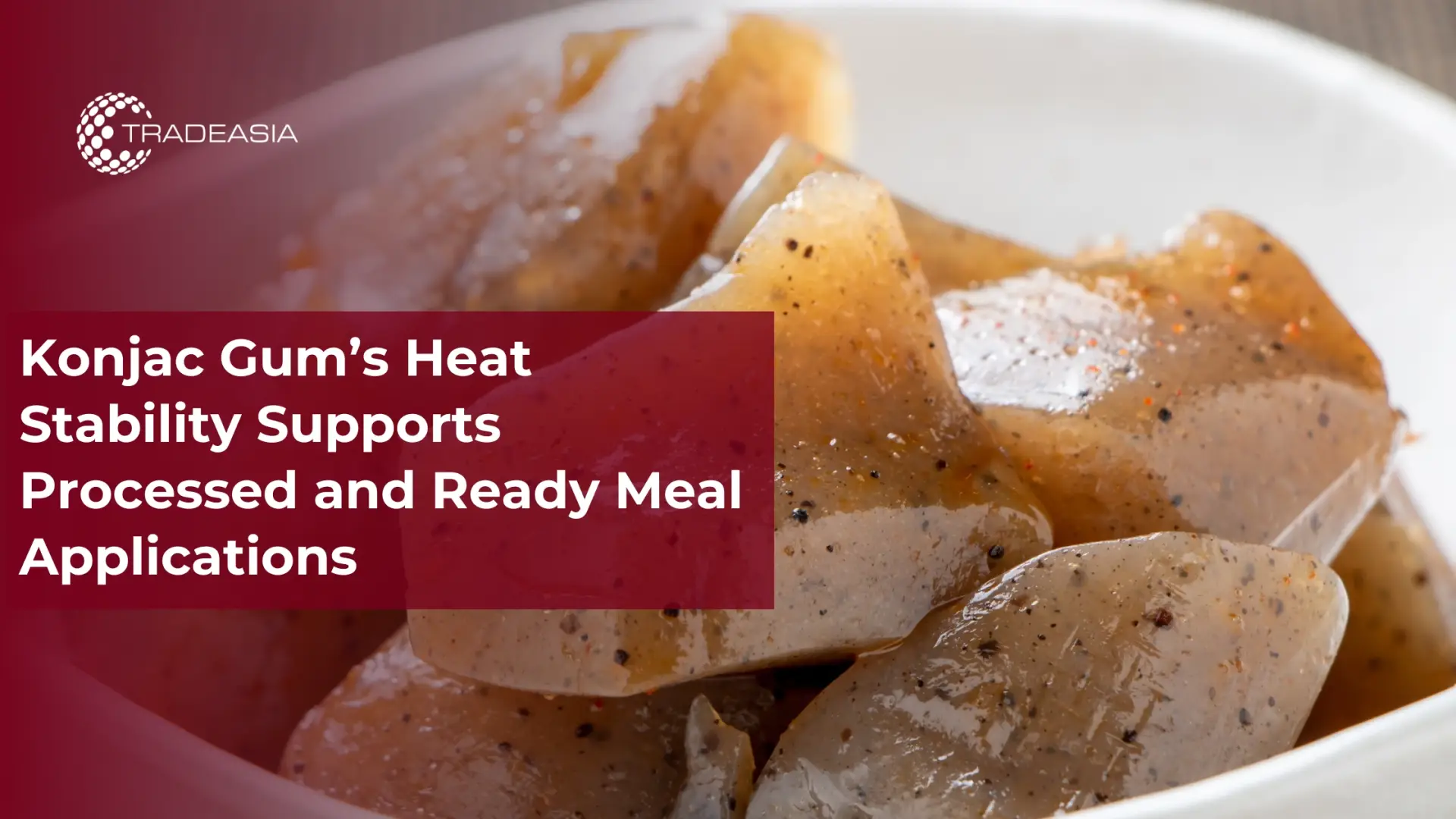
The global expansion of processed foods and ready-to-eat meals has fundamentally changed formulation priorities for food manufacturers. Products such as frozen meals, retorted soups, sauces, and microwaveable dishes are exposed to multiple thermal stresses during processing, storage, distribution, and final consumer preparation. In this environment, ingredient stability under heat is no longer optional but essential.
Konjac gum has gained attention as a hydrocolloid capable of maintaining functional performance across a wide temperature range. Its ability to withstand high-temperature processing, including retort sterilization, as well as freezing and microwave reheating, positions it as a dependable thickening and gelling agent for modern convenience foods.
Derived from the konjac root and rich in glucomannan, konjac gum forms highly stable gels and viscous systems when properly hydrated. Unlike some starches or less heat-resistant gums, konjac gum demonstrates strong resistance to viscosity breakdown and syneresis when exposed to prolonged heat or repeated thermal cycles.
In retorted products such as shelf-stable soups, sauces, and ready meals, konjac gum helps maintain consistent texture after high-temperature sterilization. In frozen foods, it supports freeze-thaw stability by reducing water migration and preventing texture collapse upon thawing. For microwaveable meals, konjac gum contributes to uniform reheating and prevents phase separation, ensuring a consistent eating experience for consumers.
One of the key challenges in ready meal production is maintaining texture uniformity across complex food matrices that may include proteins, fats, carbohydrates, and particulates. Konjac gum functions as an effective water binder and thickener, helping stabilize these systems without masking flavors or creating excessive viscosity.
Its neutral taste and clarity allow manufacturers to preserve the intended sensory profile of products, which is particularly important in premium ready meals and chef-inspired offerings. Additionally, konjac gum performs well in combination with other hydrocolloids such as carrageenan, xanthan gum, or starches, enabling formulators to design texture systems tailored to specific processing requirements.
Beyond technical performance, konjac gum aligns well with broader industry trends toward plant-based, clean-label, and fiber-enriched formulations. As a naturally derived ingredient, it fits into ingredient lists that appeal to health-conscious consumers seeking recognizable and functional components.
For manufacturers reformulating processed foods to reduce synthetic additives or modified starches, konjac gum offers a balance between functionality and label appeal. Its efficiency at low usage levels also supports cost control in high-volume ready meal production.
The global ready meal market continues to grow, driven by urbanization, changing lifestyles, and increased demand for convenient yet high-quality food options. This growth is particularly pronounced in Asia-Pacific, Europe, and North America, where frozen and microwaveable meals are becoming daily staples rather than occasional purchases.
As production volumes increase and supply chains extend across regions, manufacturers are increasingly selecting ingredients that minimize quality risk. Konjac gum’s heat stability and processing robustness make it an attractive choice for large-scale operations supplying both retail and foodservice channels.
Looking ahead, konjac gum is expected to play an expanding role in processed and ready meal applications. Continued innovation in product formats, coupled with rising consumer expectations for texture consistency and quality, will reinforce demand for hydrocolloids that perform reliably under thermal stress.
As ready meals evolve toward more complex, premium, and nutritionally positioned products, konjac gum’s combination of heat stability, functional versatility, and clean-label compatibility positions it as a strategic ingredient in next-generation convenience foods.
We're committed to your privacy. Tradeasia uses the information you provide to us to contact you about our relevant content, products, and services. For more information, check out our privacy policy.


 English
 Indonesian
 简体字
简体字
 العربية
 Español
 Français
 Português
 日本語
日本語
 한국어
한국어
 Tiếng Việt



















