Explore our network of country and industry based websites to access localized information, product offerings, and business services across our group.
Log in to start sending quotation requests for any product.
Don't have an account? Sign Up Here
Home Milk Powder in Global Food Systems
Trade Insights | Applications and Buyers | 30 December 2025
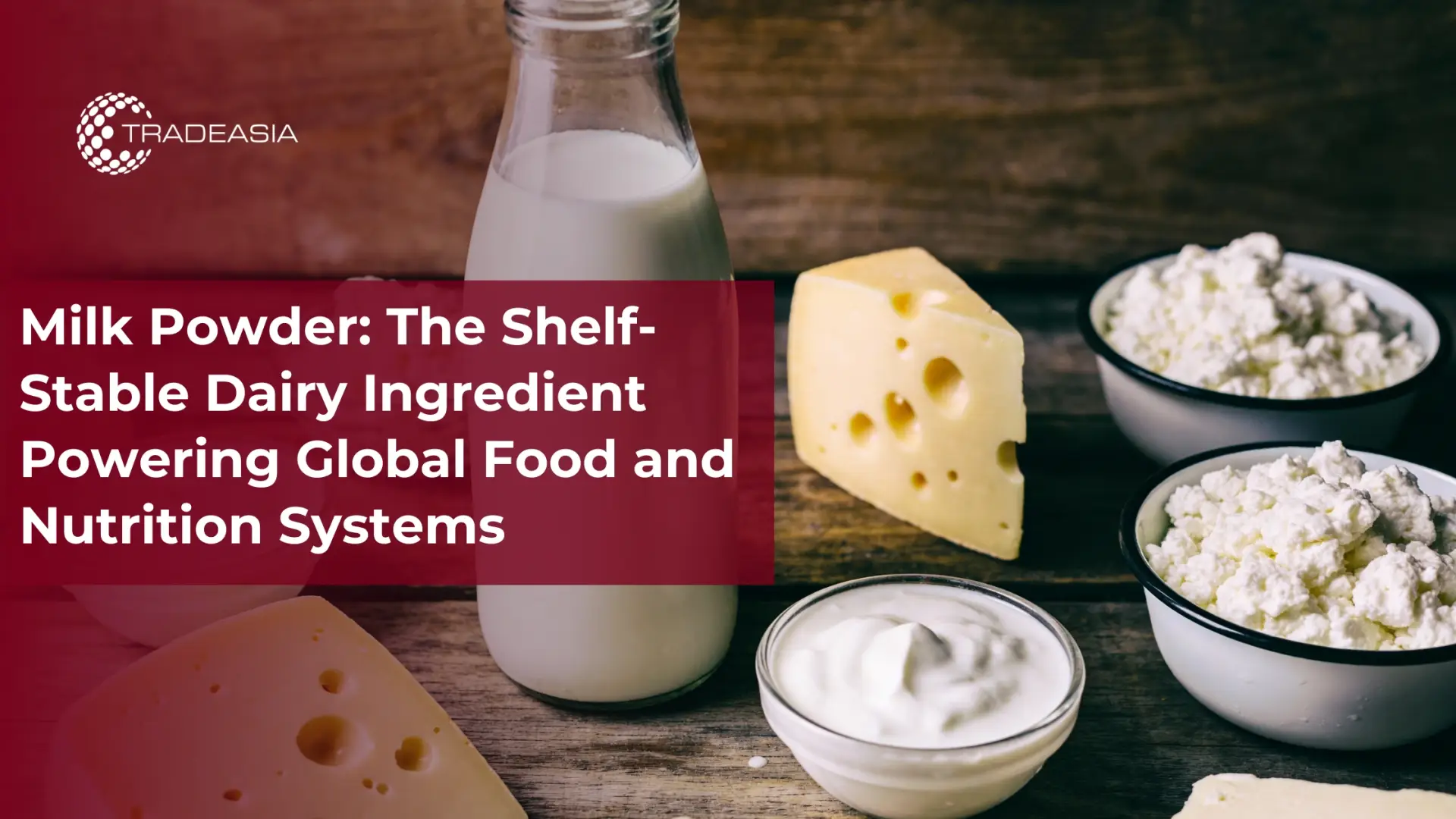
Milk powder remains one of the most strategically important dairy ingredients in the global food industry, valued for its ability to deliver the nutritional and functional benefits of fresh milk in a shelf-stable, easily transportable form. Produced by removing water from liquid milk through spray-drying or roller-drying processes, milk powder enables long-term storage without refrigeration while maintaining essential nutrients and performance characteristics. This combination has positioned milk powder as a foundational ingredient across food manufacturing, nutrition programs, and international dairy trade.
One of the strongest advantages of milk powder is its concentrated nutritional profile, which makes it highly efficient for large-scale food and nutrition applications. Depending on the specification—such as whole milk powder (WMP) or skim milk powder (SMP)—it delivers high-quality dairy protein, essential amino acids, lactose as a natural carbohydrate source, calcium, and key micronutrients. These attributes make milk powder especially valuable in regions where access to fresh milk is constrained by climate, infrastructure, or seasonality.
Because nutrients are concentrated through dehydration, milk powder allows manufacturers and institutions to deliver consistent nutritional value with precise dosing. This is particularly critical for infant nutrition, clinical and elderly nutrition, and fortified food programs, where stability, safety, and nutrient accuracy are non-negotiable requirements.
Beyond nutrition, milk powder provides a wide range of functional benefits that support food formulation across multiple categories. In beverages and dairy-based products, it contributes to body, mouthfeel, and flavor balance, while supporting protein stability during processing. In heat-treated foods, milk powder participates in Maillard reactions, enhancing color development and delivering the characteristic cooked and baked dairy notes valued in many products.
In bakery and confectionery applications, milk powder improves dough handling, crumb softness, moisture retention, and browning performance, helping manufacturers achieve consistent quality at scale. In sauces, soups, and savory products, it adds creaminess and flavor depth without the handling challenges associated with liquid milk, making it ideal for industrial production environments.
Milk powder plays a central role in recombined dairy production, allowing manufacturers to produce drinking milk, yogurt, ice cream, and evaporated milk by reconstituting powder with water and fat. This approach provides supply chain flexibility, enabling dairy processors to maintain production continuity regardless of fluctuations in raw milk availability or seasonal yield variations.
In ice cream and frozen desserts, milk powder contributes to milk solids-not-fat (MSNF), improving texture, melt resistance, and overall product stability. Its predictable performance under freezing and storage conditions makes it indispensable for large-scale dairy manufacturing serving both retail and foodservice markets.
From a trade and logistics perspective, milk powder is a cornerstone of the global dairy supply chain. Its reduced weight and volume compared to liquid milk significantly lower transportation and storage costs, enabling efficient long-distance trade. As a result, milk powder is widely exported from major dairy-producing regions to fast-growing markets in Asia, the Middle East, and Africa.
Milk powder also plays a vital role in food security initiatives. Governments, NGOs, and humanitarian organizations rely on it for emergency food aid, school feeding programs, and nutrition interventions due to its long shelf life, ease of storage, and high nutritional value.
In nutrition-focused applications, milk powder continues to be used extensively in sports nutrition, meal replacements, and functional foods. It provides a balanced combination of dairy protein and carbohydrates, supporting energy intake, muscle maintenance, and recovery. Its familiarity and digestibility contribute to high consumer acceptance across age groups and cultural contexts.
In clinical and elderly nutrition, milk powder serves as a reliable base for fortified formulations designed to address protein deficiency, bone health, and overall nutritional adequacy. Its compatibility with additional vitamins, minerals, and functional ingredients makes it highly adaptable to specialized dietary needs.
Despite the growth of plant-based alternatives, milk powder remains highly adaptable to changing market demands. Manufacturers increasingly use instantized, low-fat, or fortified milk powder variants to meet specific functional, nutritional, or labeling requirements. These adaptations allow milk powder to remain relevant in both traditional mass-market products and more specialized nutrition segments.
Its long-standing regulatory acceptance, proven safety profile, and cost efficiency continue to support its use, particularly in high-volume applications where performance consistency is essential.
Looking ahead, milk powder is expected to maintain its central role in global food and nutrition systems. Population growth, urbanization, and rising demand for shelf-stable, fortified, and affordable food products will continue to underpin consumption across both developed and emerging markets.
With its unique combination of nutritional density, functional versatility, and logistical advantages, milk powder remains a critical link between dairy production and the evolving needs of the global food industry.
We're committed to your privacy. Tradeasia uses the information you provide to us to contact you about our relevant content, products, and services. For more information, check out our privacy policy.


 English
 Indonesian
 简体字
简体字
 العربية
 Español
 Français
 Português
 日本語
日本語
 한국어
한국어
 Tiếng Việt



















