Explore our network of country and industry based websites to access localized information, product offerings, and business services across our group.
Log in to start sending quotation requests for any product.
Don't have an account? Sign Up Here
Home Monosodium Phosphate in Food and Industry
Trade Insights | Applications and Buyers | 02 December 2025
Understanding Monosodium Phosphate: Composition, Forms, and Key Properties
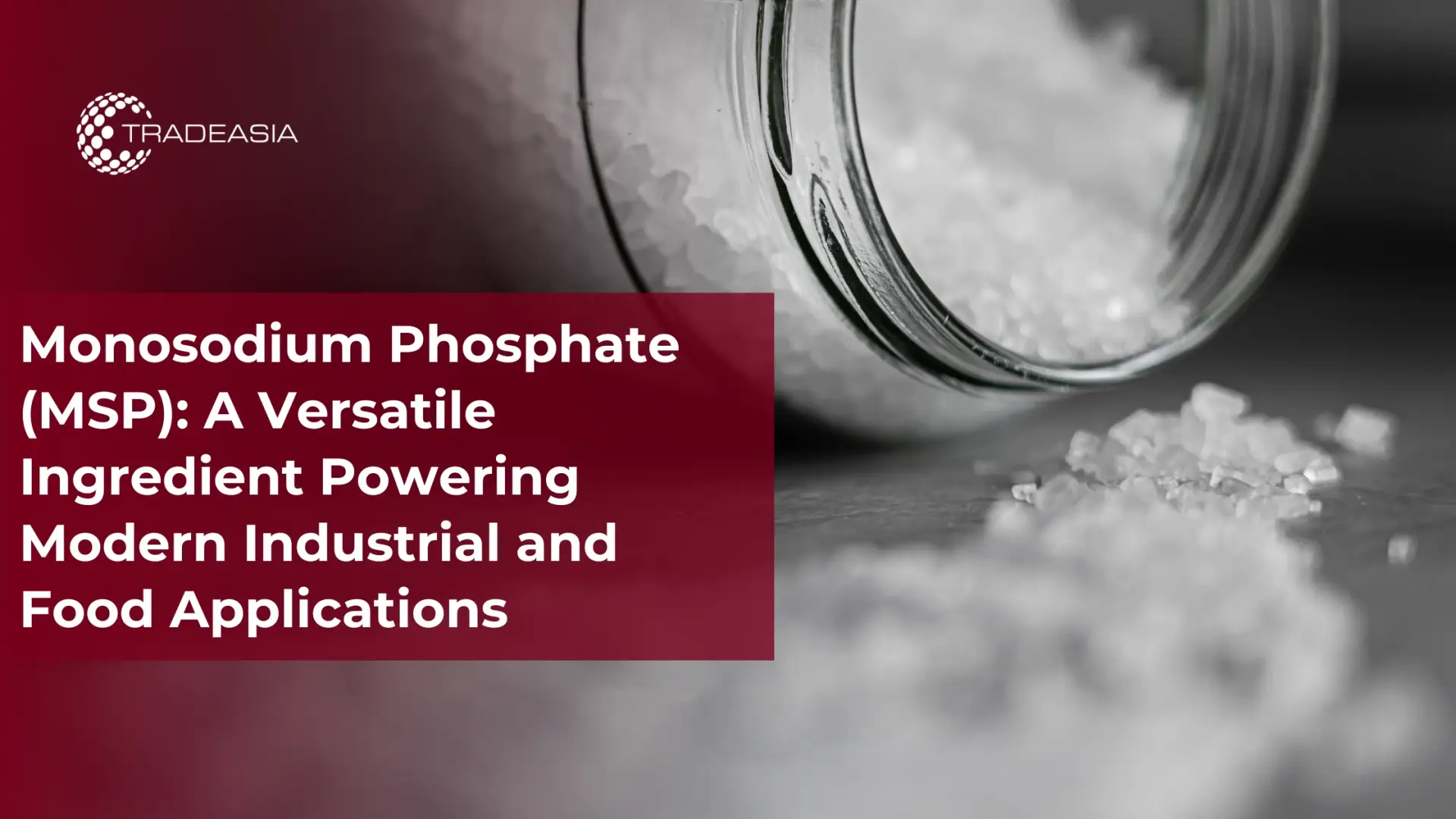
Monosodium Phosphate (MSP), also known as sodium dihydrogen phosphate (NaH₂PO₄), is an inorganic compound widely used across food, industrial, and pharmaceutical sectors. Belonging to the family of sodium phosphates, MSP is produced by the partial neutralization of phosphoric acid with sodium hydroxide, resulting in a compound that offers excellent solubility, buffering capacity, and stability.
MSP is available in various forms — monohydrate, anhydrous, and dihydrate — each suited to different technical requirements. In its pure form, MSP appears as a white crystalline powder or granule and is highly soluble in water, forming moderately acidic solutions. This controlled acidity and predictable reactivity make MSP a reliable component for formulation across industries.
Functional Benefits: Why MSP Is Widely Used
Monosodium phosphate is favored for its buffering, sequestering, emulsifying, and nutrient fortification properties. In the food industry, MSP plays an essential role in controlling pH levels, stabilizing mixtures, and improving texture. Its ability to regulate acidity makes it indispensable in beverages, processed cheese, dairy products, and baked goods.
Beyond food applications, MSP’s functionality extends to:
MSP’s versatility arises from its excellent compatibility, chemical stability, and capacity to interact predictably with other ingredients, allowing manufacturers across sectors to enhance performance, safety, and efficiency.
Industrial Role: Applications Across Key Sectors
Food & Beverage Industry
MSP is a crucial additive that ensures stability and consistency. Its pH-control function improves shelf life, enhances product quality, and prevents unwanted microbial growth. In dairy processing, MSP helps create smooth textures and prevents protein coagulation. In baking, it supports leavening systems by balancing acidity and aiding dough development.
Pharmaceutical & Healthcare Sector
In pharmaceuticals, MSP is used in oral formulations, injectables, and saline solutions. Its buffering properties help maintain drug effectiveness and stability. Additionally, MSP participates in certain physiological formulations for medical procedures where precise pH balance is required.
Industrial & Technical Uses
In water treatment, MSP contributes to corrosion control and metal ion sequestration. It is also used in detergents, ceramics, textile processing, and metal cleaning formulations where controlled chemical behavior is critical.
Agriculture & Feed Industry
As a nutrient source, MSP supplies essential phosphorus and sodium to animal feed. It is preferred for its high bioavailability and ease of absorption, contributing to improved metabolism, bone development, and performance in livestock.
Why MSP Remains Relevant Across Growing Industries
As industries increasingly prioritize efficiency, safety, and performance, MSP continues to stand out due to its multifunctional characteristics. Its broad application scope ensures steady demand, especially as global food processing, pharmaceutical manufacturing, and water treatment technologies expand.
Moreover, the shift toward higher-quality ingredients, tighter regulatory compliance, and refined production processes increases reliance on precise functional additives like MSP. Its clean reactivity profile, combined with wide regulatory acceptance (FDA, EFSA, Codex), positions it as a trusted component for global markets.
We're committed to your privacy. Tradeasia uses the information you provide to us to contact you about our relevant content, products, and services. For more information, check out our privacy policy.


 English
 Indonesian
 简体字
简体字
 العربية
 Español
 Français
 Português
 日本語
日本語
 한국어
한국어
 Tiếng Việt



















