Explore our network of country and industry based websites to access localized information, product offerings, and business services across our group.
Log in to start sending quotation requests for any product.
Don't have an account? Sign Up Here
Home How Native Tapioca Starch Optimizes Noodle Texture and Yield
Trade Insights | Applications and Buyers | 13 January 2026
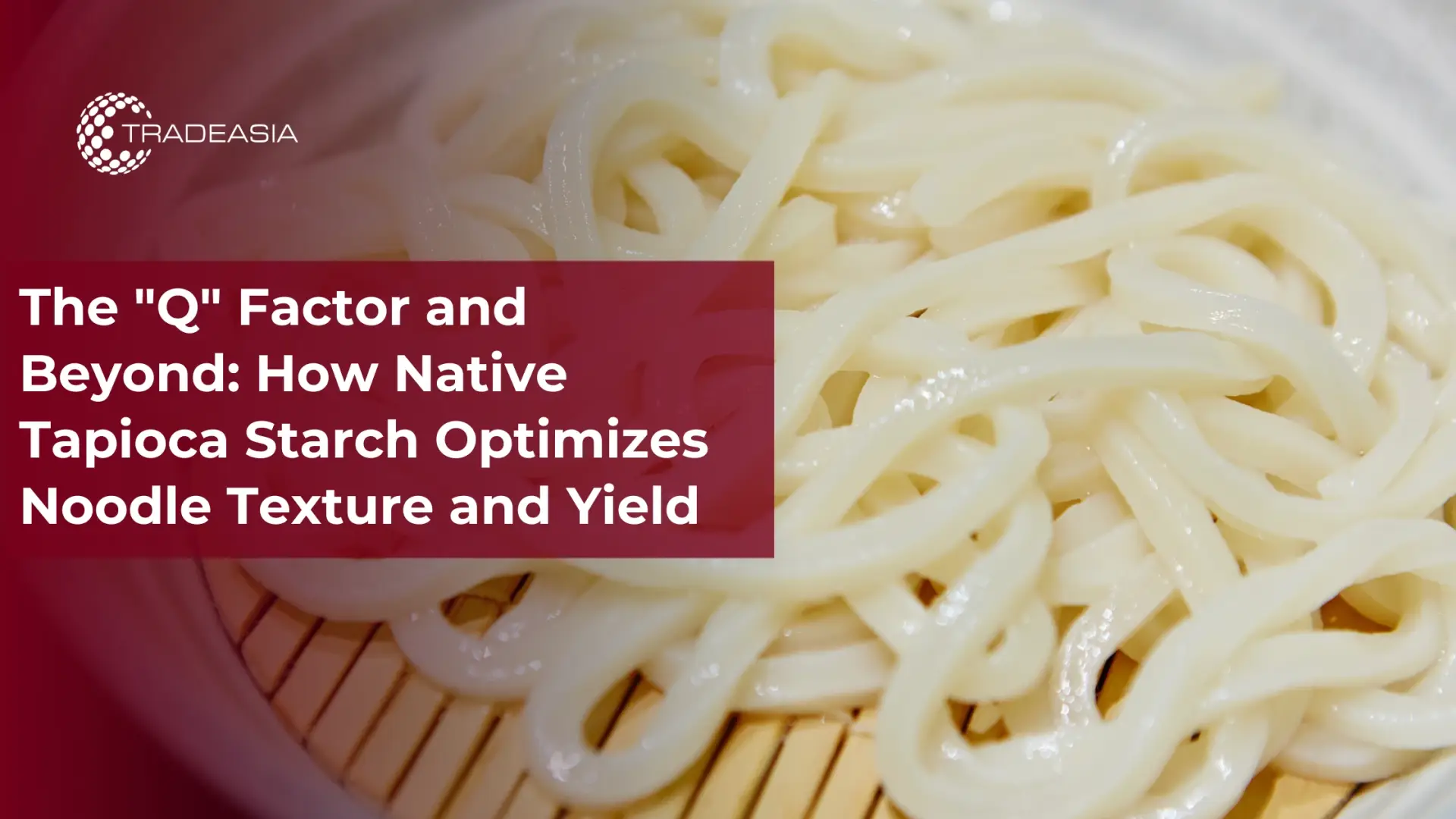
The global noodle market is undergoing a renaissance. No longer just a staple of Asian diets, noodles have exploded into a premium category worldwide. From the artisanal Ramen shops of New York and London to the rapid expansion of "Fresh Udon" packs in European supermarkets, the consumer appetite for high-quality noodles is at an all-time high.
However, as the market matures, so does the consumer palate. The defining metric of quality in this competitive landscape is no longer just flavor—it is texture. In the gold standard markets of Japan, Taiwan, and China, this texture is described as "Q" or "QQ". It is a complex sensory attribute that defies simple translation: a paradoxical combination of firm bite, springy recoil, and a smooth, slippery surface. It is the Asian equivalent of Al Dente, but with a livelier, more elastic "bounce."
While wheat gluten provides the protein backbone necessary for structure, it often lacks this refined elasticity on its own. Pure wheat noodles can easily become "short" (brittle) or mushy if overcooked. Native Tapioca Starch has emerged as the essential "Textural Engineer" to bridge this gap. By leveraging its unique amylopectin-driven functionality, manufacturers can create the perfect chew while simultaneously solving critical processing challenges regarding cooking loss, shelf-life, and economic yield.
The secret to tapioca’s superior elasticity lies in its molecular architecture. To understand the "Q" factor, one must look at the ratio of Amylose to Amylopectin.
Wheat Starch: Contains ~25–28% Amylose. Amylose is a linear polymer that tends to align into tight, rigid crystalline structures. This gives wheat noodles their "bite" but also their tendency to become hard.
Tapioca Starch: Composed of roughly 83% Amylopectin. Amylopectin is a highly branched, tree-like polymer.
When Native Tapioca Starch is substituted into a wheat flour dough (typically at a 10–15% ratio), these branched amylopectin chains act like microscopic springs within the gluten matrix. During the gelatinization (cooking) process, they unravel and swell to create a highly cohesive, flexible gel network.
This internal architecture allows the noodle to stretch and bounce back upon biting, eliminating the "brittle" texture often caused by high-protein flours or rapid drying processes. This is the essence of the "Q" texture: a noodle that offers resistance to the tooth but springs back, rather than shearing off cleanly. This resilience is particularly vital for Instant Noodles, where the deep-frying process creates a porous structure that needs internal support to avoid crumbling.
Beyond internal elasticity, Native Tapioca Starch dramatically improves the tribology (surface mouthfeel) of the noodle strand. Wheat starch granules are relatively small (2–10 microns) and can leave a rough, grainy surface profile after cooking. In contrast, tapioca granules are significantly larger (15–35 microns) and gelatinize into an exceptionally clear, viscous, and "long" paste.
This creates a microscopic "lubrication layer" on the surface of the noodle. This layer reduces friction during consumption, providing the characteristic "slippery" or smooth sensation that enhances "Slurp-ability"—a vital quality metric in Ramen and Udon culture where the tactile sensation of the noodle passing the lips is as important as the taste.
Economically, this smooth surface helps prevent the noodles from sticking together (clumping) after draining. This is a massive advantage for Ready-to-Eat (RTE) and wok-fry applications (like Yakisoba). By reducing surface tackiness, manufacturers can significantly reduce the amount of oil needed to coat the noodles during packaging, lowering ingredient costs and improving the nutritional profile for health-conscious consumers.
A major technical KPI in industrial noodle manufacturing is Cooking Loss—the leaching of starch solids and protein into the boiling water. High cooking loss results in two failures:
Turbidity: The soup base becomes cloudy, thick, and starchy, which is unacceptable for clear-broth Ramen or Pho.
Texture Degradation: The noodle loses structural integrity, becoming ragged or slimy on the exterior.
Native Tapioca Starch offers a natural engineering solution via its Low Gelatinization Temperature.
Wheat Starch: Gelatinizes at approx. 80°C–85°C.
Tapioca Starch: Gelatinizes at approx. 59°C–65°C.
When raw noodles enter boiling water, the race is on to seal the surface before solids can escape. Because tapioca starch gelatinizes significantly faster than wheat starch, it swells rapidly on the noodle surface. This creates an immediate, cohesive, gelatinous barrier that "locks in" the internal starch and protein solids. This "Rapid Seal" prevents the excessive migration of amylose into the cooking water, ensuring the broth remains clear and the noodle retains its defining sharp edges.
For the growing market of Fresh/Chilled Noodles (sold in the refrigerator section), the enemy is Retrogradation. This is the process where cooked starch re-crystallizes over time, causing the noodle to become hard, brittle, and dry—similar to how bread goes stale in the fridge.
Wheat starch (high amylose) retrogrades very quickly at refrigeration temperatures (4°C). This limits the shelf life of high-quality fresh noodles. Native Tapioca Starch serves as a powerful Anti-Staling Agent. The branched structure of amylopectin holds water more effectively and interferes with the re-crystallization of the wheat starch. By incorporating tapioca, manufacturers can extend the sensory shelf life of chilled noodles by several days. The noodles remain soft and pliable even after a week in the cold chain, reducing waste and improving the consumer experience upon reheating.
The benefits of native tapioca extend back to the factory floor, specifically in the Sheeting and Cutting stages. Industrial noodle lines run at high speeds. Doughs made from high-protein wheat flour can be tough and resistant, leading to stress on the sheeting rollers and potential tearing of the dough sheet.
Tapioca starch modifies the Dough Rheology (flow properties). It makes the dough more pliable and extensible without losing strength.
Smoother Sheeting: The dough passes through rollers with less resistance, reducing energy consumption and equipment wear.
Cleaner Cutting: When the dough sheet hits the slitter (cutting blades), the added elasticity helps form clean, sharp noodle strands with fewer "fines" or scraps.
Reduced Waste: Fewer tears and breaks mean less downtime and less dough sent back for reworking.
Finally, the rapid hydration property of tapioca translates to Economic Yield. Noodles formulated with native tapioca hydrate to the core faster than pure wheat noodles. Industrial data indicates that substituting 15% wheat flour with native tapioca can reduce the optimal cooking time by 30–60 seconds.
This reduction is critical for two reasons:
Texture Preservation: The less time the noodle spends agitating in boiling water, the less physical erosion occurs on the noodle surface.
Weight Gain: By reducing the cooking time, the noodle retains more moisture and solid weight. For food service operators who sell noodles by cooked weight (e.g., in cafeterias or noodle bars), a 2% increase in cooked yield directly improves the bottom line.
In the modern noodle industry, Native Tapioca Starch is no longer just a "filler" or a cost-reduction tool—it is a functional necessity for premium quality. It provides the "Q" texture that defines Asian authenticity, protects the product from staling in the cold chain, and enhances yield through rapid surface sealing.
For manufacturers looking to upgrade their noodle formulations, the key lies in selecting the right grade of native starch—balancing viscosity, moisture content, and microbiology. Technical partners like foodadditivesasia.com assist R&D teams in fine-tuning these substitution ratios, ensuring that the transition to tapioca not only improves the eating experience but also optimizes the factory's efficiency.
https://www.smscor.com/en/food/noodle-products/144/wheat-noodle
https://www.cargill.com/food-bev/emea/texturizers/native-starches
https://www.sciencedirect.com/science/article/abs/pii/S0268005X1830635X
We're committed to your privacy. Tradeasia uses the information you provide to us to contact you about our relevant content, products, and services. For more information, check out our privacy policy.


 English
 Indonesian
 简体字
简体字
 العربية
 Español
 Français
 Português
 日本語
日本語
 한국어
한국어
 Tiếng Việt



















