Explore our network of country and industry based websites to access localized information, product offerings, and business services across our group.
Log in to start sending quotation requests for any product.
Don't have an account? Sign Up Here
Home Potassium Chloride Market Insight: Force Behind Global Food
Trade Insights | Applications and Buyers | 04 February 2026
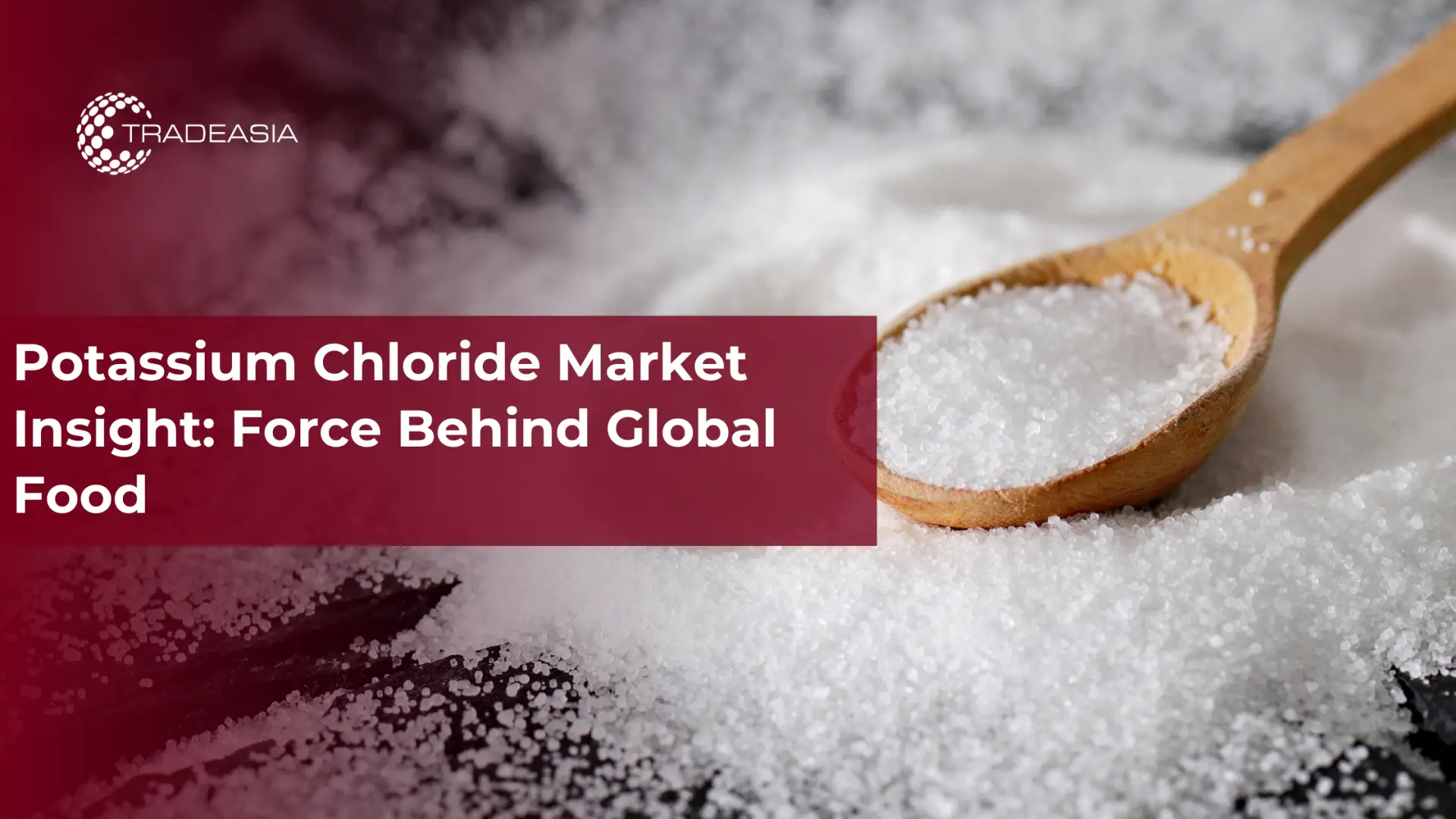
Introduction: Why Potassium Chloride Remains a Strategic Commodity
Market Size and Growth Outlook: Stability with Structural Upside
Application Landscape: Agriculture at the Core, Diversification at the Margins
Key Market Drivers: Demand from End-Sectors and Food System Pressures
Market Restraints and Risks: Toxicity, Regulation, and Price Volatility
Regional Analysis: Asia-Pacific Leads, GCC Gains Strategic Relevance
Competitive Landscape: Concentrated Power with Regional Diversification
Future Outlook: Sustainability, Precision Agriculture, and Market Resilience
Conclusion: Potassium Chloride’s Enduring Role in a Changing World
Potassium chloride (KCl) may not attract the same public attention as nitrogen or phosphate fertilizers, nor does it carry the technological allure of advanced specialty chemicals. Yet, beneath its simple chemical composition lies one of the most structurally important commodities supporting global agriculture, industrial manufacturing, and food security systems. As population growth, resource constraints, and sustainability pressures intensify, potassium chloride continues to play a foundational role across multiple value chains.
Known commercially as sylvite or potash salt, potassium chloride is a metal halide composed of potassium and chlorine. It typically appears as a white or colorless crystalline solid, odorless, highly soluble in water, and characterized by a mild, salt-like taste. These seemingly modest physical attributes enable its widespread adoption across fertilizers, pharmaceuticals, food processing, industrial chemicals, de-icing solutions, and water treatment applications. In agriculture alone, potassium chloride remains the dominant source of potassium nutrients, a macronutrient essential for plant metabolism, water regulation, and yield optimization.
From a market perspective, potassium chloride occupies a unique position. It is both a high-volume bulk commodity and a strategically sensitive material influenced by geopolitics, trade regulations, and regional production concentration. According to Fortune Business Insights, the global potassium chloride market was valued at USD 24.01 billion in 2025 and is projected to grow from USD 25.4 billion in 2026 to USD 39.82 billion by 2034, registering a compound annual growth rate (CAGR) of 5.78% during the forecast period. Parallel industry estimates from The Insight Partners suggest a steadier CAGR of around 4% from 2025 to 2031, reflecting the market’s balance between stable baseline demand and cyclical volatility.
This article explores potassium chloride not simply as a fertilizer ingredient, but as a multi-sector enabler shaped by agricultural expansion, industrial demand, sustainability transitions, and evolving global supply chains. By examining demand drivers, application shifts, regional dynamics, and competitive structures, this market insight aims to clarify why potassium chloride remains indispensable—and how its role is gradually transforming.
The potassium chloride market exhibits a growth profile that is best described as structurally resilient rather than explosively expanding. Unlike niche specialty chemicals driven by innovation cycles, KCl demand is anchored to fundamental human needs: food production, infrastructure development, and basic industrial processing. This grounding gives the market a strong baseline, even amid economic slowdowns or commodity price cycles.
Global market valuation data highlights a consistent upward trajectory. With the market expected to reach nearly USD 40 billion by 2034, growth is primarily underpinned by agricultural consumption, which continues to account for the largest share of demand. Rising global food requirements, particularly in Asia-Pacific, Africa, and Latin America, necessitate sustained fertilizer usage to maximize yields on limited arable land. Potassium chloride, as the most widely used potassium fertilizer, benefits directly from this structural reality.
At the same time, industrial and pharmaceutical applications provide incremental growth layers. Potassium chloride serves as a feedstock for producing potassium hydroxide, potassium carbonate, and other potassium-based compounds used in metal casting, welding, glass manufacturing, and chemical synthesis. In the pharmaceutical sector, pharmaceutical-grade potassium chloride is used in intravenous solutions, electrolyte replenishment therapies, and dietary supplements, particularly in clinical settings where potassium balance is critical.
While growth rates vary across reports due to differing assumptions and forecast windows, the underlying consensus is clear: potassium chloride demand is not declining, nor is it easily substitutable at scale. Instead, its growth reflects broader macro trends such as population expansion, industrialization, and agricultural intensification.
Agriculture remains the backbone of potassium chloride consumption, accounting for the majority of global demand. As a potassium fertilizer, KCl plays a crucial role in improving crop resistance to drought, enhancing photosynthesis efficiency, regulating enzyme activation, and improving overall plant health. Crops such as rice, wheat, corn, oilseeds, and fruits exhibit measurable yield improvements when potassium nutrition is adequately managed.
The increasing emphasis on food security has further elevated potassium chloride’s strategic importance. Governments across Asia, the Middle East, and Africa are investing in fertilizer access, subsidy programs, and domestic agricultural productivity to reduce reliance on food imports. In regions such as India and China, where population density places immense pressure on agricultural systems, potassium chloride remains essential to sustaining output growth.
Beyond agriculture, industrial applications form the second major demand pillar. Potassium chloride is widely used as a flux in metal processing, including welding and soldering, where it facilitates smoother metal flow and reduces oxidation. In the glass industry, KCl contributes to improving clarity, strength, and thermal resistance. The petroleum sector also consumes potassium chloride in drilling fluids, where it helps stabilize shale formations and control clay swelling.
Food processing represents another significant application, albeit more regulated. Potassium chloride is often used as a sodium chloride substitute in low-sodium food formulations, aligning with public health initiatives aimed at reducing sodium intake. While taste limitations prevent full substitution, partial replacement strategies have gained traction, especially in processed meats, snacks, and seasoning blends.
Pharmaceutical and medical applications, though smaller in volume, command higher margins. Pharmaceutical-grade potassium chloride is used in IV fluids, electrolyte solutions, and controlled-release tablets. This segment demands stringent purity standards and regulatory compliance, creating entry barriers that favor established producers with advanced refining capabilities.
The most prominent driver of the potassium chloride market is sustained demand from multiple end-use sectors, particularly agriculture, metals, glass, and petroleum. As global food production must rise to feed an expanding population, fertilizer usage remains non-negotiable. Potassium chloride’s role in enhancing crop resilience and yield makes it a critical input, especially as climate variability increases the risk of crop stress.
Industrial expansion further reinforces demand. Urbanization and infrastructure development drive consumption of metals, glass, and construction materials, all of which rely on potassium-based compounds at various stages of production. The chemical industry’s dependence on potassium chloride as a precursor material further embeds it into industrial supply chains.
Trade policies and global supply chains also influence market dynamics. Potassium chloride production is geographically concentrated, with major producers located in Canada, Russia, Belarus, and parts of the Middle East. Any disruption—whether geopolitical, logistical, or regulatory—can have immediate price and availability implications worldwide. This concentration underscores the strategic nature of the commodity and explains why many countries are exploring diversification or localization strategies.
Despite its broad utility, potassium chloride is not without constraints. One of the most cited limitations is its toxic nature at high exposure levels. Intravenous LD50 values for potassium chloride are reported at approximately 57.2 mg/kg, and excessive ingestion can lead to severe cardiac complications, including arrhythmia and cardiac arrest. While these risks are well-managed under regulated usage, they necessitate strict handling, labeling, and dosage controls, particularly in pharmaceutical and food applications.
Environmental and regulatory pressures also present challenges. Mining and processing of potash can have significant environmental footprints, including land disturbance, water usage, and waste generation. Stricter environmental regulations, especially in regions like the European Union and the Gulf Cooperation Council (GCC), increase compliance costs and can constrain supply expansion.
Price volatility represents another risk factor. Potassium chloride prices are sensitive to geopolitical tensions, energy costs, and transportation disruptions. Historical fluctuations, with prices ranging between USD 350 and USD 650 per metric ton in certain periods, create uncertainty for downstream users and complicate long-term procurement planning.
Regionally, Asia-Pacific dominates global potassium chloride consumption, driven by agricultural demand from China, India, and Southeast Asia. These countries face dual pressures of feeding large populations and preserving limited arable land, making fertilizer efficiency a strategic priority. As a result, Asia-Pacific is expected to retain the largest market share throughout the forecast period.
North America holds a significant position due to strong demand from the metal, glass, and industrial sectors, as well as its role as a major producer. Canada, in particular, remains one of the world’s largest exporters of potassium chloride, influencing global supply dynamics.
Europe demonstrates steady growth, supported by industrial applications and regulated agricultural practices. While fertilizer volumes may be lower than in Asia, the region’s emphasis on high-efficiency and specialty-grade products sustains market value.
The GCC region presents an increasingly important case study. Valued at approximately USD 1.4 billion, the GCC potassium chloride market is driven by fertilizer demand, food security initiatives, and expanding pharmaceutical applications. Countries such as Saudi Arabia, the UAE, and Qatar benefit from strategic investments, advanced logistics infrastructure, and favorable geographic positioning for export to Africa and Asia. Government-backed sustainability frameworks further encourage the use of potassium chloride as an environmentally responsible fertilizer option.
The global potassium chloride market is characterized by a mix of multinational giants and regionally dominant players. Key companies include Nutrien Ltd., The Mosaic Company, K+S AG, Israel Chemicals Ltd. (ICL), Arab Potash Company, Sinofert Holdings, and JSC Belaruskali. These firms control significant portions of global production capacity and benefit from vertical integration, long-term contracts, and established distribution networks.
Recent industry developments highlight ongoing investments in capacity expansion and restructuring. For example, Verkhnekamsk Potash Co., part of Acron Group, completed skip shaft sinking at the Talitsky Mine as part of its long-term expansion strategy. Meanwhile, Sinofert’s asset restructuring reflects efforts to optimize capital allocation and adapt to evolving market conditions.
Competition increasingly revolves around efficiency, sustainability, and supply reliability rather than product differentiation alone. Producers that can offer consistent quality, secure logistics, and compliance with environmental standards are better positioned to maintain long-term customer relationships.
Looking ahead, the potassium chloride market is expected to evolve rather than transform. Precision agriculture, controlled-release fertilizers, and digital farm management tools are reshaping how fertilizers are applied, potentially improving efficiency without reducing overall demand. Environmental awareness is also driving interest in fertilizers that support soil health and minimize runoff, reinforcing potassium chloride’s role when used responsibly.
Emerging markets in Africa and South Asia represent significant growth opportunities, particularly as governments invest in agricultural modernization. At the same time, technological advancements in mining, automation, and digitalization promise to reduce production costs and environmental impact, strengthening supply resilience.
Potassium chloride remains one of the most quietly indispensable materials in the global economy. Its importance extends beyond fertilizers into pharmaceuticals, food processing, industrial manufacturing, and energy-related applications. While challenges related to toxicity, regulation, and price volatility persist, the structural drivers of demand—food security, population growth, and industrial expansion—continue to outweigh these constraints.
As markets shift toward sustainability, efficiency, and regional diversification, potassium chloride is unlikely to lose relevance. Instead, it will increasingly be viewed not merely as a commodity, but as a strategic input underpinning resilient food systems and industrial value chains. For businesses navigating raw material sourcing, market expansion, or application development, understanding potassium chloride’s evolving landscape is no longer optional—it is essential.
For deeper insights into potassium chloride supply trends, application suitability, and sourcing options tailored to your industry needs, you can explore foodadditivesasia.com or reach out directly via food@chemtradeasia.com to continue the conversation.
https://www.fortunebusinessinsights.com/potassium-chloride-market-104578
https://www.theinsightpartners.com/reports/potassium-chloride-market
We're committed to your privacy. Tradeasia uses the information you provide to us to contact you about our relevant content, products, and services. For more information, check out our privacy policy.


 English
 Indonesian
 简体字
简体字
 العربية
 Español
 Français
 Português
 日本語
日本語
 한국어
한국어
 Tiếng Việt



















