Explore our network of country and industry based websites to access localized information, product offerings, and business services across our group.
Log in to start sending quotation requests for any product.
Don't have an account? Sign Up Here
Home The Rising Competition of Alternative Hydrocolloids on the Global CMC Market
Trade Insights | Applications and Buyers | 04 November 2025
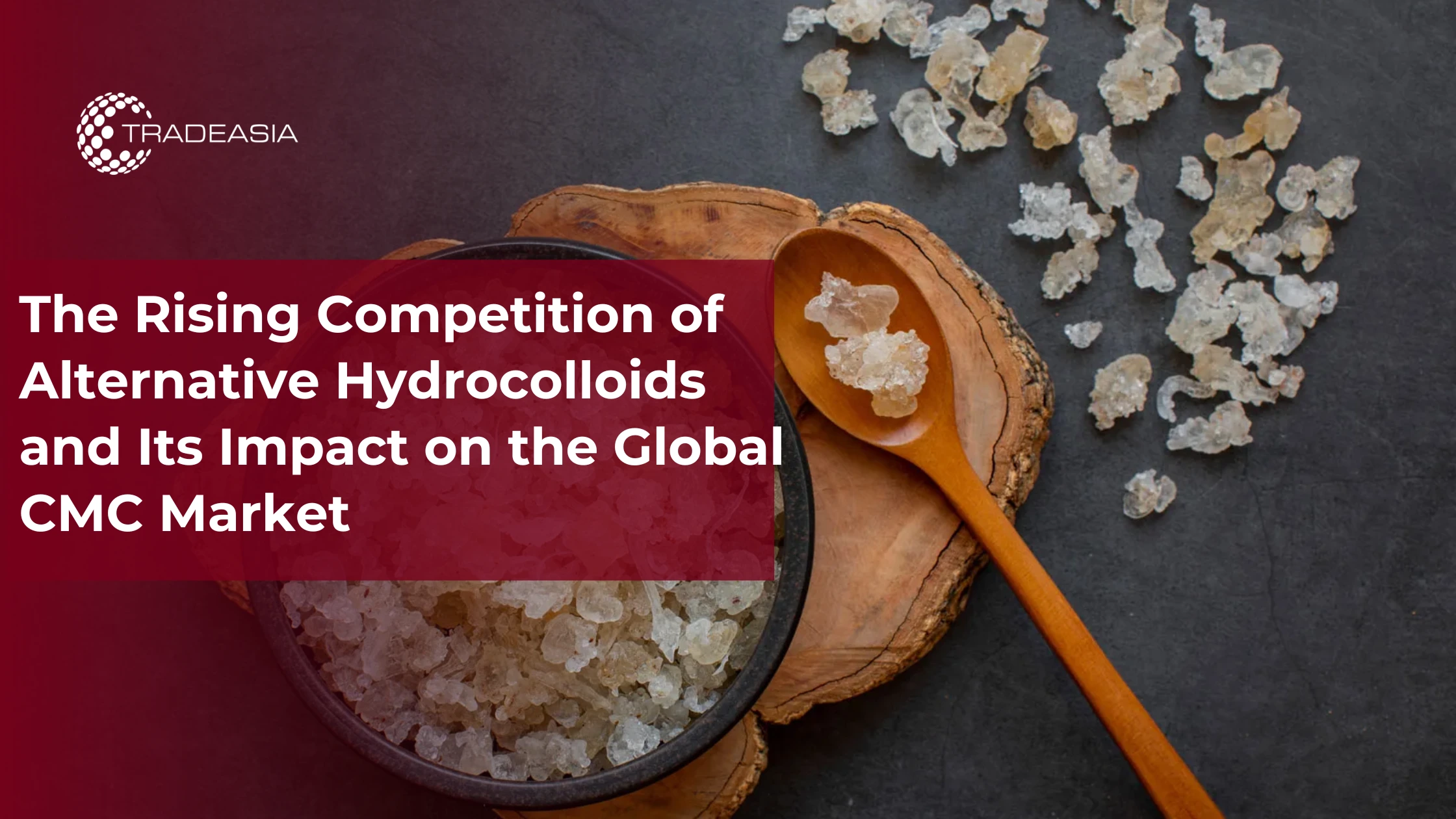
The global hydrocolloids market, valued at approximately USD 10.4 billion in 2024, is expected to grow to USD 13.95 billion by 2032 at a CAGR of around 6.4%. This growth is primarily driven by rising consumer demand for clean-label, plant-based, and naturally sourced ingredients in food, pharmaceutical, and cosmetic industries.
Natural hydrocolloids such as xanthan gum, guar gum, pectin, carrageenan, and agar are increasingly preferred due to their plant origin, clean-label appeal, and functional versatility. These alternatives align closely with trends toward vegan, allergen-free, and sustainably sourced products. The plant-based and functional foods market expansion further accelerates this trend.
Sodium Carboxylmethyl Cellulose (CMC), derived from chemically modified cellulose, traditionally holds a significant position as a thickener, stabilizer, and water-binding agent in bakery, dairy, meat products, and sauces. However, the rise of alternative hydrocolloids impacts its market share and outlook:
Clean-label Challenges: CMC is sometimes seen as less "natural" than microbial or plant-extracted gums, pressuring formulations demanding clean-label certification.
Functional Competition: Alternatives like xanthan gum excel in shear-thinning and viscosity-building, offering enhanced functionality in many food systems.
Sustainability Focus: Environmental concerns and consumer preference for sustainability increase adoption of guar gum and pectin.
Price and Supply: Raw material price volatility for cellulose affects CMC production costs, unlike some alternatives.
CMC manufacturers innovate by developing higher purity grades, improving functional performance, and adopting greener production methods. Collaborative formulations that blend CMC with other hydrocolloids are growing to achieve optimal product textures and stability. The Asia-Pacific region remains a high-growth market driven by urbanization and processed food consumption, offering significant opportunities for CMC growth alongside competitors.
The hydrocolloids market is expanding robustly, with alternative natural hydrocolloids increasingly challenging CMC’s share due to clean-label and sustainability trends. While CMC faces competitive pressures from xanthan gum, guar gum, and pectin, innovation and regional growth in Asia-Pacific support its ongoing market relevance. This dynamic reflects broader shifts towards plant-based, functional food ingredients and environmentally conscious production in the food industry.
We're committed to your privacy. Tradeasia uses the information you provide to us to contact you about our relevant content, products, and services. For more information, check out our privacy policy.


 English
 Indonesian
 简体字
简体字
 العربية
 Español
 Français
 Português
 日本語
日本語
 한국어
한국어
 Tiếng Việt



















