Explore our network of country and industry based websites to access localized information, product offerings, and business services across our group.
Log in to start sending quotation requests for any product.
Don't have an account? Sign Up Here
Home The Salt Dilemma: Navigating Sodium Reduction Policy and the MSG Solution
Trade Insights | Applications and Buyers | 09 February 2026
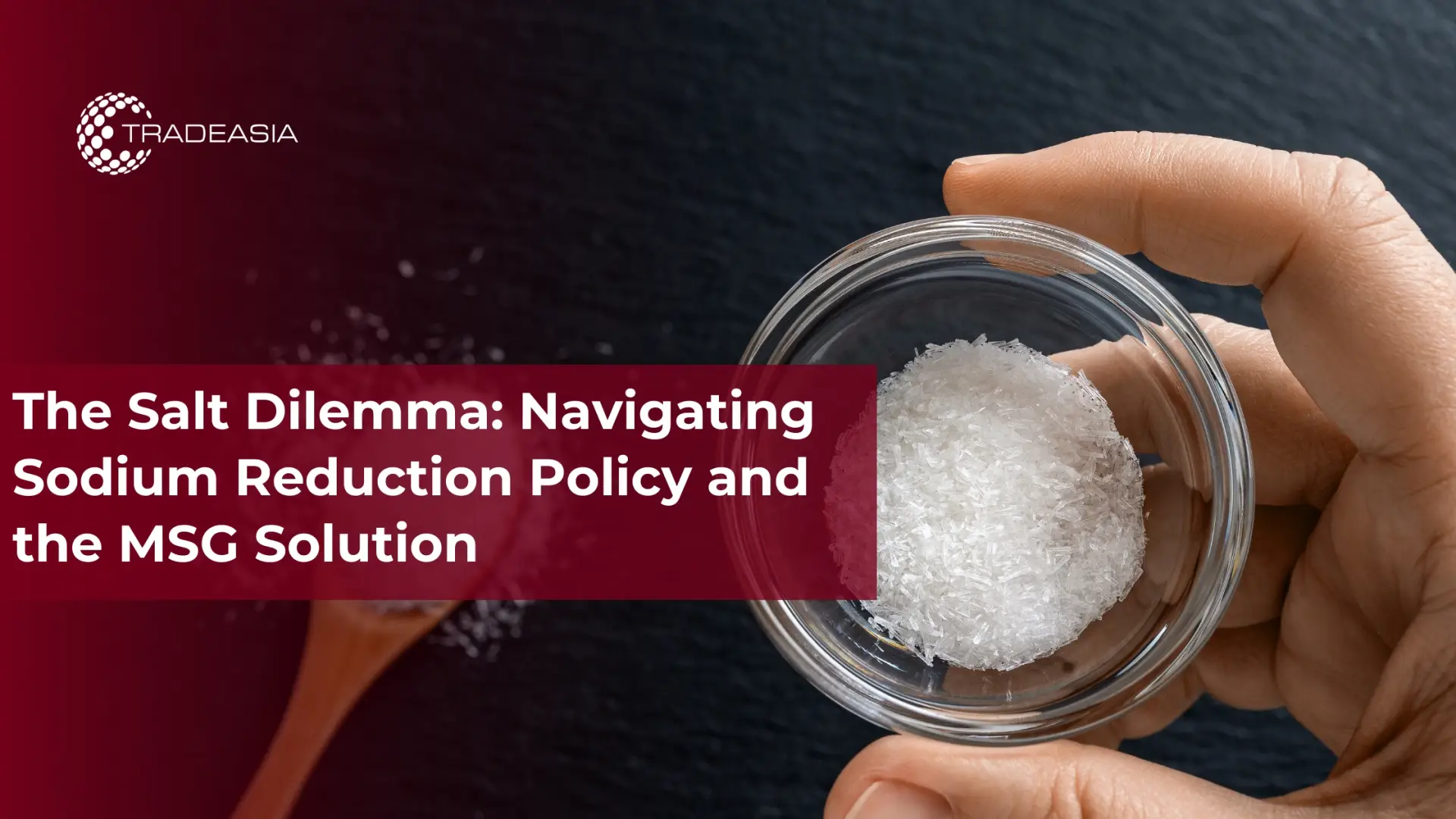
For decades, dietary fat and sugar were the primary focus of public health interventions. In recent years, however, the focus has shifted firmly onto Sodium. Cardiovascular disease (CVD) remains the leading cause of death globally, and high sodium intake is a direct, clinically proven contributor to hypertension.
For the food industry, this presents a significant formulation challenge. Sodium Chloride (salt) is the most cost-effective flavor enhancer and preservative available. Its removal often results in products lacking in palatability and stability. Yet, the pressure to reformulate is no longer merely a trend—it is rapidly becoming a requirement. This guide explores the transition of sodium reduction from voluntary advice to regulatory policy and examines how Monosodium Glutamate (MSG) serves as a scientifically viable tool for maintaining flavor profile while lowering sodium content.
The classification of sodium reduction efforts as either "Advice" or "Policy" requires nuance, as the global regulatory environment is currently in a transitional phase between the two.
Phase 1: Dietary Guidelines (Advisory Status)
Historically, organizations such as the World Health Organization (WHO) and various national health departments have operated within an advisory framework.
Public Health Benchmarks: The WHO recommends a maximum intake of 2,000 mg of sodium per day (equivalent to roughly 5g of salt).
Epidemiological Context: Despite these recommendations, global population intake levels consistently average between 9–12g of salt per day.
Operational Impact: In this phase, targets function as educational benchmarks for consumers rather than enforceable constraints on manufacturing.
Phase 2: Legislative Policy (Regulatory Status)
Due to the limited efficacy of voluntary advice in shifting population health outcomes, governments are increasingly adopting Hard Policy, shifting the burden of compliance onto manufacturers.
Voluntary Reduction Targets: Agencies such as the U.S. FDA and UK FSA have established specific, category-level reduction targets (e.g., specific limits for bakery, sauces, and processed meats). While technically voluntary, adherence is often enforced commercially by major retailers who mandate compliance as a condition of stocking.
Mandatory Maximum Limits: Nations including South Africa, Argentina, and Turkey have enacted legislation establishing maximum legal sodium limits for staple foods like bread and soups. Products exceeding these limits are prohibited from sale.
Front-of-Pack Warning Labels: Regions such as Mexico and Chile have implemented mandatory "High in Sodium" warning labels (often black stop signs) on packaging. These labels have been shown to significantly impact consumer purchasing behavior.
Industry Implications: Sodium reduction is rapidly evolving from a nutritional guideline into a strict Global Policy, requiring formulators to view sodium levels as a compliance metric essential for market access.
Successful sodium reduction requires a thorough understanding of the multifunctionality of salt beyond simple taste.
Flavor Potentiation: Sodium suppresses bitterness and enhances the perception of sweetness and savory notes. Its absence often results in a flavor profile described as "muddy" or bland.
Texture and Protein Functionality: In processed meat applications, sodium chloride extracts myofibrillar proteins (actin and myosin), which are essential for water binding and emulsification. Reducing salt compromises the binding matrix, leading to moisture loss (purge) and textural friability.
Preservation: Sodium lowers water activity ($a_w$), a critical control point for inhibiting microbial growth and extending shelf life.
When formulators reduce salt by the typical target of 30-50%, the immediate result is often a product that is organoleptically unacceptable and potentially unstable. While Potassium Chloride (KCl) is a common substitute, its application is limited by a distinct metallic bitterness often rejected by consumers.
Monosodium Glutamate (MSG / E621) is increasingly recognized by food scientists not merely as a flavor enhancer, but as a specialized Sodium Reduction Technology. The mechanism relies on the sensory properties of Umami (the fifth taste).
The Salty-Umami Interaction
Umami receptors (T1R1/T1R3) on the tongue interact synergistically with salt receptors. The presence of glutamate (Umami) amplifies the perceived intensity of saltiness.
Sensory Compensation: In a model system such as a soup, reducing salt from 0.8% to 0.5% typically results in a watery taste profile. The addition of a small concentration of MSG to the 0.5% salt solution restores the perceived salt intensity to that of the 0.8% control, despite the significant reduction in actual sodium content.
Palatability Improvement: Unlike Potassium Chloride, MSG does not introduce bitterness. Instead, it contributes "mouthfulness" (kokumi) and flavor continuity, improving the overall acceptability of low-sodium formulations.
The efficacy of MSG in sodium reduction is rooted in stoichiometry. Despite the presence of "Sodium" in the name, the sodium contribution of MSG is significantly lower than that of table salt.
Molecular Weight Analysis
Sodium Chloride (NaCl): Approximately 39% Sodium by weight.
Monosodium Glutamate (MSG Monohydrate): Approximately 12% Sodium by weight.
Calculation:
Substituting 10 grams of Sodium Chloride with 10 grams of MSG results in a sodium input reduction of nearly 70%.
Formulation Strategy:
A direct 1:1 replacement is rarely utilized due to the distinct flavor profiles (salty vs. savory). A standard industrial reduction strategy typically involves:
Reducing Salt input by 30%.
Adding MSG at 0.3% - 0.5%.
Because the sodium content of MSG is roughly one-third that of salt, the net result is a finished product with 30-40% less total sodium that maintains consumer acceptance parity with the full-salt control.
The "Clean Label" movement often presents a barrier to MSG utilization. However, regulatory bodies maintain a clear consensus regarding its safety.
Regulatory Status: The FDA, WHO, and EFSA (European Food Safety Authority) all classify MSG as Generally Recognized as Safe (GRAS). Extensive toxicological review has confirmed that MSG causes no adverse effects in the general population at standard dietary levels.
Labeling Alternatives: For brands seeking "Clean Label" positioning without E-numbers, the industry utilizes Yeast Extracts or Hydrolyzed Vegetable Proteins (HVP). These ingredients are naturally rich in glutamates (20-40%). They function identically to MSG—providing Umami and enabling salt reduction—but may be labeled as "Yeast Extract" or "Natural Flavor," thereby meeting both sodium policy targets and marketing requirements.
Sodium reduction is a policy-driven mandate reshaping the global food industry. Manufacturers failing to reformulate face risks ranging from regulatory exclusion to mandated warning labels.
While Potassium Chloride remains a valid tool, MSG (and natural glutamate sources) offers a superior sensory pathway. By leveraging the synergistic relationship between Umami and salt perception, and capitalizing on the low-sodium chemistry of the glutamate molecule, formulators can successfully navigate the conflict between strict health policies and consumer demand for taste.
Partner with Food Additives Asia for Reduction Solutions
Navigating sodium reduction requires a diverse portfolio of functional ingredients. At Food Additives Asia, we supply the full spectrum of reduction technologies:
Flavor Enhancers: High-purity Monosodium Glutamate (MSG) and I+G (Nucleotides).
Clean Label Umami: High-Glutamate Yeast Extracts and Soy Sauce Powders.
Salt Substitutes: Masked Potassium Chloride (KCl) solutions.
Meet sodium targets without sacrificing sensory quality.
To request technical calculations, samples, or reformulation advice, please visit our corporate portal at foodadditivesasia.com.
We're committed to your privacy. Tradeasia uses the information you provide to us to contact you about our relevant content, products, and services. For more information, check out our privacy policy.


 English
 Indonesian
 简体字
简体字
 العربية
 Español
 Français
 Português
 日本語
日本語
 한국어
한국어
 Tiếng Việt



















