Explore our network of country and industry based websites to access localized information, product offerings, and business services across our group.
Log in to start sending quotation requests for any product.
Don't have an account? Sign Up Here
Home Deep Dive: The Universal Emulsifier – Understanding Lecithin in Food Systems
Trade Insights | Applications and Buyers | 04 February 2026
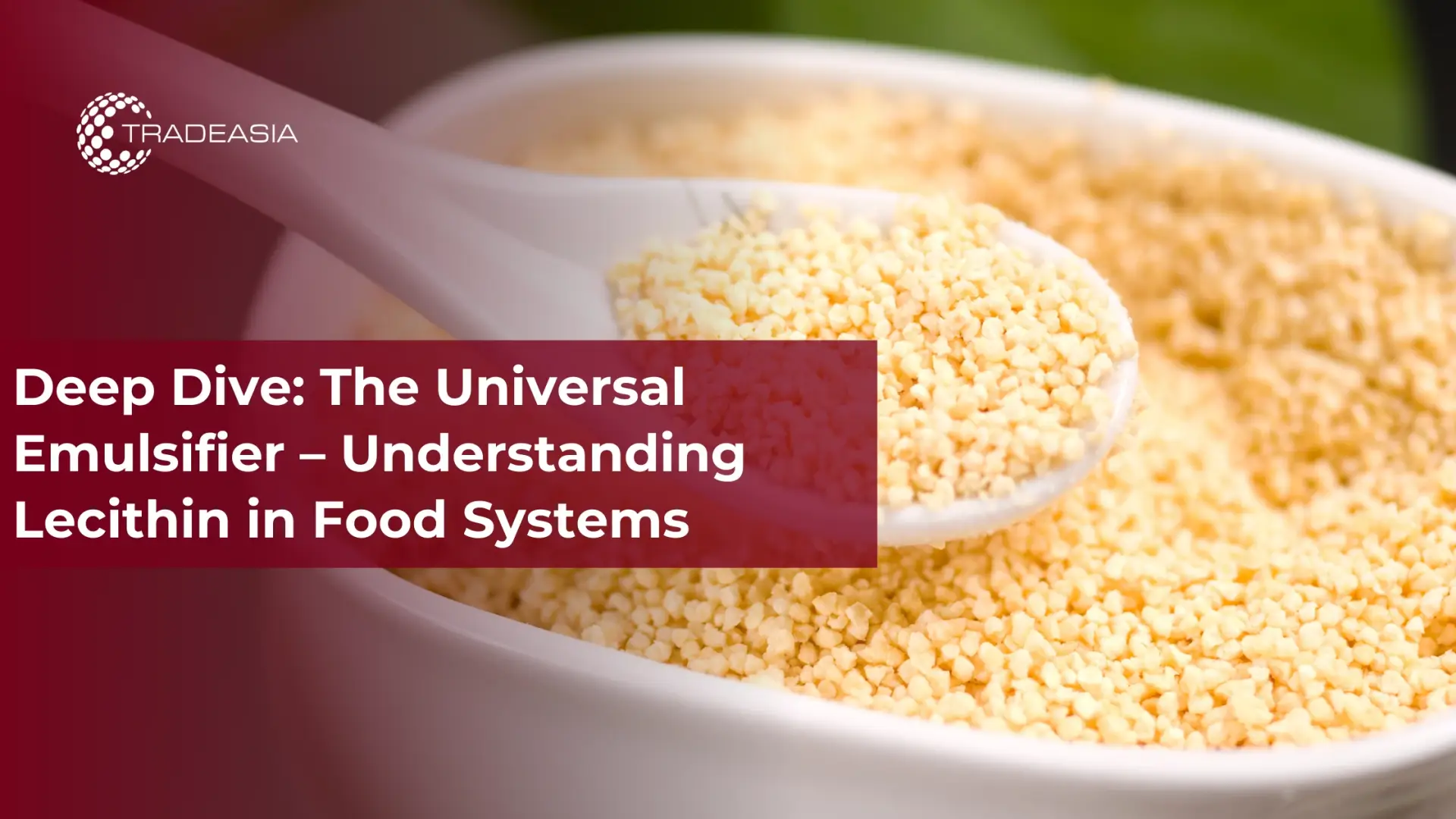
Introduction: The Industry Standard
If you scan the ingredient labels of the world's processed foods—from premium Swiss chocolate to infant formula, from margarine to sliced bread—you will find one code repeated more than almost any other: E322. This is Lecithin.
While modern food science has developed sophisticated synthetic emulsifiers (like DATEM or Polysorbates), Lecithin remains the dominant force in the industry. It is the original "Clean Label" emulsifier, extracted naturally from plant seeds. However, treating Lecithin as a generic commodity is a formulation error. It is a vital functional ingredient, and understanding how it is produced and refined is the key to selecting the precise grade for controlling viscosity, texture, and solubility in your product.
This guide moves beyond the basics to explore the industrial production of lecithin, the functional differences between botanical sources, and how to select the precise grade for your application.
Lecithin is technically a co-product of the edible oil refining industry. Whether it comes from soy, sunflower, or rapeseed, the production process follows a standardized industrial pathway known as Water Degumming.
The process begins with the raw seed (e.g., Soybean). The beans are crushed and the oil is extracted, typically using a solvent like hexane or mechanical pressing. The result is Crude Vegetable Oil. At this stage, the oil is dark and cloudy because it contains dissolved phospholipids (gums).
This is the critical separation phase.
The Mechanism: Phospholipids are hygroscopic—they love water.
The Process: Warm water (approx. 2-3%) is mixed into the crude oil. The phospholipids in the oil instantly absorb this water. As they hydrate, they swell, become heavier (denser) than the surrounding oil, and become insoluble "sludge."
The mixture is passed through a high-speed industrial centrifuge. Due to the density difference, the hydrated phospholipids (now called "Wet Gums") are flung to the outside and separated from the purified oil.
Note: The oil goes on to be refined for cooking oil, while the "Wet Gums" become the raw material for lecithin.
The Wet Gums still contain about 30-50% water. They are pumped into a vacuum dryer to evaporate the moisture carefully. If the heat is too high, the lecithin will darken (burn).
The Result: The dried product is Standard Fluid Lecithin. It is a viscous, amber-colored liquid consisting of roughly 60% active phospholipids and 40% residual oil carrier.
From this standard fluid state, manufacturers can process it further:
De-oiling: Using acetone extraction to wash away the 40% carrier oil, leaving behind a pure powder (>97% phospholipids).
Bleaching: Using hydrogen peroxide to lighten the color for applications like white chocolate.
Historically, "Lecithin" meant "Soy Lecithin." Today, the demand for allergen-free and non-GMO status has fragmented the market.
Pros: It has the best emulsifying functionality due to its optimized phospholipid profile. It is typically the most cost-effective option and is available in massive quantities.
Cons: Allergen Status. Soy is a "Big 8" allergen, requiring bold labeling in most jurisdictions. Most commercial soy is also GMO, requiring careful sourcing for "Non-GMO" claims.
Pros: Hypoallergenic. It requires no allergen labeling. It is almost exclusively Non-GMO. It is perceived as more "natural" and premium by consumers.
Cons: Supply is tighter and prices are higher. Technically, it often contains slightly lower levels of Phosphatidylcholine (PC), meaning you might need a slightly higher dosage (e.g., 1.1x) to match the performance of soy in some applications. It can also be darker in color.
Pros: Allergen-free (in many regions) and cost-effective.
Cons: High viscosity and darker color can be issues. It is less common in confectionery but popular in industrial bakery applications.
Selecting the source is step one. Step two is selecting the physical form based on how it was finished in the factory.
This is the native extract directly after drying. It is a thick, amber-colored liquid (like molasses).
Composition: ~60% Phospholipids + ~40% Vegetable Oil (carrier).
Use: General purpose. Used in chocolate, bakery, and margarine where the carrier oil can be easily incorporated into the formulation.
To make this, manufacturers use acetone to wash away the 40% vegetable oil carrier, leaving behind purified phospholipids.
Composition: >97% Phospholipids (Acetone Insolubles).
Form: Fine yellow powder or granules.
Advantage: Neutral flavor and no added oil. It is essential for dry blends (like cake mixes) or water-based systems where adding oil is undesirable.
This is a chemically modified grade. An enzyme (Phospholipase) is used to cleave one of the fatty acid tails off the phospholipid molecule.
The Result: The molecule becomes Lysophospholipid.
The Function: By removing a fat tail, the molecule becomes much more hydrophilic (water-loving). Its HLB (Hydrophilic-Lipophilic Balance) increases from ~4 (Standard) to ~8–10 (Hydrolyzed).
Application: It is far superior for Oil-in-Water emulsions like mayonnaise, creamers, and dairy alternatives. It remains stable even in hard water and acidic conditions where standard lecithin might fail.
Lecithin is rarely used for just one reason. It is a multi-functional tool.
Emulsification: Stabilizing oil droplets in water (milk, mayo) or water droplets in oil (margarine). It prevents separation and "weeping."
Release Agent (Pan Release): In bakery, lecithin prevents sticking. When sprayed on a baking belt or pan, it creates a non-stick barrier that withstands high oven heat better than oil alone.
Instantizing (Wetting): For powders like protein shakes or cocoa mixes. Lecithin reduces the surface tension of the powder particles. Instead of floating on top of the milk, the powder "wets" instantly and sinks, dissolving without clumps.
Anti-Staling (Bakery): Lecithin interacts with gluten proteins and starch. It improves dough machinability (making it less sticky) and slows down starch retrogradation, keeping bread softer for longer.
These are the two industries where lecithin is irreplaceable.
Chocolate is a suspension of solid particles (sugar, cocoa solids, milk powder) in liquid fat (cocoa butter). Without an emulsifier, these solids rub against each other, creating high friction (viscosity).
The Lecithin Effect: Lecithin coats the sugar crystals. It creates a lubricated layer around the particles, allowing them to slide past each other smoothly.
Cost Savings: Adding 0.3% to 0.5% Lecithin reduces viscosity as effectively as adding 5.0% to 8.0% Cocoa Butter. Since cocoa butter is the most expensive ingredient in chocolate, lecithin provides massive cost savings (Yield Stress reduction).
Technical Warning: There is a "Critical Concentration." If you add too much lecithin (>0.8%), the effect reverses, and the chocolate becomes thicker. Precision is key.
For a consumer, nothing is worse than a protein powder that clumps.
The Solution: Lecithination. During the spray-drying process of milk powder or whey protein, a fine mist of lecithin is sprayed onto the particles.
Mechanism: This coating changes the particle surface from hydrophobic to hydrophilic. When water is added, the lecithin creates capillary channels that pull water into the powder aggregate, causing it to disperse explosively fast.
Lecithin is the unsung hero of food stability. It is the bridge between the water phase and the oil phase, the lubricant in chocolate, and the wetting agent in instant powders.
For the modern formulator, the choice is no longer just "add lecithin." It is a choice between Standard vs. Hydrolyzed for emulsion stability, or Soy vs. Sunflower for allergen management. Making the right choice optimizes not just the texture and shelf life, but also the label appeal and cost structure of the final product.
Navigating the transition from Soy to Sunflower, or upgrading from Standard to Hydrolyzed Lecithin, requires technical expertise. At Food Additives Asia, we supply a comprehensive portfolio of high-purity lecithins:
Fluid Lecithins: Non-GMO Soy, Sunflower, and Rapeseed.
De-oiled Powders: High-purity Acetone Insolubles (>97%).
Hydrolyzed Grades: For superior Oil-in-Water stability.
Optimize your emulsion today. To request Technical Data Sheets (TDS), samples, or a formulation consultation, please visit our corporate portal at foodadditivesasia.com.
We're committed to your privacy. Tradeasia uses the information you provide to us to contact you about our relevant content, products, and services. For more information, check out our privacy policy.


 English
 Indonesian
 简体字
简体字
 العربية
 Español
 Français
 Português
 日本語
日本語
 한국어
한국어
 Tiếng Việt



















