Explore our network of country and industry based websites to access localized information, product offerings, and business services across our group.
Log in to start sending quotation requests for any product.
Don't have an account? Sign Up Here
Home Learning Center Glycerol Monostearate
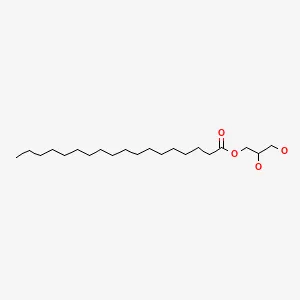
Glycerol Monostearate Structure
| IUPAC Name | : 2,3-dihydroxypropyl octadecanoate |
| CAS Number | : 31566-31-1 |
| HS Code | : 2915.70 |
| Molecular Formula | : C21H42O4 |
| Structural Formula | : C17H35COO-CH2-CH(OH)-CH2OH |
| Synonyms | : GMS, Glycerol monostearate, Monostearin, Glyceryl stearate, E471 |
| Molecular Weight | : 358.56 g/mol |
Glycerol monostearate (GMS) is the monoester of glycerol and stearic acid. It is one of the most widely used food emulsifiers globally, approved as E471, and valued for its ability to stabilize oil-in-water and water-in-oil emulsions, improve texture, and extend the shelf life of food products.
GMS is available in standard grades (40–55% monoglyceride content) and distilled grades (>90% monoglyceride content, also referred to as Distilled Monoglyceride or DMG). The distilled grade offers superior emulsification performance and is preferred in demanding food applications. It is derived from palm oil or animal fat-based sources, with palm-based GMS being preferred for Halal and vegan-certified applications.
Beyond food, GMS is also used in personal care formulations as an emulsifier and co-emulsifier in creams and lotions, in pharmaceutical tablet coatings as a lubricant, and in PVC processing as a lubricant and anti-static agent.
| Physical Description | : White to off-white waxy solid, beads, flakes, or powder. |
| Color / Form | : White to off-white. |
| Odor | : Faint, characteristic fatty odor. |
| Taste | : Bland, slightly fatty. |
| Boiling Point | : >200 °C (decomposes) |
| Melting Point | : 54–72 °C (depending on grade and fatty acid composition) |
| Flash Point | : >200 °C |
| Solubility | : Insoluble in water; dispersible in hot water; soluble in hot oils and organic solvents. |
| Density | : Approx. 0.97 g/cm³ |
| HLB Value | : Approx. 3.5–4.5 (lipophilic emulsifier) |
| Stability / Shelf Life | : Stable under normal dry storage. Susceptible to hydrolysis under strong acid or alkali conditions. |
| Viscosity | : Solid at room temperature; low viscosity liquid when melted above 60 °C. |
| Polymerization | : No hazardous polymerization. |
Glycerol monostearate is one of the most important food emulsifiers, used across bakery, dairy, confectionery, margarine, and convenience food sectors. In bread and bakery products, GMS acts as a dough conditioner and anti-staling agent by forming complexes with amylose starch, retarding starch retrogradation and extending the softness and shelf life of bread, cakes, and pastries.
In margarine and shortening, GMS promotes stable beta-prime crystal formation in the fat phase, resulting in smooth, consistent texture. In ice cream and frozen desserts, it controls fat agglomeration during freezing, improving overrun, texture uniformity, and heat shock resistance. In whipped toppings and cream substitutes, it stabilizes the aerated structure. In instant noodles, GMS reduces stickiness and improves cooking quality.
In personal care, GMS is used as a self-emulsifying ingredient in creams, lotions, and hair care products. In pharmaceuticals, it serves as a tablet lubricant, coating agent, and sustained-release matrix component. In PVC compounding, it functions as an internal lubricant and anti-static agent.
GMS is produced by glycerolysis of fats or oils (typically palm oil, palm stearin, or hydrogenated vegetable oils) with excess glycerol at elevated temperature (220–260 °C) in the presence of an alkaline catalyst (sodium hydroxide or calcium oxide). The reaction produces a crude mixture of approximately 40–55% monoglycerides, diglycerides, triglycerides, and free glycerol.
For high-purity distilled GMS (>90% monoglyceride), the crude glycerolysis product is subjected to short-path molecular distillation under high vacuum (<0.001 mbar) at 180–220 °C. The distilled product is cooled, formed into beads, flakes, or powder, and tested for quality including monoglyceride content, free fatty acid, free glycerol, acid value, iodine value, moisture, and color. Halal and Kosher certification requires use of vegetable-based oils only.
Glycerol monostearate is of low toxicity and is approved as a food additive (E471) with GRAS status. May cause mild irritation on excessive or prolonged contact. Dust from powdered form may irritate the respiratory tract.
Combustible solid with high flash point (>200 °C). Low fire risk under normal handling conditions.
Generally non-irritating to skin. Dust inhalation may cause mild respiratory irritation. Eye irritation is unlikely under normal handling conditions.
Combustible solid. Hot molten GMS may cause thermal burns.
Wash with soap and water. For burns from hot molten material, treat with cool running water and seek medical attention.
Rinse with clean water. Seek medical advice if irritation persists.
Generally safe as a food additive. Seek medical advice if large non-food quantities are ingested.
Use CO², foam, or dry chemical powder. Do not use water jet on molten material. Cool surrounding containers with water spray.
Small spill (powder/beads): Vacuum or carefully sweep up. Avoid dust generation. Collect in labeled containers for recovery or disposal.
Molten spill: Allow material to cool and solidify before collection. Scrape up solidified material. Do not allow molten product to enter drains. Warn of slip hazard from solidified material on floor.
Store in original, tightly sealed packaging in a cool, dry, well-ventilated warehouse. Protect from heat (melts above 54 °C), humidity, and direct sunlight. High humidity can cause caking and hydrolysis of the product. Keep away from strong oxidizing agents and strong acids or bases. For bulk melt storage, maintain at 65–75 °C under inert atmosphere.
Recommended storage temperature: 15–25 °C (solid form). Melt storage: 65–75 °C. Relative humidity: below 60% RH. Shelf life: 18–24 months in original sealed packaging. Suitable containers: multi-wall kraft paper bags with PE liner, HDPE drums, or stainless steel tanks for melt. Protect from moisture and strong odor sources.
For more detailed information including pricing, customization, and shipping:
Discover more about this product and understand how it may fit into your operations, formulations, or production requirements.
Browse Product

 English
 Indonesian
 简体字
简体字
 العربية
 Español
 Français
 Português
 日本語
日本語
 한국어
한국어
 Tiếng Việt



















