Explore our network of country and industry based websites to access localized information, product offerings, and business services across our group.
Log in to start sending quotation requests for any product.
Don't have an account? Sign Up Here
Home Corn Steep Liquor Market Demand: Industrial Applications and Global Buyer Trends
Trade Insights | Applications and Buyers | 03 July 2026
Introduction to Corn Steep Liquor
Industrial Applications Driving Market Demand
Global Market Trends and Industry Outlook
Buyer Intent and Procurement Considerations
Commercial Sourcing Through B2B Chemical Marketplaces
Future Opportunities for Manufacturers, Traders, and Buyers
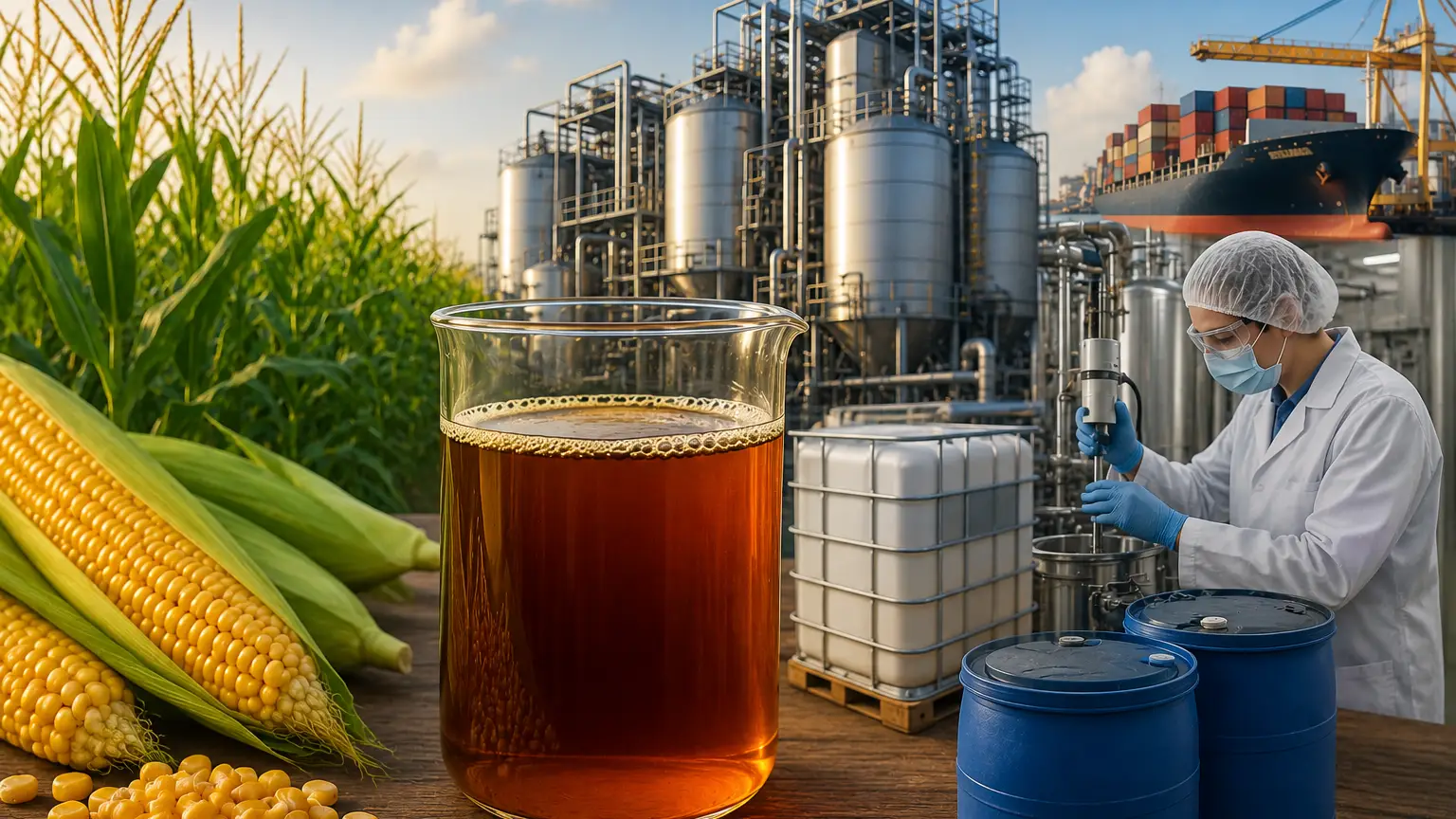
Corn Steep Liquor (CSL) is a nutrient-rich liquid by-product generated during the wet milling of corn. It contains proteins, amino acids, vitamins, minerals, organic acids, and other soluble nutrients that make it valuable across multiple industrial sectors. Rather than being treated as waste, CSL has become an important raw material that supports sustainable manufacturing while providing a cost-effective source of nutrients for industrial processes. According to technical information published by the U.S. Department of Agriculture (USDA), corn wet milling enables the recovery of numerous valuable co-products that serve food, feed, fermentation, and industrial markets.
One of the primary advantages of Corn Steep Liquor is its balanced nutrient composition. The naturally occurring nitrogen compounds and growth-promoting factors make it an effective ingredient in microbial fermentation, where microorganisms require readily available nutrients for efficient growth. Research published by the Food and Agriculture Organization (FAO) also recognizes agricultural processing co-products as important resources for improving resource efficiency and supporting circular bioeconomy practices.
Because Corn Steep Liquor originates from an established corn processing industry, supply is generally available in commercial quantities for manufacturers and industrial users. This reliable production stream has encouraged its adoption in animal nutrition, agricultural inputs, enzyme production, organic acids, antibiotics, bio-based chemicals, and industrial biotechnology. The product's versatility allows manufacturers to optimize production costs without compromising nutrient availability for biological processes.
For procurement teams, Corn Steep Liquor represents more than a commodity ingredient. Buyers increasingly evaluate consistency, nutrient specifications, logistics capability, regulatory compliance, and supplier reliability before making purchasing decisions. As industries continue emphasizing sustainable sourcing and efficient utilization of agricultural co-products, Corn Steep Liquor remains an attractive option for organizations seeking dependable raw materials that support both operational efficiency and environmental responsibility.
Growing demand for sustainable and cost-effective raw materials has expanded the industrial use of Corn Steep Liquor across several sectors. Its high concentration of soluble proteins, amino acids, vitamins, and minerals makes it an economical nutrient source for biological and agricultural processes. According to the Food and Agriculture Organization (FAO), the productive use of agricultural processing by-products contributes to resource efficiency and supports more sustainable production systems across global industries.
The fermentation industry is one of the largest commercial users of Corn Steep Liquor. Manufacturers of enzymes, organic acids, antibiotics, amino acids, yeast, and other biotechnology products use it as an economical fermentation nutrient because it provides essential nitrogen and growth factors required by microorganisms. Technical publications from the U.S. Department of Agriculture (USDA) and industrial biotechnology literature recognize Corn Steep Liquor as a widely adopted fermentation medium component that helps improve production efficiency while reducing raw material costs.
In the animal feed sector, Corn Steep Liquor is incorporated into feed formulations as a source of protein and digestible nutrients for livestock. Feed manufacturers value its nutritional profile and its ability to complement other feed ingredients while supporting cost-effective production. In agriculture, the product is also utilized in liquid fertilizers and soil amendment formulations, where its organic nutrient content can contribute to improved soil fertility and sustainable nutrient management. These applications continue to expand as agricultural producers seek environmentally responsible alternatives to conventional inputs.
The diversity of these end-use applications strengthens commercial demand for Corn Steep Liquor across regional and international markets. Manufacturers, distributors, and procurement teams increasingly source the product based on consistent nutrient composition, dependable supply, regulatory compliance, and logistics capability. As industrial biotechnology, animal nutrition, and sustainable agriculture continue to grow, Corn Steep Liquor is expected to remain an important ingredient supporting multiple value chains within the global bio-based economy.
Corn Steep Liquor is increasingly positioned within the global shift toward bio-based raw materials and circular economy models. As industries look to reduce dependency on synthetic inputs, CSL is gaining attention as a renewable nutrient source derived from corn wet milling. According to the U.S. Department of Agriculture (USDA), the expansion of corn processing capacity and co-product utilization continues to strengthen global supply availability for industrial derivatives such as CSL.
The Asia-Pacific region is one of the fastest-growing markets for Corn Steep Liquor, driven by expanding fermentation industries, livestock production, and bio-based manufacturing sectors. Countries with strong industrial biotechnology ecosystems are increasing imports of fermentation nutrients to support enzyme, amino acid, and organic acid production. Reports from the Organisation for Economic Co-operation and Development (OECD) highlight the accelerating adoption of bioeconomy strategies in emerging economies, which directly supports demand for agricultural co-products like CSL.
In North America and Europe, Corn Steep Liquor demand is closely linked to mature fermentation industries and advanced animal nutrition sectors. These regions prioritize consistent quality standards, traceability, and regulatory compliance, making supplier reliability a critical procurement factor. The European Commission’s bioeconomy strategy further emphasizes the utilization of renewable biological resources, reinforcing CSL’s role in sustainable industrial production systems.
From a commercial standpoint, global trade flows of Corn Steep Liquor are influenced by corn production cycles, wet milling capacity, and downstream industrial demand. Buyers increasingly evaluate supply chain resilience, pricing stability, and technical specifications when selecting suppliers. As sustainability regulations tighten worldwide, CSL is expected to maintain steady demand growth as a functional and cost-efficient industrial ingredient supporting multiple manufacturing sectors.
Corn Steep Liquor attracts strong commercial interest from procurement teams operating in fermentation, animal nutrition, and agricultural manufacturing. Buyers typically include enzyme producers, amino acid manufacturers, feed formulators, fertilizer companies, and industrial biotech firms. According to industry procurement insights referenced by the U.S. Department of Agriculture (USDA), buyers in bio-based supply chains prioritize consistent nutrient composition and reliable bulk availability when sourcing fermentation inputs.
Procurement teams evaluate Corn Steep Liquor based on key parameters such as total solids content, nitrogen value, microbial compatibility, and storage stability. These technical specifications are critical in fermentation industries where nutrient consistency directly affects yield efficiency and production scalability. In animal feed and agricultural applications, buyers also assess safety compliance, traceability, and alignment with regional feed or fertilizer regulations, as highlighted in FAO guidance on agricultural by-product utilization.
A major factor influencing purchasing decisions is supplier reliability and logistics capability. Because CSL is typically traded in bulk liquid form, transportation efficiency, storage infrastructure, and delivery timing significantly impact procurement costs. Buyers often compare multiple suppliers to ensure competitive pricing while maintaining product quality consistency across shipments.
Ultimately, Corn Steep Liquor purchasing decisions are driven by both technical and commercial considerations. Buyers seek suppliers who can deliver stable product quality, transparent specifications, and dependable global distribution, making B2B marketplaces an essential channel for sourcing decisions.
B2B chemical marketplaces play a critical role in connecting global buyers with reliable Corn Steep Liquor suppliers. Platforms such as Tradeasia / Chemtradeasia / Tradechem Marketplace help streamline sourcing by offering verified supplier networks, standardized product listings, and efficient inquiry-to-order workflows. According to general market distribution analysis from OECD bioeconomy reports, digital procurement channels are increasingly important in global chemical trade due to their efficiency and transparency.
For Corn Steep Liquor buyers, digital marketplaces reduce sourcing complexity by enabling quick comparison of suppliers, specifications, and logistics options. This is particularly important in bulk chemical procurement, where even small variations in quality or delivery timelines can significantly affect downstream production. Market intelligence from industry trade associations indicates that digital procurement adoption is growing rapidly across Asia, Europe, and the Middle East.
Tradeasia and similar platforms also support international trade compliance by ensuring documentation alignment, export readiness, and supplier verification. This reduces procurement risks and improves transaction reliability for industrial buyers operating across borders. As global supply chains become more interconnected, digital sourcing channels are becoming central to chemical trade efficiency.
In this context, Corn Steep Liquor benefits from strong visibility within B2B marketplaces, enabling manufacturers and distributors to connect with qualified buyers. This improves market liquidity and ensures better alignment between supply availability and industrial demand.
The long-term outlook for Corn Steep Liquor remains positive, supported by the expansion of bio-based industries and sustainable manufacturing practices. According to OECD bioeconomy projections, demand for renewable industrial inputs is expected to grow steadily as industries transition toward greener production systems.
Emerging applications in biotechnology, biofertilizers, and sustainable agriculture are expected to further strengthen CSL demand. As companies invest in alternative protein production, microbial fermentation, and circular economy solutions, Corn Steep Liquor is likely to remain a preferred nutrient source due to its cost efficiency and availability.
In addition, advancements in industrial fermentation technology are improving the efficiency of CSL utilization, enabling higher yield outputs and reduced production costs. This strengthens its position as a strategic raw material in industrial biotechnology value chains.
Overall, Corn Steep Liquor is expected to maintain steady global demand growth, particularly in regions expanding their bio-based manufacturing capabilities.
Corn Steep Liquor plays a vital role in supporting fermentation, animal feed, and agricultural industries through its rich nutrient profile and cost-effective availability. Its importance continues to grow alongside global sustainability trends and the expansion of bio-industrial production systems.
For B2B buyers, reliable sourcing of Corn Steep Liquor is essential to maintaining production efficiency and cost stability. As global demand increases, selecting trusted suppliers through established chemical marketplaces becomes a key procurement strategy.
Sources
We're committed to your privacy. Tradeasia uses the information you provide to us to contact you about our relevant content, products, and services. For more information, check out our privacy policy.


 English
 Indonesian
 简体字
简体字
 العربية
 Español
 Français
 Português
 日本語
日本語
 한국어
한국어
 Tiếng Việt



















