Explore our network of country and industry based websites to access localized information, product offerings, and business services across our group.
Log in to start sending quotation requests for any product.
Don't have an account? Sign Up Here
Home Corn vs Tapioca Starch in Industrial Use
Trade Insights | Applications and Buyers | 13 April 2026
1. Introduction
2. Industrial Demand for Corn and Tapioca Starch in America
3. Functional Properties: Corn Starch vs Tapioca Starch
4. Applications and Performance in Key US Industries
5. Sourcing Tapioca Starch Through foodadditivesasia.com
6. Conclusion (give the disclaimer that )
In the American industrial landscape, starches are far more than simple thickening agents. They are critical functional ingredients that drive texture, stability, process efficiency, and cost optimization across food, paper, textile, adhesive, pharmaceutical, and bioplastic sectors. Among the many botanical sources, corn starch and tapioca starch dominate numerous applications, each offering distinct performance characteristics and supply-chain dynamics that manufacturers must understand to stay competitive.
Historically, the United States has relied heavily on corn-based ingredients due to its vast maize production, established processing infrastructure, and mature commodity markets. At the same time, global trade and the rise of Asia-based ingredient hubs have increased access to alternative starches such as tapioca starch, derived from cassava roots. As clean-label, gluten-free, and allergen-conscious trends accelerate, tapioca starch has gained traction as a versatile and consumer-friendly option in both food and non-food industries.
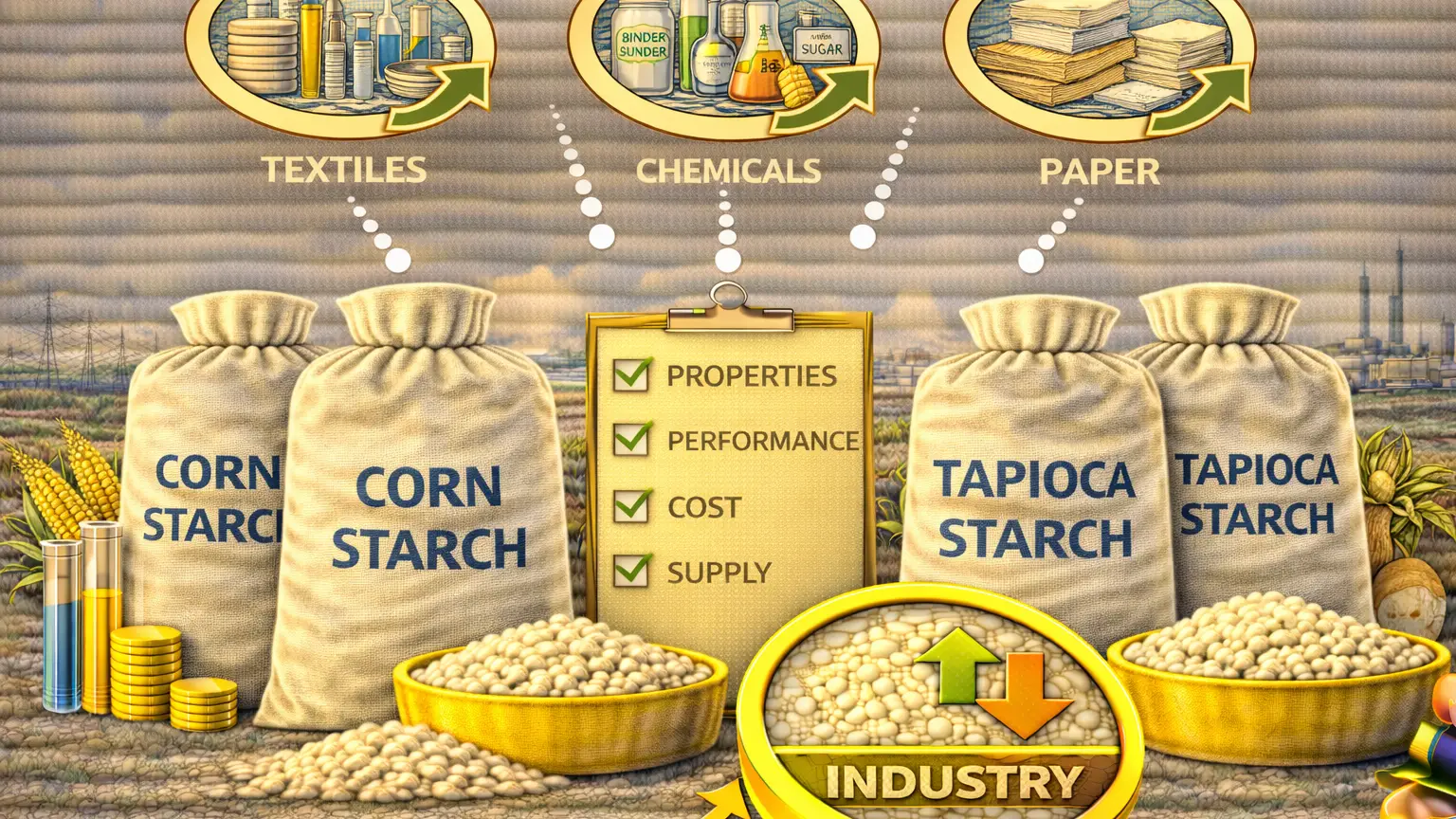
This article examines the technical, commercial, and strategic differences between corn and tapioca starch for industrial users in America. It highlights functional properties, key application areas, and market trends, with a particular focus on sourcing high-quality tapioca starch and related derivatives through platforms such as foodadditivesasia.com. The goal is to support procurement, R&D, and operations teams as they evaluate starch choices for performance, cost, and long-term reliability.
The United States is one of the world’s largest producers and consumers of starch, with corn starch accounting for the majority of domestic industrial starch use. US corn production regularly exceeds 350 million metric tons per year, and a significant share is processed into starch, sweeteners, ethanol, and other derivatives. This scale has entrenched corn starch as a default option in many American factories, especially in paper, adhesives, and conventional food processing where supply security and price transparency are paramount.
However, demand for alternative starches has expanded as manufacturers seek differentiated textures, improved freeze–thaw stability, and cleaner ingredient declarations. Tapioca starch, largely produced in Thailand, Vietnam, Indonesia, and other Southeast Asian countries, has become a major export commodity. According to trade data over the last decade, North America has steadily increased imports of cassava-based starches and modified tapioca derivatives, particularly for gluten-free foods, specialty coatings, and applications where neutral flavor and clarity are crucial.
From a strategic sourcing perspective, American buyers now operate in a dual-supply environment. On one side, domestic corn starch offers logistical convenience, shorter lead times, and integration with existing US infrastructure. On the other, imported tapioca starch provides formulation advantages and marketing benefits such as “grain-free” or “gluten-free” positioning. Ingredient platforms like foodadditivesasia.com have simplified access to Asian tapioca producers by aggregating certified suppliers, technical documentation, and export logistics in one channel, making it easier for US companies to diversify their starch portfolios without building their own overseas sourcing networks.
At the molecular level, both corn and tapioca starch are composed of amylose and amylopectin, yet their ratios and granular structures differ enough to create distinct functional profiles. Standard corn starch typically has an amylose content in the range of 25–28%, while native tapioca starch often has slightly lower amylose and a highly branched amylopectin structure. This difference contributes to tapioca’s characteristically elastic gels and transparent pastes, compared with the more opaque, sometimes firmer gels produced by corn starch.
In thermal processing, tapioca starch generally exhibits lower gelatinization temperatures and produces smoother, more cohesive textures. This makes it attractive in applications such as sauces, gravies, and frozen ready meals, where a glossy, translucent appearance and stable viscosity after freeze–thaw cycles are important. Corn starch, by contrast, can provide higher gel strength and is widely used where firmness and structure are required, such as in confectionery gels, molded products, and certain paper and corrugating adhesives that benefit from robust film formation.
Modified starches derived from both corn and tapioca further expand the performance envelope. Crosslinked and stabilized tapioca starches can deliver excellent shear and acid resistance, while pregelatinized forms enable instant thickening in cold-processed foods and dry mixes. Many of these specialty grades are available through foodadditivesasia.com, which connects buyers to manufacturers offering technical variants such as acetylated distarch phosphate, hydroxypropylated tapioca, and dextrinized tapioca tailored for coatings and adhesives. For US formulators, understanding these functional nuances helps determine when a switch from corn to tapioca can improve product quality or processing efficiency.
In the American food industry, both corn and tapioca starch play central roles, but they are often chosen for different reasons. Corn starch is ubiquitous in bakery fillings, puddings, and traditional gravies, benefiting from its cost-effectiveness and familiarity. Tapioca starch, however, has gained popularity in gluten-free breads, snacks, and clean-label soups, where its neutral taste and clear pastes are advantageous. For frozen meals, tapioca’s superior freeze–thaw stability helps reduce syneresis and texture breakdown, improving consumer perception and shelf-life performance.
Beyond food, industrial sectors such as paper and packaging, textiles, and adhesives rely heavily on starches as binders and surface modifiers. Corn-based starches have long dominated these applications in the US due to established supply chains and compatibility with existing equipment. Nevertheless, tapioca derivatives are increasingly evaluated for specialty coatings, where their film-forming properties and clarity can enhance printability and surface smoothness. In textile sizing, tapioca starch can provide good adhesion with reduced dusting, while in certain water-based adhesives it can improve tack and flexibility compared with some conventional corn-based formulations.
Emerging sectors, including biodegradable plastics and pharmaceutical excipients, also present opportunities for tapioca starch. Bioplastic developers often explore blends of thermoplastic starch with other polymers, and tapioca’s high purity and relatively consistent granule size can support uniform processing. In pharmaceuticals and nutraceuticals, tapioca-based excipients appeal to brands seeking non-GMO, allergen-friendly, and plant-based claims. Platforms such as foodadditivesasia.com help US innovators access pharmaceutical- and food-grade tapioca starch options with documentation that aligns with FDA expectations, including specifications for moisture, microbial limits, and heavy metal content.
For American manufacturers interested in incorporating tapioca starch into their formulations, reliable sourcing is as important as functional performance. foodadditivesasia.com serves as a specialized gateway to Asian starch producers, particularly those in Thailand, Vietnam, and other major cassava-growing regions. By curating a network of audited suppliers, the platform enables US buyers to identify tapioca starch, modified tapioca, and derivative products that meet defined quality and regulatory standards, including ISO, HACCP, Halal, and Kosher certifications where required.
Typical product specifications available through such channels include detailed parameters on moisture content (often around 12–14% for native tapioca starch), pH, whiteness, viscosity profiles, particle size distribution, and microbial counts. Modified grades list functional attributes such as cold-water solubility, shear resistance, or acid stability, which are critical for matching a starch to a specific industrial process. Access to certificates of analysis (COA), safety data sheets (SDS/MSDS), and technical data sheets helps American R&D teams conduct initial screening and lab trials without lengthy back-and-forth communication.
From a logistics and commercial standpoint, foodadditivesasia.com and similar sourcing platforms support containerized shipments, flexible packaging options (such as 25 kg bags or bulk bags), and coordination with US importers and customs brokers. This can reduce the perceived barrier of working directly with overseas suppliers. For companies seeking to diversify away from single-source corn-based inputs, building a relationship with a tapioca-focused network offers strategic resilience, potential cost advantages in certain market cycles, and access to a broader portfolio of starch technologies that can be leveraged across multiple product lines.
Corn starch and tapioca starch each occupy important positions in America’s industrial ecosystem. Corn starch benefits from domestic abundance, mature infrastructure, and cost competitiveness, making it a logical choice for many high-volume, price-sensitive applications. Tapioca starch, by contrast, stands out for its neutral flavor, clarity, freeze–thaw stability, and strong consumer perception in gluten-free and clean-label markets. For industrial users, the decision is rarely binary; instead, it involves selecting the right starch or blend for each specific process, performance target, and brand positioning.
As market demands evolve toward transparency, sustainability, and differentiated functionality, the role of tapioca starch is likely to expand in both food and non-food sectors. American manufacturers that proactively evaluate tapioca-based solutions can unlock new textures, improve product stability, and address consumer concerns related to allergens and genetically modified ingredients. Platforms like foodadditivesasia.com make it more practical to explore these options by connecting US buyers with established Asian producers, standardized specifications, and a range of native and modified tapioca starch grades tailored to modern industrial needs.
This article is provided solely for informational and market insight purposes and does not constitute technical, safety, regulatory, or professional advice. Users should independently verify all data and suitability for their specific processes by consulting qualified experts, reviewing official documentation such as MSDS/SDS and regulatory guidelines, or contacting our team directly before making formulation, safety, or procurement decisions.
We're committed to your privacy. Tradeasia uses the information you provide to us to contact you about our relevant content, products, and services. For more information, check out our privacy policy.


 English
 Indonesian
 简体字
简体字
 العربية
 Español
 Français
 Português
 日本語
日本語
 한국어
한국어
 Tiếng Việt



















