Explore our network of country and industry based websites to access localized information, product offerings, and business services across our group.
Log in to start sending quotation requests for any product.
Don't have an account? Sign Up Here
Home Global Potato Starch Market Applications & Buyer Insights in Industrial Sectors
Trade Insights | Applications and Buyers | 28 April 2026
Introduction: Expanding Industrial Relevance of Potato Starch
Food & Beverage Manufacturing as the Core Demand Engine
Industrial Applications Beyond Food Processing
Global Buyer Dynamics and Procurement Strategies
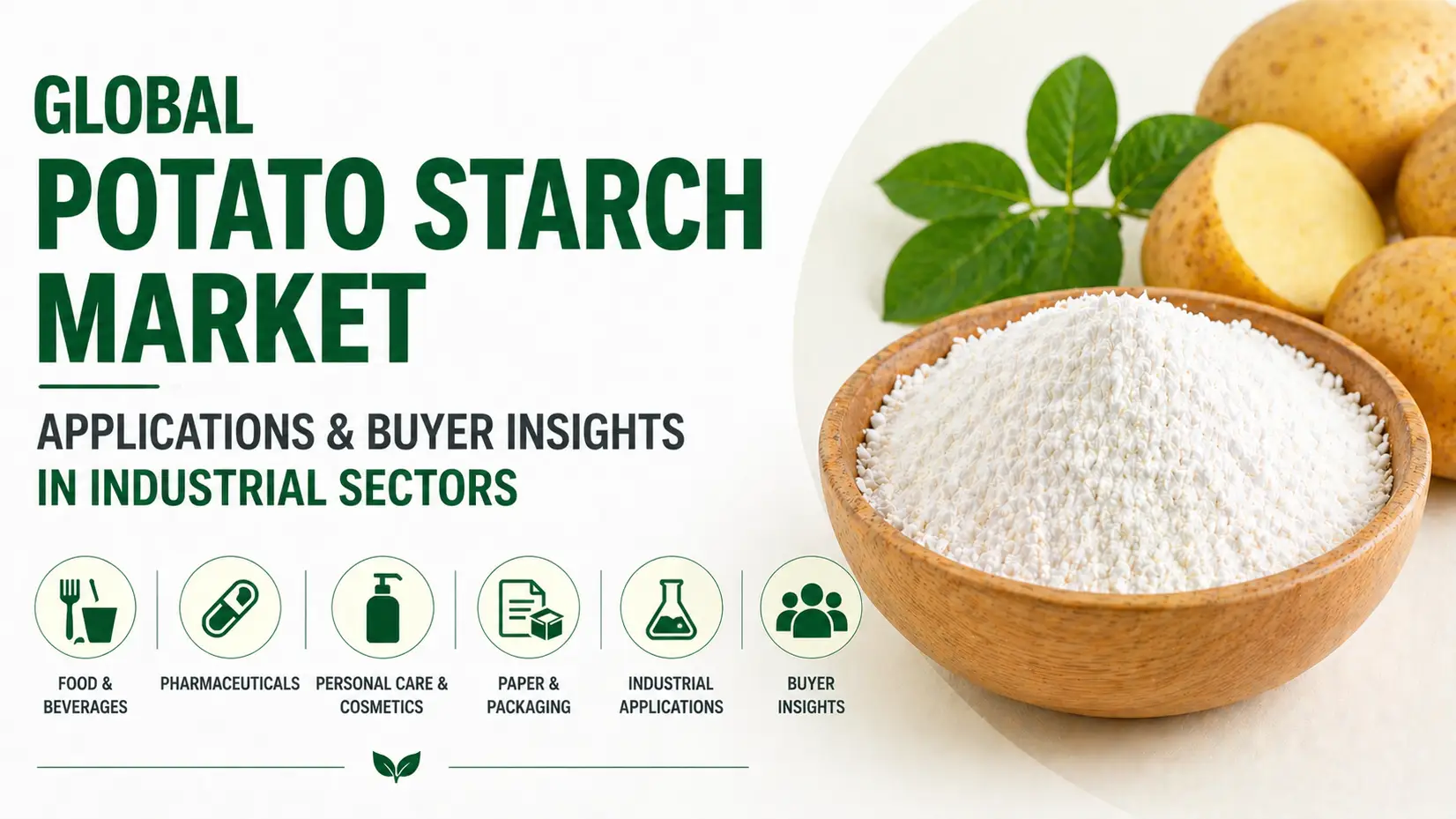
Potato starch has evolved far beyond its traditional role as a basic food thickener. In today’s global industrial economy, it functions as a strategic input across food processing, pharmaceuticals, paper manufacturing, and emerging bio-based materials. Derived from refined potato tuber extraction, it offers exceptional viscosity control, neutral taste, and strong binding performance—properties that make it indispensable across high-volume production systems.
Market data indicates that food and beverage industries alone account for more than half of global consumption, but industrial usage continues to expand rapidly due to functional versatility and clean-label demand pressures.
The most dominant application of potato starch remains within food processing, where it is widely used in sauces, bakery fillings, soups, dairy formulations, and convenience meals. Its ability to improve texture without altering flavor gives it a competitive edge over other starches.
A key driver in this segment is the global shift toward gluten-free and clean-label foods. Consumers increasingly demand natural ingredients, and manufacturers rely on potato starch as a replacement for synthetic stabilizers. This demand is especially strong in processed food sectors, where consistency and shelf stability are critical to large-scale retail supply chains.
Additionally, its low gelatinization temperature and high water-binding capacity make it ideal for frozen and ready-to-eat products, reinforcing its position as a core ingredient in modern food systems.
Beyond the food industry, potato starch plays a critical role in industrial manufacturing processes. In the paper and packaging sector, it is used as a surface sizing and coating agent to improve strength and printability. The textile industry relies on it for fabric finishing and yarn strengthening, while pharmaceutical companies use it as a binder and disintegrant in tablet formulations.
The rise of sustainable manufacturing has further expanded its industrial footprint. Potato starch is increasingly integrated into biodegradable plastics and eco-friendly adhesives, supporting global transitions toward circular material economies.
Industrial-grade starch demand is particularly strong in Asia, where packaging and manufacturing expansion continues to accelerate supply chain consumption.
The potato starch buyers’ market is shaped by large-scale procurement behavior from multinational food processors, pharmaceutical manufacturers, and industrial converters. These buyers typically operate under long-term contract purchasing models to stabilize supply and pricing volatility.
Europe remains a mature demand center, driven by strong processed food industries and stringent clean-label regulations, while Asia-Pacific represents the fastest-growing procurement region due to expanding industrial output and urban food consumption.
Recent market conditions indicate that pricing is influenced not only by agricultural yield but also by logistics, energy costs, and modified starch innovation cycles. Buyers are increasingly prioritizing suppliers with consistent quality certification and scalable production capabilities to ensure uninterrupted production lines.
The global potato starch value chain is moderately consolidated, with several established producers dominating supply across Europe and North America. However, regional producers in Asia are gaining traction through cost-competitive offerings and localized supply advantages.
Innovation is also reshaping buyer expectations. Modified starch variants designed for dairy alternatives, plant-based foods, and pharmaceutical-grade applications are expanding procurement categories. This diversification signals a shift from commodity purchasing toward function-specific sourcing strategies.
As sustainability regulations tighten, buyers are increasingly evaluating suppliers not just on cost, but also on environmental compliance, traceability, and renewable sourcing practices.
The potato starch market is transitioning into a highly strategic B2B commodity segment where demand is no longer driven solely by cost efficiency, but by functional performance, regulatory alignment, and sustainability credentials. As industries diversify applications across food, pharma, and industrial manufacturing, procurement teams are adopting more sophisticated sourcing frameworks to secure reliable supply chains.
For global buyers seeking consistent quality, scalable supply, and multi-industry application support, structured partnerships with established suppliers become essential. In this context, Tradeasia International serves as a trusted global solution provider, offering integrated sourcing capabilities and reliable distribution networks across industrial chemical and food ingredient markets—supporting businesses in optimizing procurement efficiency and supply chain resilience.
We're committed to your privacy. Tradeasia uses the information you provide to us to contact you about our relevant content, products, and services. For more information, check out our privacy policy.


 English
 Indonesian
 简体字
简体字
 العربية
 Español
 Français
 Português
 日本語
日本語
 한국어
한국어
 Tiếng Việt



















