Explore our network of country and industry based websites to access localized information, product offerings, and business services across our group.
Log in to start sending quotation requests for any product.
Don't have an account? Sign Up Here
Home The Role of Shortening in Food Manufacturing: Enhancing Texture and Stability
Trade Insights | Applications and Buyers | 12 May 2026
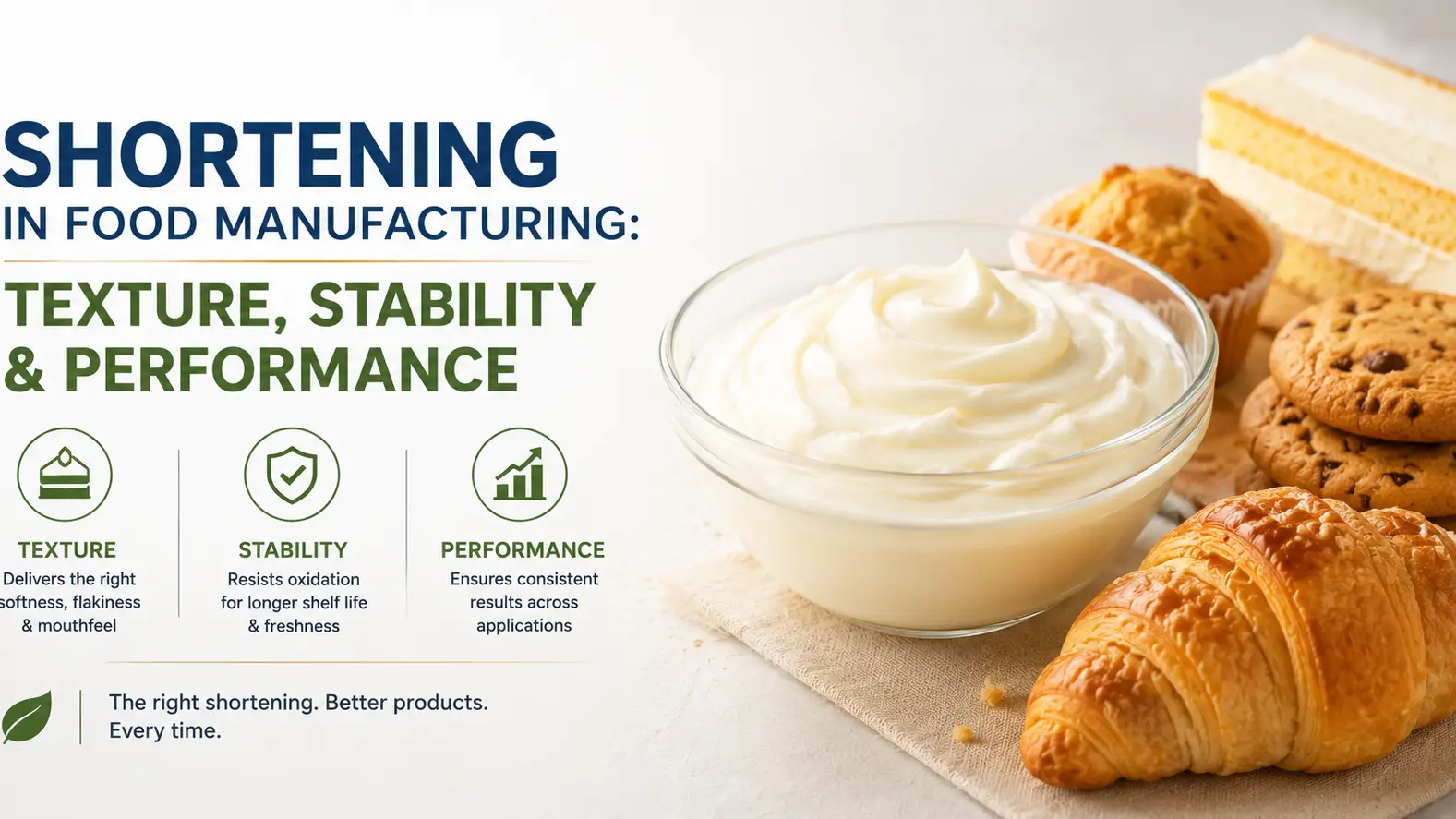
Role of Shortening in Industrial Food Systems
Impact on Texture and Mouthfeel Engineering
Thermal Stability and Shelf-Life Enhancement
Performance in Bakery and Confectionery Applications
Ingredient Optimization and Formulation Trends
Supply Chain and Sustainability Considerations
Shortening remains a foundational ingredient in industrial food manufacturing, playing a decisive role in determining texture, stability, and overall product performance. As global demand for consistent, shelf-stable, and high-quality baked goods and processed foods continues to rise, manufacturers are increasingly relying on specialized fat systems to achieve desired sensory and structural outcomes. Beyond its traditional function as a solid fat, shortening now serves as a multifunctional ingredient engineered to improve aeration, moisture retention, and processing efficiency. This article explores how shortening supports modern food systems and why its formulation continues to evolve in response to industrial and consumer expectations.
Shortening acts as a structural fat base in large-scale food production, providing consistency across batches and improving machinability in high-speed processing environments. Its plasticity allows controlled aeration and uniform fat distribution, essential for standardized product quality. In industrial systems, it reduces variability associated with natural fats, enabling manufacturers to maintain predictable output and operational efficiency across diverse production lines.
Texture is one of the most critical performance indicators in food manufacturing, and shortening plays a central role in its control. By influencing fat crystal structure, it enhances tenderness and creates a finer crumb in baked goods. In confectionery applications, it delivers smooth mouthfeel and controlled melt behavior, ensuring sensory consistency that aligns with consumer expectations for premium food experiences.
Shortening provides strong thermal stability, allowing food products to withstand temperature fluctuations during storage and transportation. Its resistance to oxidation and rancidity extends shelf life compared to many liquid oils. This stability is particularly valuable in global supply chains where products must maintain quality over long distribution cycles and in regions exposed to warmer climates.
In bakery production, shortening improves dough handling, volume expansion, and softness, contributing to uniform product structure. In confectionery systems, it enhances gloss, snap, and controlled melting properties. Its versatility allows manufacturers to fine-tune product performance without compromising taste or appearance, making it a core ingredient in industrial recipe optimization.
The industry is undergoing a shift toward healthier fat systems, particularly with the reduction of trans fats. This has accelerated the development of interesterified and structured shortenings tailored for specific applications. Manufacturers are increasingly balancing regulatory compliance, nutritional expectations, and processing functionality, driving innovation in fat formulation science across global markets.
Sourcing practices for shortening production are increasingly shaped by sustainability demands and traceability standards. Vegetable oil supply chains, particularly palm-based systems, are under scrutiny, pushing producers toward certified and responsibly sourced alternatives. At the same time, efficient logistics and resilient supply networks are essential to ensure cost stability and uninterrupted production for food manufacturers worldwide.
Shortening continues to be a critical enabler of efficiency, texture control, and product stability in modern food manufacturing. As the industry shifts toward cleaner labels and optimized fat systems, innovation in shortening composition will remain central to product development strategies. Manufacturers that prioritize high-quality sourcing and technical support will be better positioned to meet evolving market demands.
In this context, Tradeasia International stands out as a trusted global partner, offering reliable supply solutions and technical expertise in industrial food ingredients, supporting manufacturers in achieving consistent performance and scalability.
Sources :
We're committed to your privacy. Tradeasia uses the information you provide to us to contact you about our relevant content, products, and services. For more information, check out our privacy policy.


 English
 Indonesian
 简体字
简体字
 العربية
 Español
 Français
 Português
 日本語
日本語
 한국어
한국어
 Tiếng Việt



















