Explore our network of country and industry based websites to access localized information, product offerings, and business services across our group.
Log in to start sending quotation requests for any product.
Don't have an account? Sign Up Here
Home Sodium Acetate Market Demand: Applications and Buyer Insights
Trade Insights | Applications and Buyers | 14 August 2026

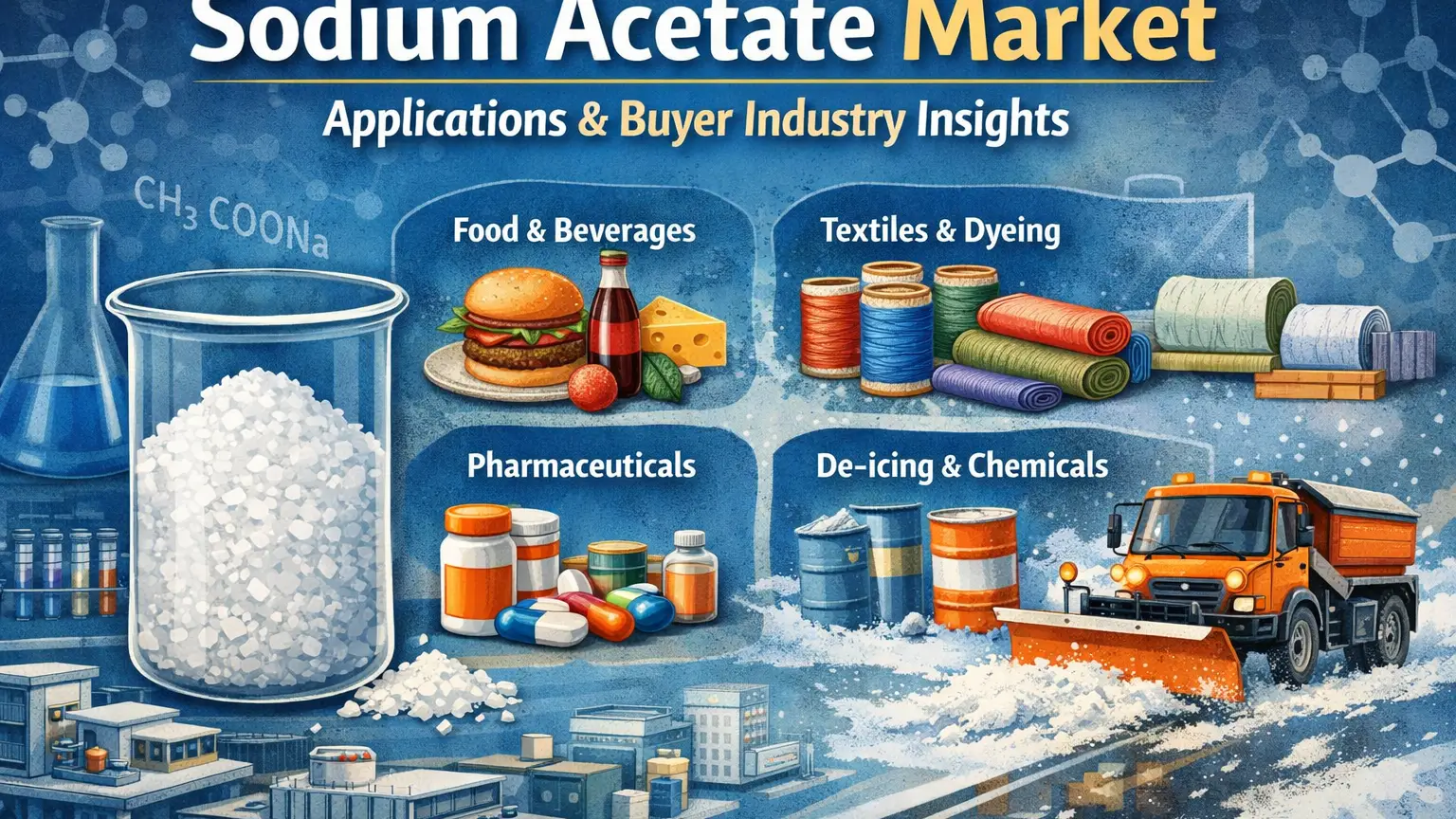
Sodium Acetate Market and Commercial Relevance
Food and Beverage Applications
Pharmaceutical and Healthcare Applications
Industrial and Chemical Applications
Key Sodium Acetate Buyers
B2B Sourcing and Supplier Selection
Market Outlook and Procurement Opportunities
Conclusion: Building Reliable Sodium Acetate Supply
Sources
Sodium acetate is a versatile sodium salt of acetic acid used in food processing, pharmaceuticals, chemical operations, textiles, water treatment and other industrial applications. Its buffering capability, pH-control properties and compatibility with different formulations make it commercially relevant to manufacturers that require predictable chemical performance. Market research estimates the global sodium acetate market at USD 143.70 million in 2025, with projected growth to USD 214.17 million by 2032 at a 5.86% CAGR.
For B2B buyers, sodium acetate is not simply a commodity chemical; grade selection depends heavily on the intended application. Food processors may prioritize food-grade compliance and additive documentation, while pharmaceutical manufacturers can require substantially tighter purity and quality controls. This application-driven segmentation creates opportunities for suppliers capable of matching product specifications with downstream manufacturing requirements.
The commercial importance of sodium acetate also comes from its ability to perform different technical functions. In food systems, Codex identifies sodium acetate as INS 262(i) and recognizes functional classes including acidity regulator, preservative and sequestrant. These characteristics allow procurement teams to evaluate sodium acetate according to both technical performance and regulatory suitability rather than price alone.
Food and beverage processing represents one of the most commercially important application areas for sodium acetate. According to the Codex GSFA database, sodium acetate is permitted across multiple food categories under specified conditions, including certain dairy products, pasta and noodles, fish products, egg products, fermented vegetables and other food categories.
For food manufacturers, the purchasing decision extends beyond basic chemical identity. Consistent quality, appropriate food-grade documentation, regulatory compliance and reliable batch performance are important when sodium acetate is incorporated into production processes. Depending on the formulation, buyers may use it for acidity regulation, preservation or related functional purposes, making specification control particularly important.
The breadth of Codex-listed applications demonstrates why food-grade sodium acetate can serve diverse processing requirements rather than a single niche. Current Codex information also identifies permitted uses under good manufacturing practice for several categories, while specific food standards may establish additional conditions. For international procurement, buyers should therefore verify the applicable regulations and food standards in their destination market before finalizing specifications.
Pharmaceutical and healthcare applications create a different purchasing environment because material quality and documentation become central procurement criteria. Sodium acetate can be used in pharmaceutical and medical formulations where controlled chemical composition and reliable performance are required. Market research identifies pharmaceuticals as an important application segment and projects continued demand as pharmaceutical manufacturing expands.
Buyers in this segment generally evaluate suppliers more rigorously than commodity purchasers. Specifications, analytical certificates, manufacturing controls, traceability and consistency between batches can influence supplier qualification. Consequently, a competitive sodium acetate supplier needs to provide more than a quoted price; it needs to support the buyer's technical and quality-assurance process.
This makes pharmaceutical sodium acetate sourcing particularly dependent on grade selection and intended use. Procurement teams should establish the required specification before requesting quotations and distinguish pharmaceutical requirements from food or industrial-grade purchasing. A supplier able to clearly identify the applicable grade, documentation package and production consistency can reduce qualification friction and improve long-term purchasing reliability.
Outside food and healthcare, sodium acetate has a broad industrial role. Current market research identifies applications spanning textiles and leather, chemical synthesis, water treatment and other industrial operations. Its buffering properties and chemical compatibility make it useful where controlled process conditions are important.
Industrial buyers often approach sodium acetate from a process-efficiency perspective. Depending on the application, they may evaluate solubility, purity, physical form, packaging and consistency alongside cost. Textile processing, chemical manufacturing and water-treatment operations can therefore represent distinct buyer groups with different technical specifications and consumption patterns.
The diversity of industrial applications also supports a broader B2B market for both anhydrous and trihydrate forms. Market segmentation identifies these two principal product types alongside food, industrial and pharmaceutical grades. For distributors, this creates an opportunity to serve multiple downstream sectors, provided the product specification and documentation are aligned with each customer's application.
Food manufacturers are among the most significant potential buyers because sodium acetate can provide several functional benefits within regulated food applications. Typical procurement stakeholders include processed-food manufacturers, dairy processors, pasta and noodle producers, meat and seafood processors, ingredient distributors and food-formulation companies. Codex's current database demonstrates the range of food categories in which sodium acetate has recognized provisions.
Pharmaceutical companies, chemical manufacturers, textile processors and water-treatment operators form additional buyer groups. Their purchasing priorities can differ substantially: pharmaceutical buyers may emphasize purity and documentation, while industrial buyers may place greater weight on supply continuity, technical consistency, packaging and landed cost.
For distributors and international traders, understanding these buyer differences is essential. A procurement team purchasing sodium acetate for food production will not necessarily have the same supplier-qualification criteria as a chemical manufacturer. Effective B2B sourcing therefore begins with identifying the final application, required grade and relevant compliance requirements before comparing suppliers.
Sodium acetate procurement should be based on total supply value rather than the lowest nominal quotation. Buyers should consider product grade, specification consistency, packaging, lead times, documentation, export capability and supplier responsiveness. These factors become particularly important when sodium acetate is incorporated into continuous production processes where interruptions can create costs far greater than the initial material-price difference.
For international buyers, supplier selection also involves logistics and commercial risk management. Procurement teams can improve purchasing reliability by confirming product specifications before contracting, requesting relevant quality documentation and establishing clear shipment and packaging requirements. This approach helps align the supplier's offering with the buyer's production and regulatory needs.
A B2B chemical marketplace can support this process by connecting qualified buyers with suppliers and making it easier to compare product capabilities according to application. For sodium acetate, the strongest sourcing strategy is therefore one that combines technical suitability, commercial competitiveness and dependable supply rather than treating the chemical as a purely price-driven commodity.
The sodium acetate market is positioned for continued expansion as food processing, pharmaceuticals and industrial applications maintain demand. A 2026 market estimate places global market value at USD 153.81 million, with projected growth to USD 214.17 million by 2032 and a 5.86% CAGR. This indicates a market where application diversification can remain an important source of commercial opportunity.
For suppliers and distributors, the opportunity is increasingly tied to specialization. Food-grade sodium acetate can target ingredient and food-processing buyers, while pharmaceutical and industrial grades address different technical and qualification requirements. Suppliers that communicate these distinctions clearly can position themselves more effectively in international procurement channels.
For buyers, the outlook reinforces the importance of establishing dependable sourcing relationships before demand becomes urgent. Evaluating qualified suppliers, confirming grades and maintaining alternative sourcing options can strengthen procurement resilience. As sodium acetate demand develops across multiple industries, buyers and distributors that combine technical understanding with disciplined sourcing are better positioned to capture long-term value.
Sodium acetate has commercial relevance because one product can serve multiple industrial roles, from food additive and acidity regulator to pharmaceutical and chemical-processing applications. Its market is supported by diversified end-use demand, while regulatory requirements and application-specific specifications make informed supplier selection increasingly important.
For manufacturers, distributors and procurement teams, successful sodium acetate sourcing ultimately depends on matching the right grade with the right application and supply model. Tradeasia International can support businesses seeking dependable chemical sourcing by connecting application requirements with suitable products, international procurement capabilities and B2B supply solutions. This creates a practical pathway for buyers looking to strengthen sodium acetate procurement while maintaining attention to quality, compliance and supply continuity.
https://www.fao.org/gsfaonline/additives/details.
https://www.fao.org/food/food-safety-quality/scientific-advice/jecfa/jecfa-
https://www.fao.org/gsfaonline/additives/results
We're committed to your privacy. Tradeasia uses the information you provide to us to contact you about our relevant content, products, and services. For more information, check out our privacy policy.


 English
 Indonesian
 简体字
简体字
 العربية
 Español
 Français
 Português
 日本語
日本語
 한국어
한국어
 Tiếng Việt