Explore our network of country and industry based websites to access localized information, product offerings, and business services across our group.
Log in to start sending quotation requests for any product.
Don't have an account? Sign Up Here
Home Emerging Markets Lift Sodium Metabisulfite Trade Volumes
Market Insight | 22 December 2025
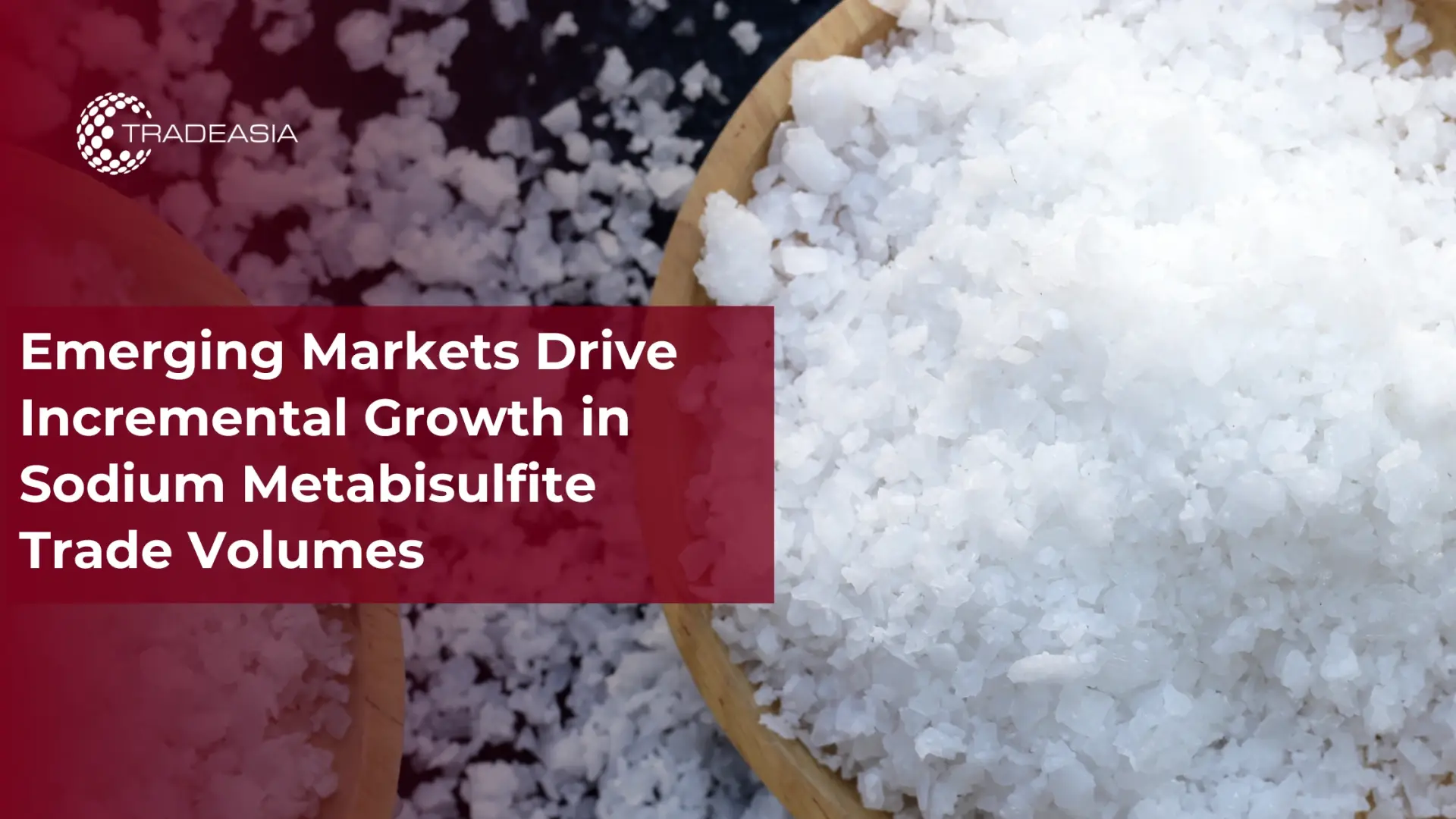
Urbanization and expanding industrial capacity across Asia, the Middle East, and Africa are driving higher import demand for sodium metabisulfite.
Global trade volumes of sodium metabisulfite are increasingly shaped by demand growth in emerging markets, where rapid urbanization and industrial expansion are accelerating consumption across multiple end-use sectors. While demand in mature markets remains relatively stable due to environmental scrutiny and substitution efforts, developing economies are recording incremental growth supported by infrastructure investment, food processing expansion, and water treatment needs.
Urban population growth in Asia, the Middle East, and Africa continues to drive demand for treated water, processed food, and industrial materials. Sodium metabisulfite plays a functional role in many of these applications, including dechlorination in water treatment, oxidation control in industrial processing, and preservation in selected food and beverage products.
As cities expand and industrial zones develop, demand for reliable and scalable chemical inputs increases. Sodium metabisulfite remains favored in these environments due to its strong reducing properties, predictable performance, and compatibility with existing infrastructure.
Despite rising consumption, domestic production capacity for sodium metabisulfite remains limited in many emerging markets. Manufacturing is often concentrated in China and a small number of producers in India and Europe, while downstream users in Southeast Asia, the Middle East, and Africa rely heavily on imports.
This supply imbalance is sustaining cross-border trade flows, particularly for industrial-grade material used in water treatment, mining, pulp & paper, and textile processing. Food-grade sodium metabisulfite is also imported to support food processors that require consistent quality and regulatory-compliant inputs.
Large-scale infrastructure projects—such as municipal water systems, wastewater treatment plants, mining operations, and energy facilities—are expanding across emerging economies. Sodium metabisulfite is commonly used as a dechlorination agent and oxygen scavenger in these systems, helping protect equipment and ensure compliance with water quality standards.
As governments prioritize access to clean water and industrial self-sufficiency, demand for cost-effective treatment chemicals is expected to rise steadily. Sodium metabisulfite’s established performance profile positions it as a default solution for many new and expanding facilities.
In the food industry, sodium metabisulfite continues to be used in controlled applications such as wine and beer production, seafood processing, dried fruits, and starch manufacturing. In emerging markets, expanding food processing capacity and export-oriented production are reinforcing baseline demand, particularly where cost efficiency remains a key consideration.
While labeling requirements and clean-label trends influence formulation strategies, sodium metabisulfite remains permitted within regulated limits, supporting its continued use in mass-market and industrial food applications.
From a B2B perspective, buyers in emerging markets prioritize supply reliability, price stability, and consistent quality. Global traders and chemical distributors play a critical role in bridging the gap between concentrated production hubs and geographically dispersed end users.
Long-term supply contracts, flexible logistics, and the ability to offer both industrial- and food-grade specifications are becoming increasingly important differentiators. As demand grows incrementally rather than explosively, supplier relationships and risk management are key factors shaping purchasing decisions.
Looking toward 2030, global sodium metabisulfite trade volumes are expected to grow at a moderate pace, driven primarily by emerging markets. Asia-Pacific is projected to remain the largest source of incremental demand, followed by the Middle East and parts of Africa where industrialization and water infrastructure investment are accelerating.
In contrast, demand in Europe and North America is likely to remain stable or marginally decline due to substitution efforts and environmental considerations. This divergence will reinforce the importance of international trade, with emerging markets accounting for a growing share of global import volumes.
Overall, sodium metabisulfite is expected to maintain its position as a strategically important industrial chemical, with emerging markets playing a central role in sustaining global trade flows through 2030.
We're committed to your privacy. Tradeasia uses the information you provide to us to contact you about our relevant content, products, and services. For more information, check out our privacy policy.


 English
 Indonesian
 简体字
简体字
 العربية
 Español
 Français
 Português
 日本語
日本語
 한국어
한국어
 Tiếng Việt




















