Explore our network of country and industry based websites to access localized information, product offerings, and business services across our group.
Log in to start sending quotation requests for any product.
Don't have an account? Sign Up Here
Home Understanding the Role of Potassium Nitrate in Food Processing and Curing
Trade Insights | Applications and Buyers | 09 December 2025
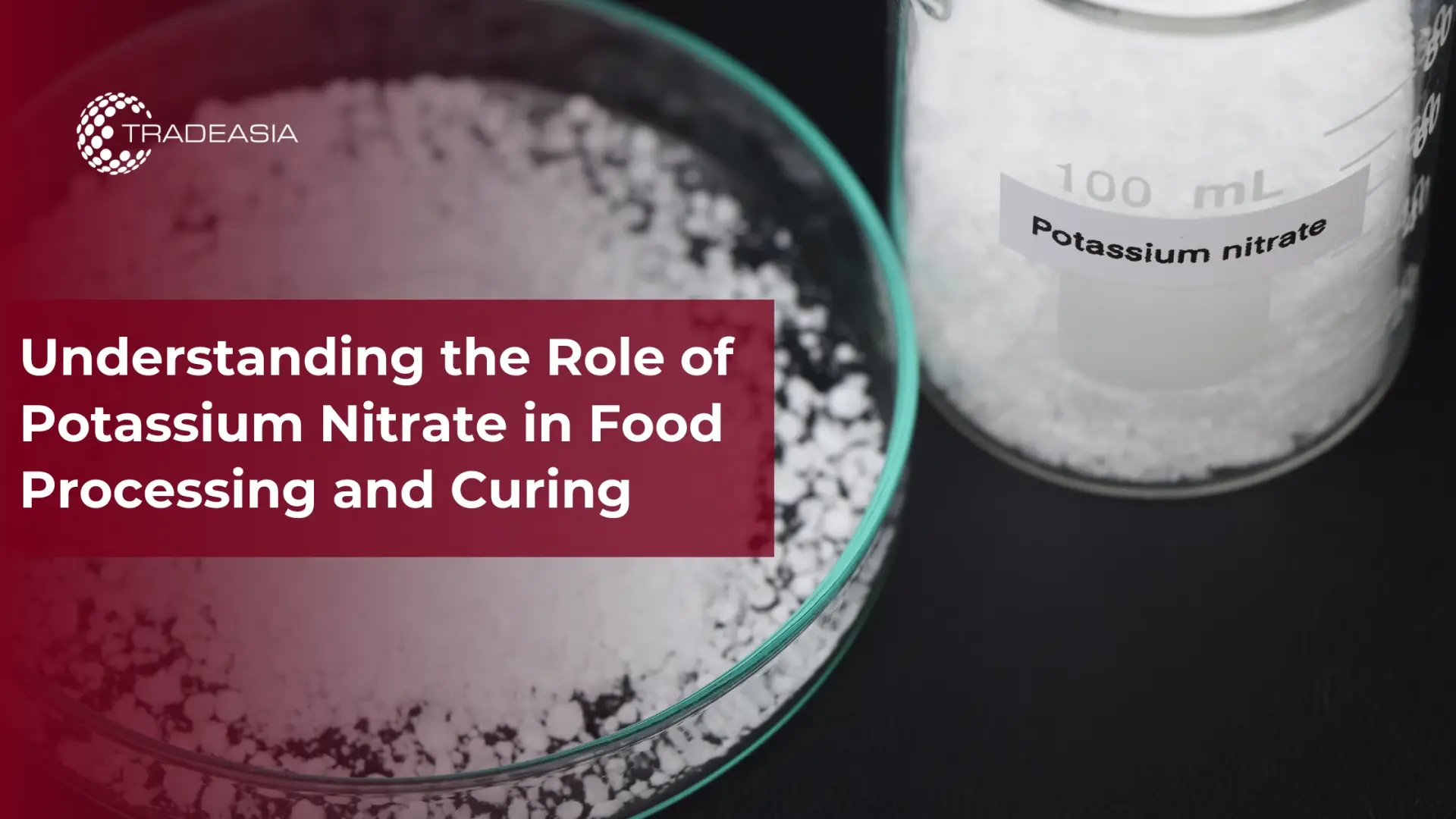
Potassium Nitrate (KNO₃), historically known as “saltpeter,” is a crystalline salt composed of potassium and nitrate ions. In food processing, it has long been used as a curing agent — especially in traditional and dry-cured meat products, some fish products, and certain cheeses. As a source of nitrate (NO₃⁻), potassium nitrate serves as a “reservoir” that under appropriate conditions can gradually convert to nitrite (NO₂⁻), the active substance that delivers many of the desired preservation, color, and safety effects in cured foods.
Slow-acting nitrate reservoir: When KNO₃ is added to meat (or fish/cheese), its nitrate content does not immediately cure the product. Instead, over time — often aided by naturally occurring bacteria — the nitrate is reduced to nitrite. This gradual conversion is especially useful for long-ripened or traditionally dry-cured products (e.g. salami, dry-cured ham), where slow, controlled curing ensures deeper penetration and uniformity.
Color development and stability: The nitrite, produced from the nitrate, is then chemically converted (through nitric oxide, NO) to bind with meat pigments (myoglobin), forming stable nitrosomyoglobin or nitroso-heme pigments. These compounds give cured meats their characteristic pink or reddish color — a color that remains stable even after cooking or prolonged storage.
Antimicrobial and preservation effect: Nitrite (derived from nitrate) acts to suppress or inhibit growth of certain pathogenic or spoilage microbes — especially anaerobic bacteria such as Clostridium botulinum — reducing the risk of foodborne illness and extending shelf life. This remains one of the most important food-safety benefits of nitrate/nitrite curing.
Flavor and rancidity control: Beyond safety and color, curing with nitrate/nitrite also helps develop the characteristic “cured meat” flavors and helps stabilize lipids (fats) against oxidation — which reduces rancidity or off-flavors over time. Because potassium nitrate acts as a slow-release nitrate source, it supports gradual flavor development over extended curing or aging periods.
Potassium nitrate’s use remains relevant mainly in the following areas:
Dry-cured meats and charcuterie: Products like salami, dry sausages, dry-cured hams, and other long-aged meats often rely on nitrate (via potassium nitrate or sodium nitrate) as part of their traditional curing salt mixture.
Cured fish or seafood products (in some jurisdictions): In certain fish products, nitrate/nitrite salts may be used to preserve, stabilize color, and reduce microbial spoilage.
Cheese and aged dairy products: In some traditional cheese-making processes, nitrates (including from potassium nitrate) can be used to prevent undesirable microbial activity during ripening — though usage depends heavily on regulation and local food-safety standards.
Artisanal and heritage-style foods: Small-scale or artisanal producers often continue to use potassium nitrate for its slow-acting, traditional curing properties — especially where long curing/aging, flavor depth, and authentic methods are valued.
While potassium nitrate offers many benefits in food processing, its use is closely regulated — and for good reason:
Because nitrate itself is not active: the real “curing effect” comes from nitrite, which must be generated — a process depending on microbial activity and environmental conditions. That makes outcomes more variable and harder to control compared with using nitrite salts directly.
Potential for harmful byproducts: Under some conditions (especially high-temperature cooking), nitrites/nitrates in cured foods can lead to the formation of nitrosamines, which are compounds associated with increased health risk. For that reason many regulatory bodies limit the amount of nitrate/nitrite that may be added or may remain (residual) in final products.
Slow and inconsistent curing: Because conversion from nitrate → nitrite (→ nitric oxide → pigment) depends on microbial reduction and diffusion, curing takes longer and results may be uneven — especially in large cuts of meat or products with low microbial activity.
Changing consumer preferences and “clean-label” trends: Some modern consumers avoid foods cured with synthetic nitrates/nitrites (or labeled “with nitrates/nitrites”), pushing producers to find alternative methods or limit additive use.
Potassium nitrate remains a valuable, historically proven, multifunctional food additive for curing, preserving, and stabilizing meat, fish, and some dairy products — especially in contexts where long curing or aging, stable color, flavor depth, and extended shelf life matter. Its role as a slow-release nitrate source allows traditional curing methods to remain viable.
However — because its effectiveness depends on microbial conversion, and because of safety/regulatory concerns around nitrite/nitrate residues and byproducts — its use must be carefully controlled, transparently labeled, and complemented with good manufacturing practices. For many modern, fast-turnover processed meats, direct nitrite salts or other preservation methods may be preferred; but for artisanal, long-aged, or heritage-style products, potassium nitrate retains relevance.
Source
https://www.sciencedirect.com/science/article/pii/S0309174007001994
https://www.sciencedirect.com/topics/immunology-and-microbiology/potassium-nitrate
https://www.foodpreserving.org/2014/11/preservatives-in-meat.html
We're committed to your privacy. Tradeasia uses the information you provide to us to contact you about our relevant content, products, and services. For more information, check out our privacy policy.


 English
 Indonesian
 简体字
简体字
 العربية
 Español
 Français
 Português
 日本語
日本語
 한국어
한국어
 Tiếng Việt



















