Explore our network of country and industry based websites to access localized information, product offerings, and business services across our group.
Log in to start sending quotation requests for any product.
Don't have an account? Sign Up Here
Home How Acetic Acid Supply Chains Are Adapting to Global Trade Shifts
Trade Insights | Supply Chain | 13 May 2026
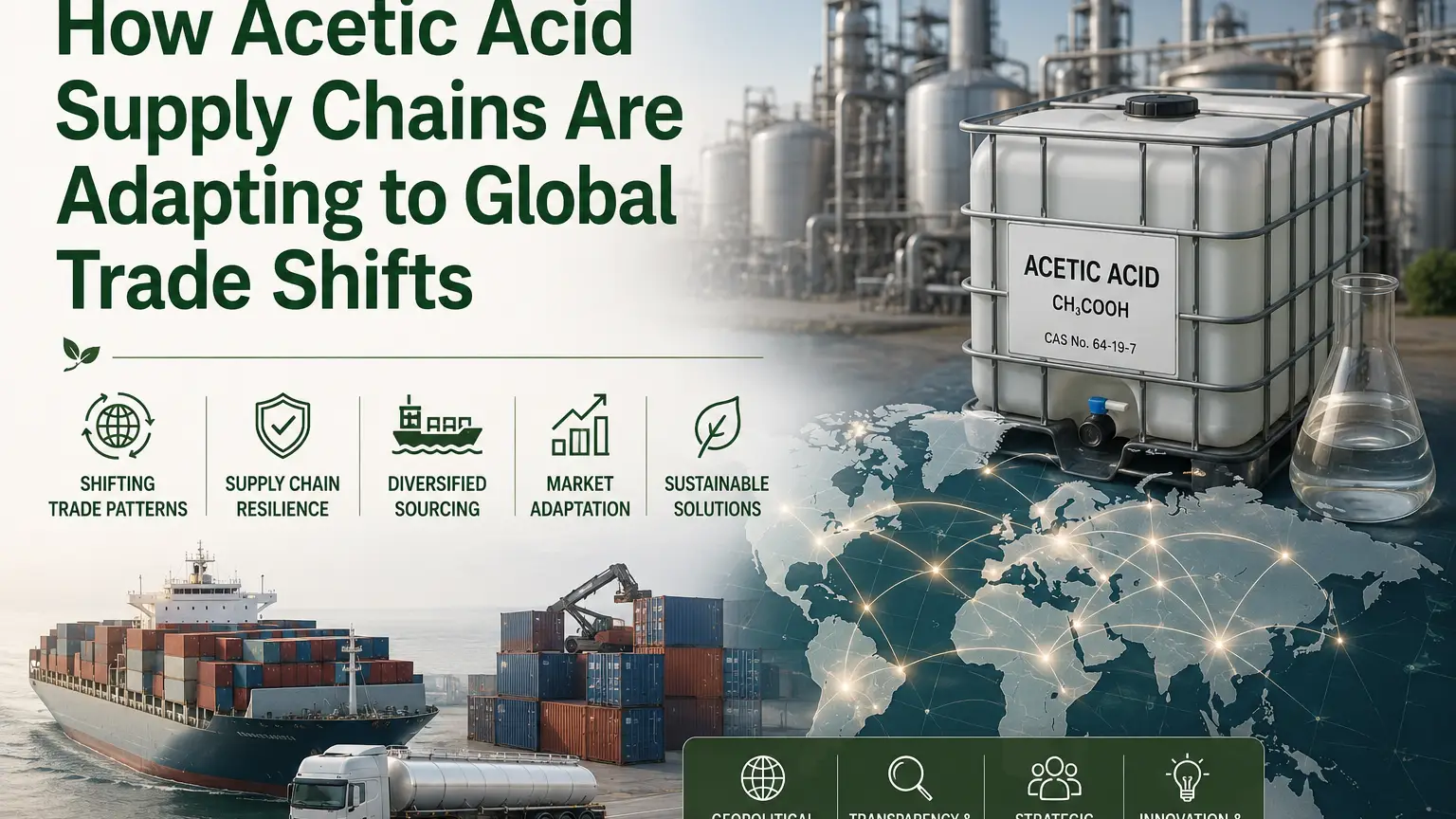
The Growing Importance of Acetic Acid in Global Industries
Trade Policy Changes Reshaping Chemical Supply Networks
Logistics and Freight Challenges Affecting Supply Continuity
Regional Production Shifts and Market Diversification
Sustainability Pressures Influencing Supply Chain Decisions
Digitalization and Supply Chain Visibility in Chemical Trade
Conclusion
The global acetic acid market is undergoing a period of transformation as shifting trade policies, logistics disruptions, and evolving industrial demand continue to reshape supply chain strategies. Acetic acid, widely used in the production of vinyl acetate monomer, purified terephthalic acid, solvents, and food additives, remains a critical raw material across multiple industries. However, increasing geopolitical tensions, freight volatility, and regional manufacturing realignments are compelling producers and distributors to rethink how products move across international markets.
As manufacturers seek greater resilience and operational flexibility, supply chain adaptation has become essential for maintaining stable pricing, reliable delivery, and long-term competitiveness in the acetic acid sector.
Acetic acid continues to experience steady demand growth due to its essential role in textiles, packaging, paints, adhesives, pharmaceuticals, and food processing. Emerging economies across Asia-Pacific and the Middle East are driving increased consumption as industrial manufacturing activities expand. This growing demand places additional pressure on suppliers to maintain uninterrupted raw material flows while balancing cost efficiency and product availability.
Manufacturers are now prioritizing strategic sourcing and inventory optimization to reduce vulnerabilities associated with global market uncertainty.
Recent changes in international trade regulations and tariffs have significantly influenced chemical procurement strategies. Countries are increasingly implementing localized manufacturing incentives and stricter import controls, encouraging businesses to diversify supplier bases beyond traditional production hubs.
For acetic acid suppliers, this means developing alternative sourcing channels and strengthening regional partnerships. Companies that previously depended heavily on single-country sourcing models are now expanding procurement across multiple regions to minimize exposure to geopolitical disruptions and fluctuating trade conditions.
Global logistics disruptions have become one of the largest operational concerns within the chemical industry. Port congestion, container shortages, rising fuel prices, and extended shipping lead times have all contributed to supply instability in recent years.
Acetic acid producers and distributors are responding by improving warehousing capabilities and adopting more flexible transportation strategies. Many businesses are also increasing local inventory levels near high-demand industrial zones to avoid production interruptions caused by delayed international shipments.
Reliable logistics partnerships are now considered a competitive advantage in maintaining stable supply chain performance.
The global acetic acid market is witnessing a gradual shift toward regional production diversification. While Asia remains a dominant manufacturing center, companies are increasingly exploring investments in the Middle East, Southeast Asia, and other emerging industrial regions.
This diversification strategy helps reduce dependency on concentrated production areas while improving supply responsiveness to regional customers. Countries with expanding petrochemical infrastructure are becoming attractive destinations for chemical manufacturers seeking stable feedstock access and favorable export opportunities.
As a result, regional supply networks are becoming more interconnected and strategically balanced.
Environmental regulations and sustainability initiatives are also shaping modern acetic acid supply chains. Industrial buyers are placing greater emphasis on responsible sourcing, emissions reduction, and environmentally compliant logistics operations.
Chemical producers are investing in cleaner manufacturing technologies and energy-efficient transportation solutions to align with evolving sustainability expectations. Businesses that integrate sustainable supply chain practices are increasingly viewed as preferred partners among multinational manufacturers seeking greener procurement solutions.
Sustainability is no longer only a compliance issue; it has become a strategic factor influencing long-term supplier relationships.
Digital transformation is playing a growing role in improving supply chain resilience within the chemical sector. Advanced analytics, real-time shipment tracking, and predictive demand forecasting are enabling companies to respond more quickly to market fluctuations and operational disruptions.
Digital supply chain platforms also provide greater transparency across procurement, inventory management, and customer communication processes. For acetic acid distributors, enhanced visibility supports faster decision-making and improved service reliability in increasingly competitive markets.
Technology adoption is expected to remain a key driver of efficiency and supply chain agility across the global chemical industry.
As global trade dynamics continue to evolve, acetic acid supply chains are adapting through diversification, digitalization, and stronger regional partnerships. Businesses that embrace flexible sourcing strategies and resilient logistics frameworks will be better positioned to manage uncertainty while meeting growing industrial demand.
For companies seeking dependable chemical sourcing and international distribution support, Tradeasia International continues to provide integrated supply chain solutions tailored to the evolving needs of global industries. With an extensive distribution network and market expertise, the company supports businesses in maintaining stable and efficient access to essential industrial chemicals.
Sources :
We're committed to your privacy. Tradeasia uses the information you provide to us to contact you about our relevant content, products, and services. For more information, check out our privacy policy.


 English
 Indonesian
 简体字
简体字
 العربية
 Español
 Français
 Português
 日本語
日本語
 한국어
한국어
 Tiếng Việt



















