Explore our network of country and industry based websites to access localized information, product offerings, and business services across our group.
Log in to start sending quotation requests for any product.
Don't have an account? Sign Up Here
Home End-to-End The Processing Chain Mapping of Bovine Gelatin
Trade Insights | Supply Chain | 04 May 2026
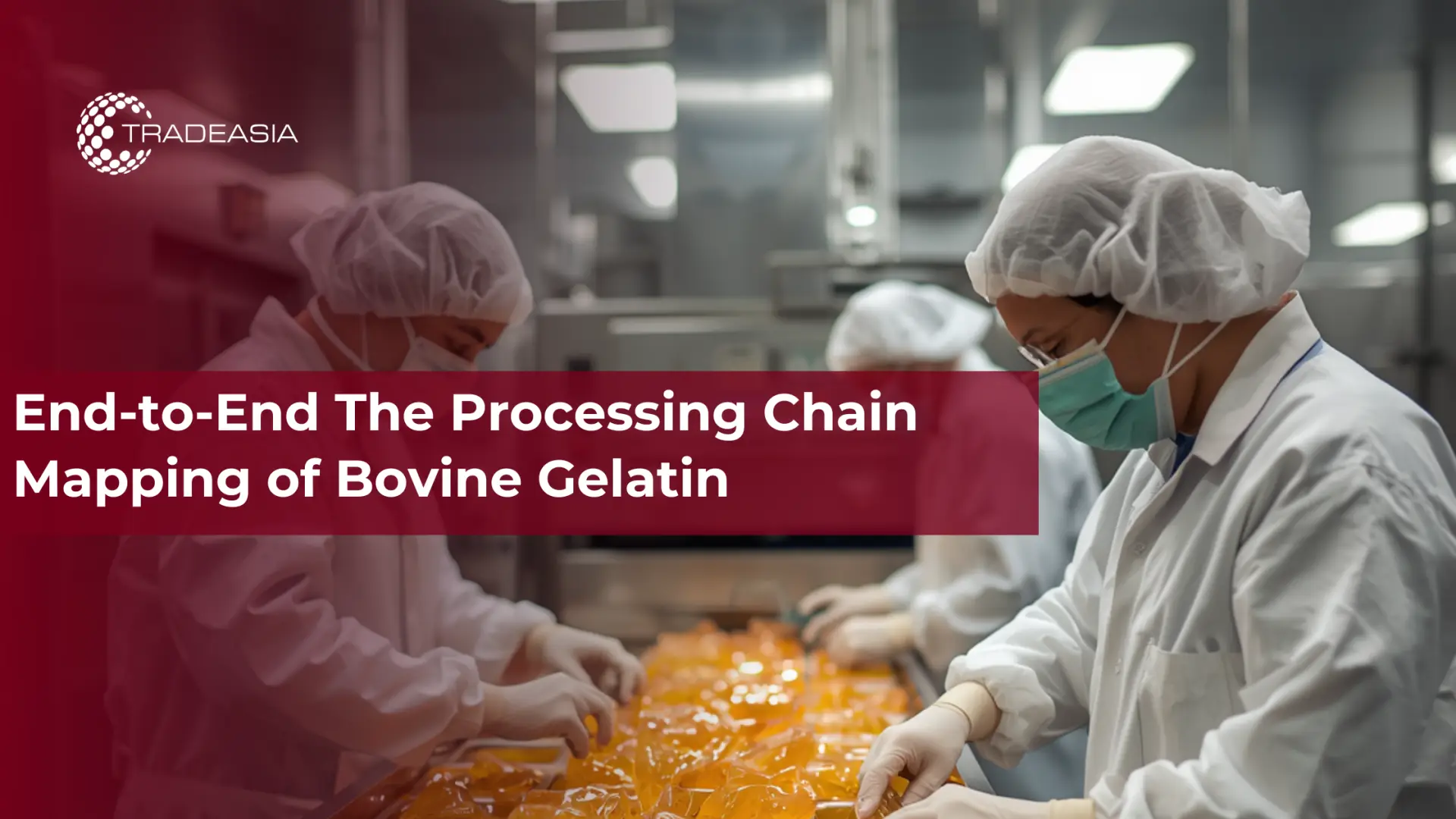
Bovine gelatin represents one of the most compelling examples of value creation within the global food and pharmaceutical supply chain, where low-value animal by-products are transformed into highly functional, high-demand ingredients. Derived from collagen found in bovine bones and hides, gelatin is widely used across industries ranging from confectionery and dairy to pharmaceuticals and nutraceuticals. Its unique ability to form thermo-reversible gels, stabilize emulsions, and enhance texture has made it indispensable in modern formulation science.
At the core of this transformation lies a complex and highly controlled processing chain that begins at the slaughterhouse and extends through multiple stages of extraction, purification, concentration, and drying. Unlike many plant-based hydrocolloids, gelatin production depends on the integration of upstream livestock industries with downstream processing infrastructure. This interconnected system requires not only technical precision but also strict adherence to safety, traceability, and quality standards.
One of the defining characteristics of bovine gelatin production is the use of two primary extraction pathways: acid processing (Type A gelatin) and alkaline processing (Type B gelatin). Each method is associated with specific raw materials, processing timelines, and functional outcomes, which in turn influence the suitability of the final product for different applications. In parallel, the industry differentiates between food-grade and pharmaceutical-grade gelatin, each of which must meet distinct regulatory and performance criteria.
As global demand for gelatin continues to grow—driven by expanding food applications, increasing use in capsules, and rising interest in collagen-based health products—the efficiency and reliability of the processing chain have become critical factors. Understanding how gelatin is produced, refined, and differentiated provides valuable insight into both its functional performance and its supply chain dynamics.
This article offers a comprehensive and detailed analysis of the bovine gelatin processing chain, examining each stage from raw material sourcing to final product classification. It explores the technological, operational, and quality considerations that define the industry, with a particular focus on extraction methods and grade differentiation.
The production of bovine gelatin begins with the collection of raw materials from the meat processing industry, primarily in the form of bones and hides. These materials are by-products of cattle slaughter and are typically sourced from regulated slaughterhouses that comply with veterinary and food safety standards. The availability and quality of these raw materials are directly linked to the scale and structure of the global cattle industry, making gelatin production inherently dependent on livestock supply chains.
Bovine hides are generally used for acid processing, while bones are more commonly associated with alkaline processing. Each raw material presents distinct characteristics in terms of collagen content, structure, and impurity levels. Hides contain relatively pure collagen fibers, which makes them suitable for shorter processing cycles. Bones, on the other hand, contain mineral components such as calcium phosphate, which must be removed during processing, resulting in longer and more complex treatment.
The quality of raw materials is a critical determinant of the final gelatin properties. Factors such as animal age, breed, and handling conditions can influence collagen structure and, consequently, extraction efficiency. In addition, strict traceability systems are required to ensure compliance with safety regulations, particularly in relation to risks such as bovine spongiform encephalopathy (BSE). This necessitates careful sourcing and documentation throughout the supply chain.
Before collagen can be extracted, raw materials must undergo extensive pre-treatment to remove impurities and prepare the structure for subsequent processing. This stage is essential for ensuring both product quality and process efficiency.
For bovine bones, the pre-treatment process typically begins with cleaning and degreasing. Bones are crushed into smaller pieces to increase surface area and then subjected to hot water or solvent extraction to remove fats. Following this, a demineralization step is carried out using dilute acid, usually hydrochloric acid, to dissolve inorganic components and produce a material known as ossein. This step is critical for exposing the collagen matrix and enabling effective extraction.
In the case of hides, pre-treatment involves washing, liming, and neutralization. The liming process uses alkaline solutions to remove hair, fats, and non-collagenous proteins, while also swelling the collagen fibers. This prepares the material for acid treatment and subsequent extraction.
These pre-treatment steps are not only necessary for functional reasons but also play a key role in ensuring microbiological safety and consistency. Any variation in pre-treatment conditions can affect downstream processing and final product quality.
The core of gelatin production lies in the extraction of collagen, which is achieved through either acid or alkaline processing. These two methods differ significantly in terms of raw materials, processing time, and resulting gelatin properties.
Acid processing, used to produce Type A gelatin, is typically applied to bovine hides. In this method, the pre-treated hides are soaked in dilute acid solutions for a relatively short period, often ranging from several hours to a few days. The acid treatment breaks down cross-links in the collagen structure, allowing it to be converted into gelatin upon heating. The extraction itself is carried out by heating the material in water at controlled temperatures, resulting in the release of gelatin into the solution.
Alkaline processing, used for Type B gelatin, is more commonly applied to bovine bones and involves a much longer treatment period. The raw material is soaked in alkaline solutions, such as lime, for several weeks or even months. This extended treatment breaks down more stable cross-links in the collagen structure, making it suitable for extraction. The subsequent extraction process is similar to that used in acid processing but typically requires more controlled conditions due to the nature of the raw material.
The choice between acid and alkaline processing has a direct impact on the functional properties of the gelatin. Type A gelatin generally has a higher isoelectric point and different gelation characteristics compared to Type B gelatin. These differences influence how the gelatin behaves in various applications, making the selection of extraction method a critical decision in production.
Once the gelatin has been extracted into solution, it must undergo a series of purification steps to remove impurities and achieve the desired level of quality. This stage is particularly important for ensuring compliance with food and pharmaceutical standards.
The purification process typically includes filtration, deionization, and sterilization. Filtration removes solid particles and residual impurities, while deionization eliminates dissolved salts and other ionic contaminants. Advanced filtration techniques, such as ultrafiltration, may also be used to control molecular weight distribution and improve product consistency.
Sterilization is carried out to ensure microbiological safety, often using high-temperature treatments. This step is critical for meeting regulatory requirements and ensuring that the final product is safe for consumption or pharmaceutical use.
The purified gelatin solution is then concentrated through evaporation, reducing its water content and preparing it for drying. Throughout this process, strict quality control measures are applied to monitor parameters such as viscosity, gel strength, and microbial load.
The final stage of gelatin production involves drying the concentrated solution to produce a stable, solid product. This is typically achieved through methods such as drum drying or belt drying, which remove moisture while preserving the functional properties of the gelatin.
The dried gelatin is then ground into powder or processed into sheets or granules, depending on the intended application. Particle size and physical form are important considerations, as they affect solubility, handling, and performance in formulation.
At this stage, the product is also standardized to ensure consistent quality. This may involve blending different batches to achieve specific Bloom values or other functional characteristics. Packaging is carried out under controlled conditions to prevent contamination and maintain product integrity.
A key aspect of the gelatin industry is the differentiation between food-grade and pharmaceutical-grade products. While both types are derived from the same raw materials, they are subject to different processing requirements and quality standards.
Food-grade gelatin is used in applications such as confectionery, dairy, and processed foods, where functional performance and sensory properties are the primary considerations. Regulatory requirements focus on safety, purity, and labeling, but are generally less stringent than those for pharmaceutical products.
Pharmaceutical-grade gelatin, on the other hand, must meet highly rigorous standards related to purity, consistency, and biocompatibility. It is used in applications such as capsule shells, where precise performance and safety are critical. This requires additional processing steps, tighter quality control, and compliance with pharmacopeial standards.
The production of pharmaceutical-grade gelatin often involves more advanced purification techniques and stricter traceability requirements. As a result, it commands a higher price and occupies a premium segment of the market.
Beyond basic grade classification, gelatin products are further differentiated based on functional properties such as Bloom strength, viscosity, and clarity. These parameters determine how the gelatin performs in specific applications and are carefully controlled during production.
High Bloom gelatin is typically used in applications requiring strong gels and high elasticity, such as gummy candies and capsules. Lower Bloom gelatin is suitable for softer textures and applications where flexibility is required.
Viscosity is another important parameter, influencing the behavior of gelatin solutions during processing and application. Clarity is particularly important in products such as desserts and aspics, where visual appearance is a key quality attribute.
Manufacturers must carefully match these properties to application requirements, often working closely with customers to develop customized solutions.
The production of bovine gelatin is a highly sophisticated process that transforms raw animal by-products into versatile and high-value functional ingredients. From raw material sourcing and pre-treatment to extraction, purification, and final processing, each stage plays a critical role in determining product quality and performance.
The distinction between acid and alkaline processing highlights the importance of technological choice in shaping gelatin properties, while the differentiation between food and pharmaceutical grades underscores the diversity of applications and market requirements.
As demand for gelatin continues to grow across multiple industries, the efficiency, scalability, and quality control of the processing chain will remain central to the industry’s success. Understanding this complex system is essential for manufacturers, suppliers, and buyers seeking to navigate the evolving landscape of global gelatin production.
For businesses seeking high-quality Bovine Gelatin or other food ingredients products and reliable sourcing solutions, visit foodingredientsasia.com for more information about specifications, applications, and supply capabilities. For direct inquiries, product details, or customized requirements, please contact food@chemtradeasia.com. Our team is ready to assist you with professional support and comprehensive solutions tailored to your needs.
We're committed to your privacy. Tradeasia uses the information you provide to us to contact you about our relevant content, products, and services. For more information, check out our privacy policy.


 English
 Indonesian
 简体字
简体字
 العربية
 Español
 Français
 Português
 日本語
日本語
 한국어
한국어
 Tiếng Việt



















