Explore our network of country and industry based websites to access localized information, product offerings, and business services across our group.
Log in to start sending quotation requests for any product.
Don't have an account? Sign Up Here
Home Citric Acid Anhydrous Supply Chain Market Outlook
Trade Insights | Supply Chain | 27 February 2026
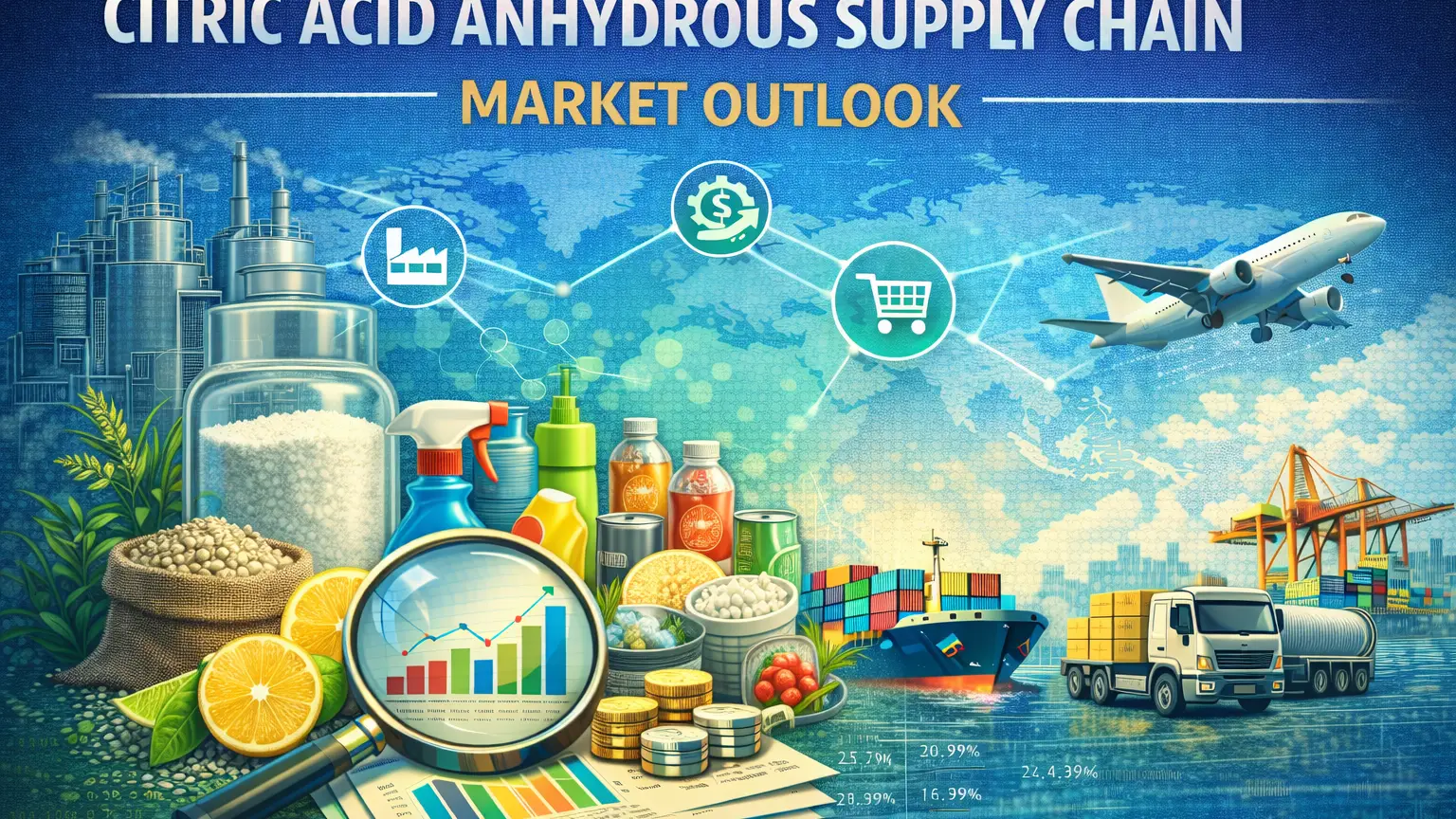
The citric acid anhydrous supply chain in 2026 has evolved into a structurally mature yet geopolitically sensitive ecosystem. As a cornerstone ingredient in food processing, beverages, pharmaceuticals, and industrial formulations, citric acid continues to demonstrate its importance as both a commodity chemical and a strategic procurement item. Market participants are increasingly treating it not just as an input, but as a supply chain risk indicator reflecting broader agro-industrial dynamics.
Across global markets, demand remains firmly anchored in processed food expansion and clean-label reformulation trends. However, supply stability is increasingly dictated by upstream agricultural inputs and regional production concentration. As documented in recent industry analyses, Asia-Pacific continues to dominate global output, reinforcing its position as the backbone of international distribution networks .
The global citric acid anhydrous supply chain remains heavily concentrated in Asia, particularly China and India, which collectively supply more than half of worldwide production. This concentration creates a dual dynamic: cost efficiency on one hand and systemic dependency on the other.
By 2026, Asia-Pacific producers have strengthened their dominance through fermentation optimization and large-scale capacity integration. However, this dominance also means downstream regions such as Europe and North America remain structurally import-dependent. This dependency has encouraged multinational buyers to diversify sourcing strategies, balancing cost advantages with geopolitical and logistical risk exposure.
The result is a supply chain increasingly characterized by “hub-and-spoke” trade flows, where Asia acts as the primary production hub while consumption markets rely on layered distributor networks for continuity and compliance assurance.
One of the most critical factors shaping the citric acid anhydrous supply chain is feedstock sensitivity. As a fermentation-based product, its cost structure is closely tied to agricultural commodities such as corn, sugar, and molasses. In 2026, this dependency continues to amplify pricing variability across regions.
Fluctuations in crop yields, energy inputs, and agricultural trade policies directly influence production economics. Even marginal shifts in corn or sugar availability can propagate across the entire value chain, impacting contract pricing and procurement stability. Industry data confirms that feedstock costs remain one of the most significant drivers of overall production expense volatility .
As a result, suppliers and buyers are increasingly adopting indexed pricing models and long-term contracts to mitigate exposure to raw material cycles. This shift reflects a broader trend toward financialization and risk-sharing within chemical procurement ecosystems.
Logistics has become a defining pillar of citric acid supply chain competitiveness in 2026. While production remains relatively concentrated, distribution networks have become more diversified, with improved shipping reliability and regional warehousing reducing previous bottlenecks.
Freight normalization post-global disruptions has helped stabilize supply timelines, but variability still exists in lead times due to port congestion, regulatory inspections, and container imbalances. These challenges have elevated the importance of supply chain resilience strategies, including multi-origin sourcing and distributed inventory management.
Digital procurement platforms and predictive logistics analytics are also reshaping how buyers manage procurement cycles. Instead of reactive purchasing, companies are increasingly leveraging forward-looking demand modeling to stabilize input costs and ensure continuity across production lines.
The citric acid anhydrous supply chain in 2026 reflects a mature yet strategically fragile global system. While production efficiency has improved significantly, structural dependencies on Asia-Pacific manufacturing and agricultural feedstocks continue to define market behavior. At the same time, logistics modernization and contract-based procurement strategies are gradually reducing volatility exposure for industrial buyers.
In this evolving landscape, global enterprises are prioritizing partners capable of integrating sourcing intelligence, logistics coordination, and supply risk mitigation into a unified procurement framework. Tradeasia International positions itself within this space as a global chemical solution provider, supporting industrial buyers with consistent sourcing access, market insight, and end-to-end supply chain facilitation across key citric acid markets.
Sources:
We're committed to your privacy. Tradeasia uses the information you provide to us to contact you about our relevant content, products, and services. For more information, check out our privacy policy.


 English
 Indonesian
 简体字
简体字
 العربية
 Español
 Français
 Português
 日本語
日本語
 한국어
한국어
 Tiếng Việt



















