Explore our network of country and industry based websites to access localized information, product offerings, and business services across our group.
Log in to start sending quotation requests for any product.
Don't have an account? Sign Up Here
Home Citric Acid Monohydrate: The Versatile Powerhouse in Food
Trade Insights | Supply Chain | 08 April 2026
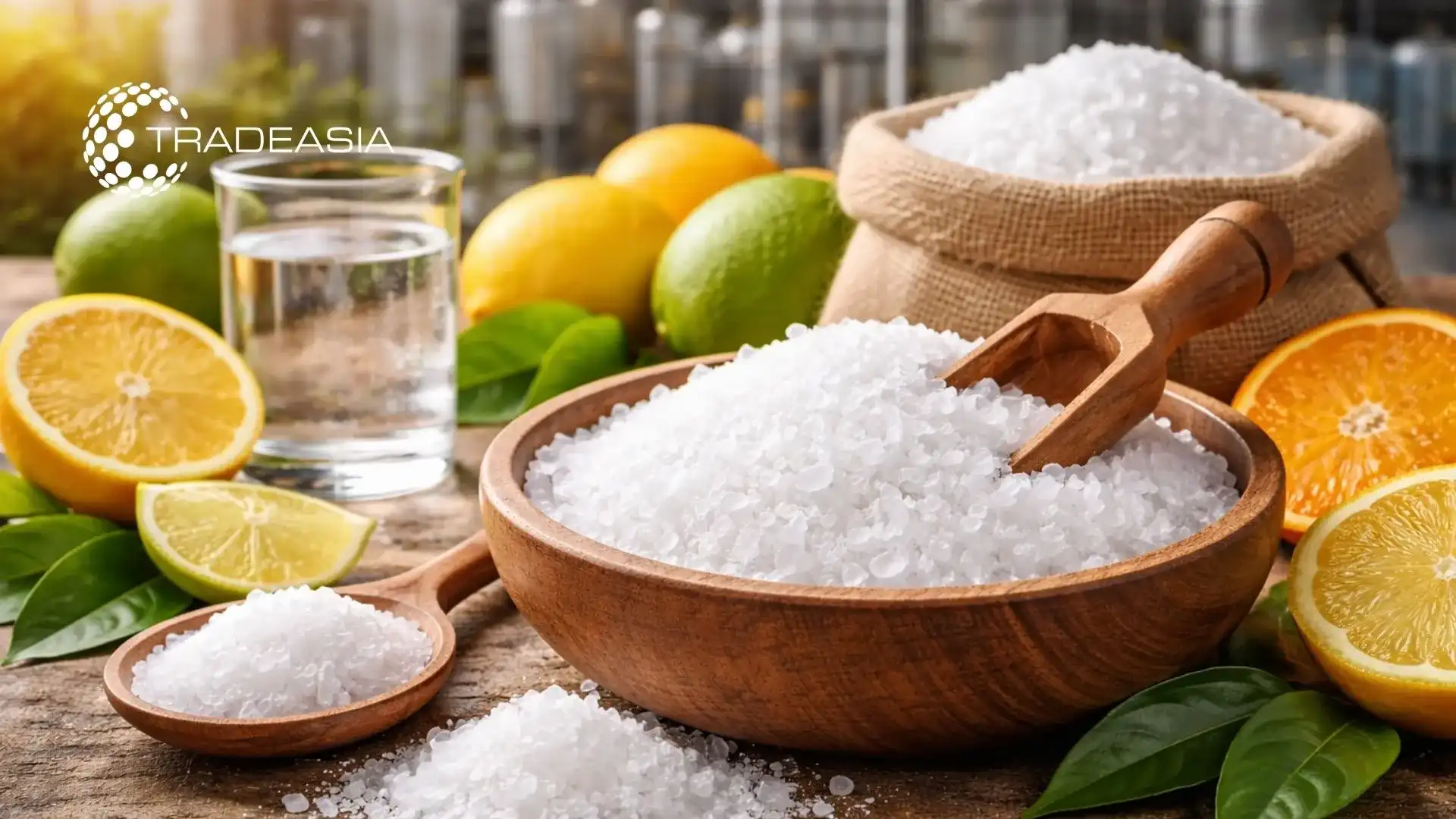
Introduction Citric Acid Monohydrate
What is Citric Acid Monohydrate?
Key Applications in the Food & Beverage Industry
Benefits and Functional Properties
Global Market Trends and Supply Chain Insights
Sourcing and Quality Considerations
Conclusion
The global food industry is a complex ecosystem driven by consumer demand for safety, quality, taste, and extended shelf life. At the heart of meeting these demands lies a category of unsung heroes: food additives. Among these, Citric Acid Monohydrate stands out as one of the most ubiquitous and versatile ingredients. This organic acid, naturally found in citrus fruits, is produced on an industrial scale through microbial fermentation, making it a cost-effective and consistent workhorse for food manufacturers worldwide.
From the tangy zest in your soft drink to the preserved color in your jar of peaches, Citric Acid Monohydrate plays multiple critical roles. Its importance transcends mere flavoring; it is a key player in food preservation, pH control, and texture modification. For procurement specialists, supply chain managers, and product developers, understanding this compound is essential for navigating formulation challenges, ensuring regulatory compliance, and securing a stable supply in a dynamic global market. This article delves deep into the science, applications, benefits, and market dynamics of this indispensable food additive.
Citric Acid Monohydrate (C6H8O7·H2O) is the crystalline form of citric acid that contains one molecule of water of hydration. This differentiates it from its anhydrous counterpart, which lacks the water molecule. The monohydrate form is typically produced by crystallizing citric acid from a cold water solution. It appears as colorless, odorless crystals or a white crystalline powder with a strongly acidic taste. While both forms are functionally similar in many applications, the monohydrate is often preferred in certain food and pharmaceutical processes due to its consistent solubility and handling characteristics under specific environmental conditions.
From a specification standpoint, high-grade Citric Acid Monohydrate for food use must meet stringent purity criteria as outlined by standards such as the Food Chemicals Codex (FCC), USP, or EU food-grade regulations. Key parameters include assay (typically not less than 99.5%), limits on heavy metals like lead and arsenic, oxalate, sulfate, and readily carbonizable substances. Its solubility in water is excellent, and it decomposes at higher temperatures, losing its water of crystallization around 70-75°C before eventually melting and decomposing at much higher temperatures. This predictable behavior makes it a reliable ingredient in thermal processing.
The functionality of Citric Acid Monohydrate makes it a cornerstone in numerous food and beverage segments. In the beverage industry, it is the primary acidulant, providing the sharp, refreshing tartness in soft drinks, fruit juices, energy drinks, and ready-to-drink teas. It enhances fruit flavors, balances excessive sweetness, and acts as a preservative by creating an acidic environment that inhibits microbial growth. Its synergy with antioxidants like ascorbic acid helps prevent browning in freshly cut or processed fruits and vegetables, a critical application in the fresh-cut produce sector.
Beyond beverages, its applications are vast. In confectionery, it imparts a sour taste to candies like gummies and hard sweets, while also acting as a buffering agent. In jams, jellies, and preserves, it is crucial for achieving the correct gel set with pectin, which requires a specific pH range. The dairy industry utilizes it in processed cheese production as an emulsifying salt, helping to create a smooth, homogeneous texture. In the baking industry, it serves as a leavening agent when combined with baking soda in some mixes, and in fats and oils, it acts as a sequestrant to inactivate metal ions that can catalyze rancidity, thereby extending shelf life.
The widespread use of Citric Acid Monohydrate is justified by a suite of powerful functional properties. First and foremost is its role as a highly effective acidulant. It provides a clean, rapid, and pronounced sour taste that is readily acceptable to consumers globally, making it superior to many other acidulants for flavor profiling. Secondly, its function as a pH regulator and buffer is indispensable. Many food processes, such as gelling with pectin or the effectiveness of certain preservatives, are pH-dependent; citric acid allows precise control over this critical parameter.
Another paramount benefit is its chelating or sequestering ability. Citric Acid Monohydrate binds to metal ions like iron and copper. This action prevents catalytic oxidation (which causes off-flavors and color loss) in oils, beverages, and canned goods, thereby significantly enhancing shelf stability and maintaining sensory quality. Furthermore, it acts as a synergist for antioxidants and, in some meat products, can help improve curing color and stability. Its status as a naturally occurring substance (when produced via fermentation) aligns with the growing consumer preference for "clean-label" or naturally derived ingredients, adding to its market appeal.
The global market for Citric Acid Monohydrate is substantial and growing, driven by rising demand for processed foods, beverages, and convenience products, particularly in emerging economies in Asia-Pacific and Latin America. According to recent market analyses, the global citric acid market was valued at over USD 3.5 billion in 2023 and is projected to grow at a steady CAGR. The food and beverage segment accounts for the largest share of this consumption. A key trend is the shift in production geography. While China remains the dominant producer, accounting for a significant majority of global output, there is a growing strategic emphasis on supply chain diversification.
Recent global events have highlighted vulnerabilities in concentrated supply chains, prompting manufacturers in North America and Europe to seek more regional or multi-sourced supply options for critical ingredients like Citric Acid Monohydrate. Price volatility, influenced by the cost of raw materials (primarily corn-based substrates for fermentation), energy, and logistics, remains a constant consideration for buyers. Furthermore, sustainability is becoming a key differentiator. Producers are increasingly investing in greener production processes, waste reduction, and sustainable sourcing of raw materials to meet the environmental, social, and governance (ESG) criteria of large multinational food corporations.
For businesses integrating Citric Acid Monohydrate into their supply chain, selecting the right supplier is a strategic decision that impacts product quality, regulatory compliance, and operational continuity. A reliable supplier, such as Chemtradeasia, offers more than just a commodity; they provide assurance. Key considerations begin with certifications and compliance. The supplier must provide products that consistently meet relevant international standards (FCC, USP, BP, EP, JP, Halal, Kosher) and be able to furnish comprehensive documentation, including Certificates of Analysis (CoA) and Material Safety Data Sheets (MSDS/SDS).
Beyond paperwork, evaluating a supplier's technical support and logistics capability is crucial. Can they provide formulation assistance? Do they have robust quality control systems from raw material to finished product? What is their packaging flexibility (25kg bags, big bags, etc.) and global distribution network? In today's market, partners who offer market intelligence, transparent communication about supply conditions, and risk-mitigation strategies add immense value. Establishing a relationship with a knowledgeable global supplier ensures not just a transaction, but a partnership that can navigate market fluctuations and technical challenges effectively.
Citric Acid Monohydrate is far more than a simple souring agent. It is a multifunctional additive integral to the safety, stability, flavor, and appearance of a vast array of food and beverage products. Its unique combination of acidulating, chelating, buffering, and preservative properties makes it an irreplaceable tool for food scientists and manufacturers. As consumer trends evolve towards natural ingredients and extended shelf life, and as global supply chains face new pressures, the strategic importance of this compound only increases.
Understanding its applications, benefits, and the dynamics of its global market empowers industry professionals to make informed sourcing and formulation decisions. By partnering with credible and experienced global suppliers who prioritize quality, consistency, and supply chain resilience, businesses can leverage the full potential of Citric Acid Monohydrate to create successful, high-quality products for the global marketplace.
Disclaimer: The information presented in this article is for informational and market insight purposes only. It is not intended as technical, safety, or professional advice for specific formulations or applications. Specifications, regulations, and market conditions are subject to change. Readers are strongly advised to verify all information independently, consult official technical documentation (including the relevant Safety Data Sheet), and seek guidance from qualified professionals for their specific needs and circumstances. For precise product specifications and application suitability, please contact our technical team directly.
We're committed to your privacy. Tradeasia uses the information you provide to us to contact you about our relevant content, products, and services. For more information, check out our privacy policy.


 English
 Indonesian
 简体字
简体字
 العربية
 Español
 Français
 Português
 日本語
日本語
 한국어
한국어
 Tiếng Việt