Explore our network of country and industry based websites to access localized information, product offerings, and business services across our group.
Log in to start sending quotation requests for any product.
Don't have an account? Sign Up Here
Home Corn Steep Liquor Sourcing Guide: Industrial Applications and Markets
Trade Insights | Supply Chain | 03 July 2026
Understanding Corn Steep Liquor
Industrial Applications Across Key Markets
Global Market Trends and Demand
Buyer Intent and Procurement Considerations
Commercial Supply Chain and Sourcing Strategy
Future Outlook for Corn Steep Liquor
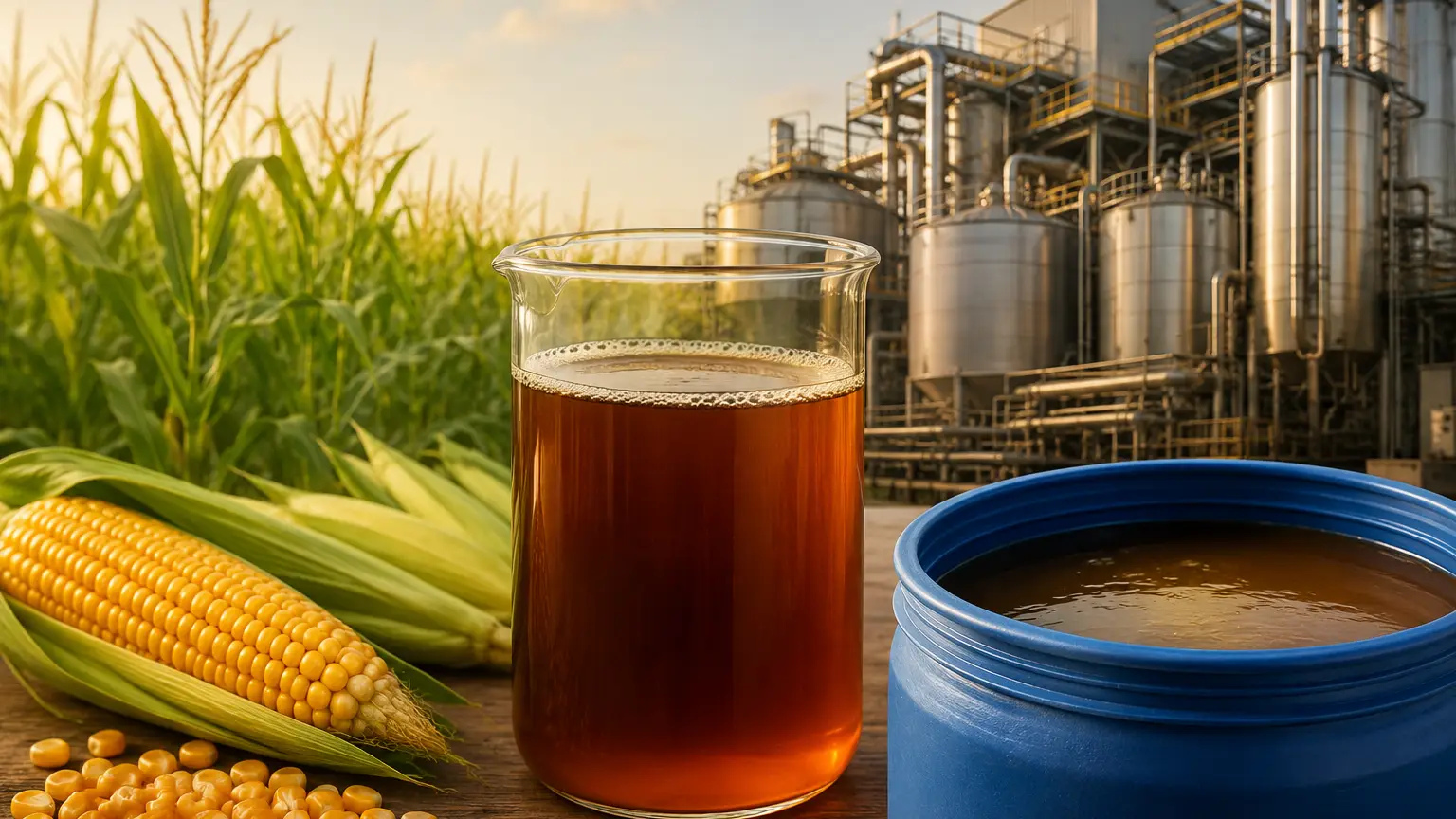
Corn Steep Liquor (CSL) is a nutrient-rich liquid generated during the wet milling of corn. It contains proteins, amino acids, vitamins, minerals, and organic compounds that make it valuable across several industrial sectors. As a cost-effective nutrient source, CSL supports biological growth processes while contributing to efficient utilization of agricultural by-products.
The production of Corn Steep Liquor begins during corn soaking, where soluble nutrients are extracted into water before starch separation. The resulting liquid becomes a concentrated source of nutrients suitable for industrial fermentation, animal nutrition, and agricultural applications.
According to the U.S. Department of Agriculture, corn processing continues to play an important role in supplying value-added co-products that improve sustainability throughout agricultural supply chains.
Its balanced nutritional composition provides manufacturers with an economical alternative to more expensive nutrient ingredients while supporting circular economy initiatives.
Corn Steep Liquor serves multiple industries because of its rich nutritional profile and affordability. Manufacturers rely on CSL to enhance microbial growth, improve feed formulations, and support agricultural productivity.
In industrial fermentation, Corn Steep Liquor functions as an excellent nutrient medium for producing enzymes, antibiotics, organic acids, ethanol, and microbial cultures. Biotechnology companies frequently incorporate CSL into fermentation media to reduce production costs without sacrificing nutrient availability.
Animal feed manufacturers use CSL as a protein-rich ingredient that contributes energy, minerals, and digestible nutrients in livestock feed formulations.
The Food and Agriculture Organization (FAO) highlights the importance of efficient feed ingredients and agricultural by-products in improving sustainability within global food production systems.
Agricultural producers also apply Corn Steep Liquor as an organic nutrient input to enhance soil fertility and microbial activity in certain fertilizer programs.
Growing interest in sustainable manufacturing has strengthened demand for industrial co-products such as Corn Steep Liquor. Companies increasingly seek renewable raw materials that improve production efficiency while reducing waste.
Fermentation industries continue expanding due to increasing production of bio-based chemicals, enzymes, pharmaceuticals, and renewable fuels. This trend creates stable demand for nutrient-rich fermentation ingredients including CSL.
The global animal nutrition industry also supports long-term consumption as feed manufacturers optimize cost-effective protein supplementation.
According to OECD-FAO Agricultural Outlook publications, increasing livestock production and bioeconomy investments continue influencing demand for agricultural processing co-products worldwide.
As environmental regulations encourage resource efficiency, Corn Steep Liquor remains commercially attractive because it utilizes existing agricultural value chains.
Industrial buyers evaluate Corn Steep Liquor based on both technical specifications and supply reliability. Procurement teams typically compare suppliers according to quality consistency, nutrient composition, logistics capability, and documentation.
Typical buyers include fermentation manufacturers, feed producers, biotechnology companies, agricultural input suppliers, distributors, and chemical trading organizations.
Procurement departments often assess moisture content, protein concentration, storage stability, microbiological quality, production origin, and available packaging before finalizing purchase decisions.
According to ASTM International and industry quality management practices, standardized specifications and supplier consistency remain essential for industrial raw material procurement.
A comprehensive product page enables buyers to compare technical information, request quotations, review specifications, and evaluate supplier capabilities more efficiently.
Corn Steep Liquor is traded globally through integrated agricultural processing and chemical distribution networks. Reliable sourcing minimizes production interruptions while supporting long-term manufacturing contracts.
Manufacturers frequently seek suppliers capable of maintaining consistent production volumes, export documentation, logistics coordination, and responsive technical support.
Distributors benefit from suppliers offering flexible packaging options, competitive pricing, stable inventory management, and international shipping experience.
According to International Trade Centre market guidance, resilient supply chains and diversified sourcing strategies have become increasingly important for industrial procurement organizations.
Tradeasia and Tradechem Marketplace support industrial buyers by connecting manufacturers, distributors, and procurement teams with reliable sourcing opportunities across international markets while facilitating commercial inquiries and supply chain communication.
Demand for Corn Steep Liquor is expected to remain positive as industries prioritize sustainable manufacturing, biotechnology expansion, and circular economy initiatives.
Growth in industrial biotechnology, renewable chemicals, livestock nutrition, and environmentally responsible agriculture continues creating new commercial opportunities for CSL suppliers and distributors.
Innovation within fermentation technologies is expected to increase utilization of nutrient-rich agricultural co-products that lower production costs while improving sustainability.
Industry analyses from organizations such as FAO and OECD suggest that agricultural processing co-products will continue supporting global food, feed, and bio-based manufacturing sectors.
For procurement professionals, selecting experienced suppliers with dependable logistics, consistent quality, and transparent documentation will remain critical as international sourcing requirements become increasingly sophisticated.
We're committed to your privacy. Tradeasia uses the information you provide to us to contact you about our relevant content, products, and services. For more information, check out our privacy policy.


 English
 Indonesian
 简体字
简体字
 العربية
 Español
 Français
 Português
 日本語
日本語
 한국어
한국어
 Tiếng Việt



















