Explore our network of country and industry based websites to access localized information, product offerings, and business services across our group.
Log in to start sending quotation requests for any product.
Don't have an account? Sign Up Here
Home Maize Starch Market : Trends & Global Outlook
Trade Insights | Supply Chain | 31 March 2026
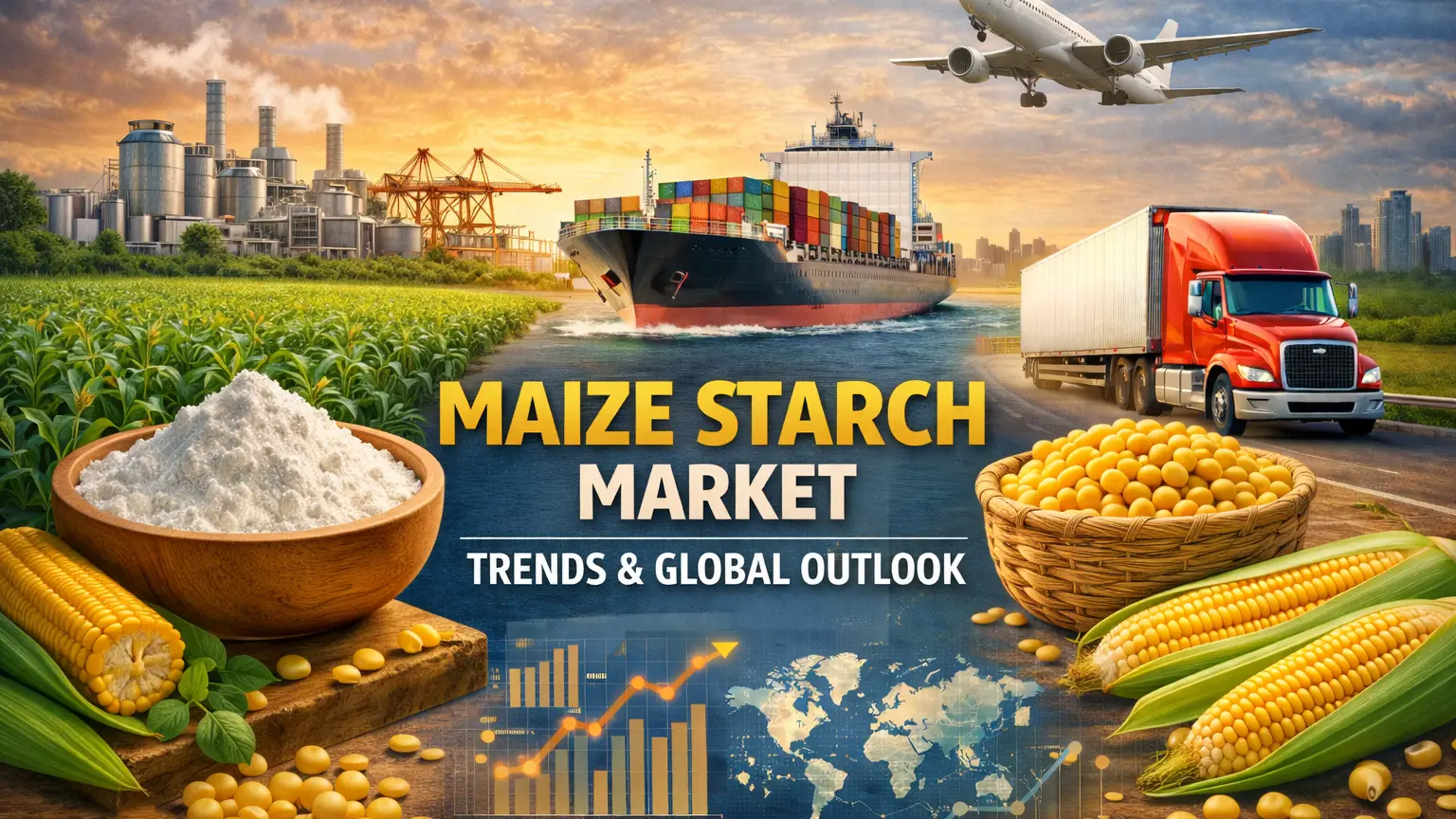
The maize starch supply chain in 2026 stands at a critical inflection point, shaped by agricultural volatility, shifting trade flows, and expanding industrial demand. Once a relatively stable commodity segment, maize starch has evolved into a strategic raw material supporting food processing, pharmaceuticals, packaging, and bio-based industries. With the global market valued at over USD 29 billion and projected for steady growth, supply chain resilience has become a defining competitive factor.
The maize starch market is experiencing heightened cost volatility driven by logistics inefficiencies and freight instability. Shipping disruptions and fluctuating container rates have forced buyers to shift away from lean inventory models toward buffer stocking strategies. This transition has tightened spot availability and amplified short-term pricing fluctuations.
At the same time, processors are facing margin compression as raw material costs rise faster than downstream contract adjustments. The imbalance between input and output pricing is forcing manufacturers to rethink procurement strategies, often prioritizing supply security over cost optimization.
As a derivative of corn, maize starch remains highly exposed to upstream agricultural risks. Climate variability, rising fertilizer costs, and unpredictable crop yields are directly impacting feedstock availability. These disruptions create ripple effects across processing capacity and pricing structures.
The divide between vertically integrated producers and independent processors is also widening. Integrated players benefit from better control over raw material sourcing, while smaller processors face higher exposure to price shocks and supply inconsistencies. This structural imbalance is reshaping competitive dynamics within the industry.
Global trade continues to play a pivotal role in maize starch distribution, but 2026 marks a shift toward regionalization. Asia-Pacific dominates demand with over 40% market share, while MENA markets rely heavily on imports, creating exposure to external supply shocks.
Export concentration among a limited number of producing countries further amplifies price sensitivity. Even minor disruptions can trigger significant global price movements. As a result, buyers are increasingly diversifying sourcing strategies and investing in regional supply networks to reduce dependency on long-haul trade routes.
Demand for maize starch is no longer driven solely by volume but by functionality and sustainability. The rise of biodegradable packaging, clean-label food products, and industrial biochemicals is transforming the value chain.
Modified starches now account for a significant share of the market, reflecting a shift toward performance-driven applications. Digitalization is also playing a growing role, with AI-driven production and supply chain optimization enabling more agile and efficient operations.
This evolution is pushing suppliers to move beyond commodity positioning and focus on innovation, traceability, and application-specific solutions.
The maize starch supply chain in 2026 is defined by complexity, but also by opportunity. Companies that can navigate agricultural uncertainty, adapt to regional trade shifts, and align with evolving demand trends will be best positioned for long-term growth.
In this evolving landscape, global sourcing partners such as Tradeasia International are increasingly relevant. By bridging supply-demand gaps, offering diversified sourcing networks, and ensuring consistent product availability, they provide a strategic advantage for manufacturers seeking stability in a volatile market. As supply chains continue to regionalize and specialize, partnering with experienced global distributors can help businesses secure both resilience and competitiveness.
We're committed to your privacy. Tradeasia uses the information you provide to us to contact you about our relevant content, products, and services. For more information, check out our privacy policy.


 English
 Indonesian
 简体字
简体字
 العربية
 Español
 Français
 Português
 日本語
日本語
 한국어
한국어
 Tiếng Việt



















