Explore our network of country and industry based websites to access localized information, product offerings, and business services across our group.
Log in to start sending quotation requests for any product.
Don't have an account? Sign Up Here
Home Pectin Supply Chain Market: Global Trade, Risks & Outlook Analysis
Trade Insights | Supply Chain | 26 March 2026
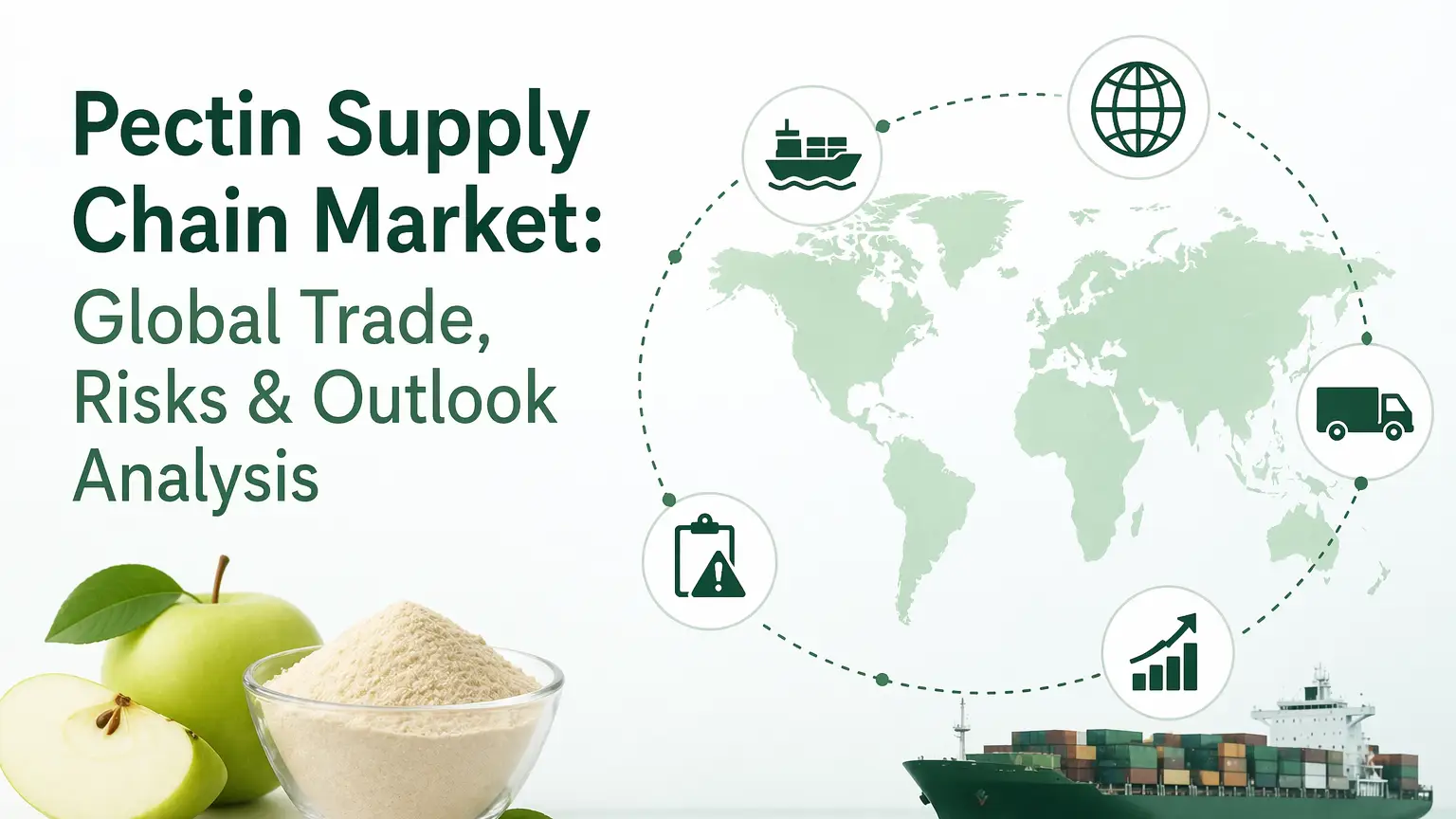
In 2026, the pectin supply chain stands at a critical intersection of agricultural dependency, industrial processing complexity, and shifting global demand for clean-label ingredients. Valued at over USD 1.6–1.7 billion globally, the market continues to expand steadily toward USD 3 billion+ projections by the early 2030s, driven by food, pharmaceutical, and nutraceutical applications .
Yet beneath this growth lies a structurally fragile supply system. Pectin, derived primarily from citrus peels and apple pomace, is not a standalone agricultural product but a by-product of juice industries. This dependency creates inherent volatility in sourcing, pricing, and long-term contract stability.
The first defining issue in the 2026 pectin supply chain is extreme raw material concentration. Citrus fruits alone account for more than 80% of global pectin feedstock, with citrus peel residues forming the backbone of industrial extraction . This dependence exposes the supply chain to agricultural shocks such as citrus greening disease, climate variability, and fluctuating juice consumption patterns.
In practical terms, pectin production capacity cannot expand independently of citrus processing output. When juice demand declines, peel availability tightens, creating immediate upstream shortages. This structural constraint has led major manufacturers to diversify toward apple, sugar beet, and sunflower-derived pectin sources, though these alternatives often require higher processing costs or yield functional differences.
Beyond agriculture, the second pressure point lies in energy-intensive extraction processes. Pectin production requires acid extraction, filtration, and drying stages that are highly sensitive to energy pricing and water usage. Since 2023, rising utility costs have significantly increased production expenses, compressing margins across Europe and Asia.
At the same time, environmental compliance requirements are tightening wastewater treatment and chemical handling standards, especially in mature markets. This has pushed manufacturers toward integrated biorefinery models, where pectin is co-produced with other citrus derivatives to improve efficiency and cost absorption.
These operational realities are reshaping procurement strategies. Buyers increasingly favor long-term contracts and indexed pricing models to stabilize exposure, while suppliers invest in automation and process optimization to preserve competitiveness.
The third major transformation is geographic. Historically dominated by European processors, the pectin supply chain is rapidly decentralizing toward Asia-Pacific. China and India are scaling extraction capacity to meet domestic demand and reduce reliance on imported hydrocolloids.
This regional shift is redefining global trade flows. Instead of long-haul exports from Europe and Latin America, manufacturers are increasingly adopting localized sourcing hubs to reduce freight costs and lead times. However, disparities in quality standards and extraction technology remain a bottleneck for full substitution of established Western suppliers.
Over the long term, Asia-Pacific is expected to emerge as both a production and innovation hub, particularly as demand from processed foods, pharmaceuticals, and plant-based products continues to expand.
The fourth strategic driver is demand-side transformation. Clean-label, plant-based, and minimally processed food trends are accelerating the use of pectin as a natural gelling and stabilizing agent in place of synthetic alternatives .
This shift is not only expanding demand but also reshaping procurement expectations. Buyers now require full traceability from orchard to finished ingredient, supported by digital supply chain systems and sustainability certifications. Circular sourcing—particularly the use of fruit waste streams—has become a competitive advantage, linking sustainability performance directly to contract eligibility.
Technological improvements in extraction, including enzymatic processing, are also improving yield efficiency and aligning production with sustainability mandates.
The 2026 pectin supply chain is no longer defined purely by agricultural output or commodity pricing. It is evolving into a strategically managed ecosystem shaped by energy economics, regional trade realignment, and regulatory expectations for transparency and sustainability.
In this increasingly complex environment, companies are prioritizing resilient sourcing structures, diversified feedstock strategies, and long-term supplier collaboration to maintain continuity and cost stability.
Against this backdrop, Tradeasia International plays a quiet but meaningful role as a global solution provider, connecting manufacturers with reliable plant-based raw material supply networks and helping navigate volatility in agricultural and industrial inputs. Its integrated sourcing approach supports buyers seeking continuity in an increasingly fragmented global pectin value chain.
Sources:
We're committed to your privacy. Tradeasia uses the information you provide to us to contact you about our relevant content, products, and services. For more information, check out our privacy policy.


 English
 Indonesian
 简体字
简体字
 العربية
 Español
 Français
 Português
 日本語
日本語
 한국어
한국어
 Tiếng Việt



















