Explore our network of country and industry based websites to access localized information, product offerings, and business services across our group.
Log in to start sending quotation requests for any product.
Don't have an account? Sign Up Here
Home Phosphoric Acid Supply Chain Market Dynamics and Global Trade Realignment
Trade Insights | Supply Chain | 29 April 2026
Upstream Feedstock Concentration and Resource Dependency
Fertilizer-Driven Demand and Global Consumption Patterns
Logistics Disruptions and Cost Transmission Across Regions
Geopolitical Trade Shifts and Supply Chain Resilience Strategies
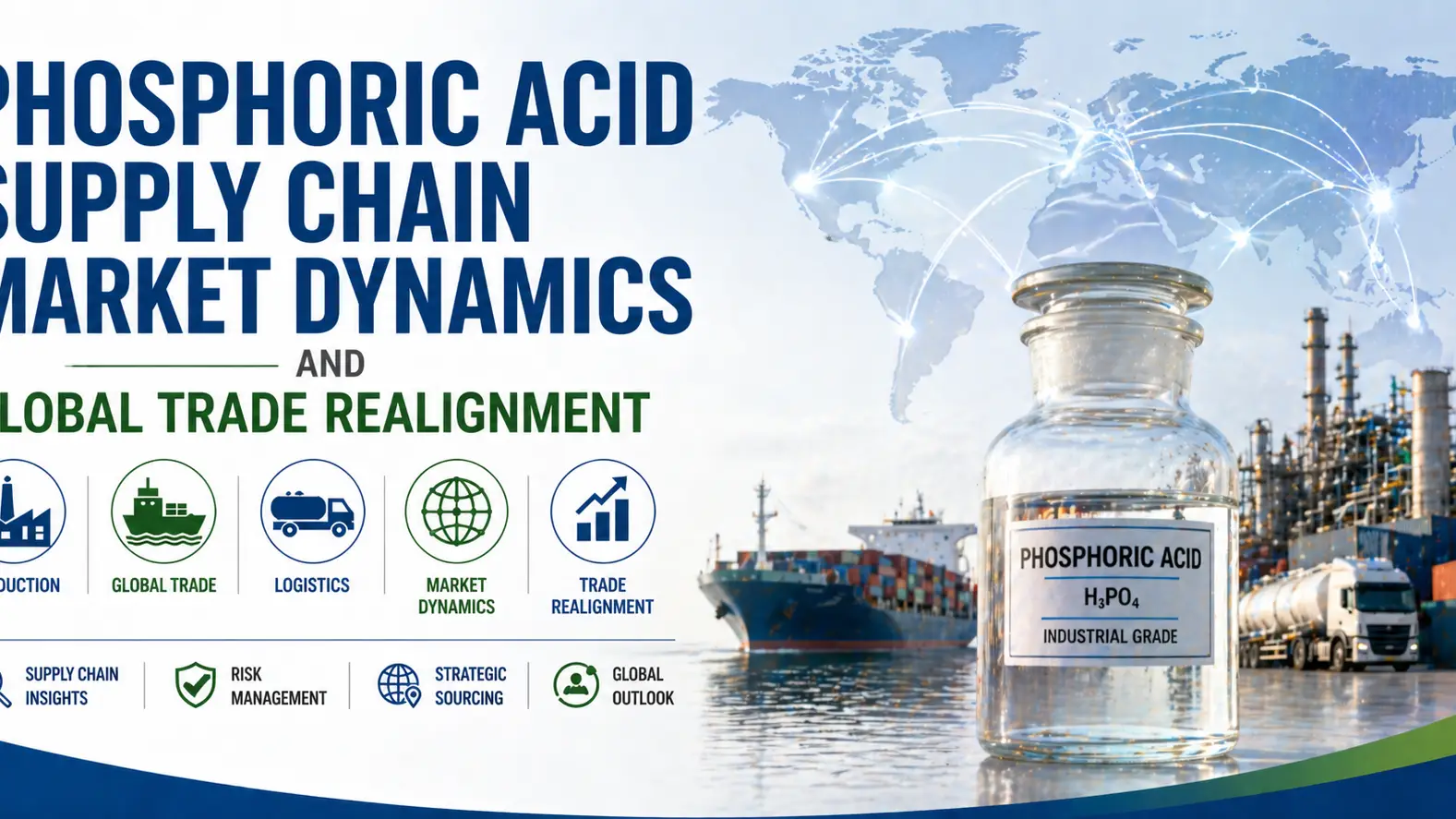
The phosphoric acid supply chain market in 2026 sits at the intersection of agricultural demand security and industrial chemical dependency. As a core intermediate in phosphate-based fertilizers and multiple industrial applications, phosphoric acid has evolved into a strategically sensitive commodity. Recent market evaluations indicate that global demand continues to expand steadily, yet the supply chain is increasingly shaped by upstream concentration, logistics volatility, and geopolitical trade realignments, creating a complex operating environment for producers and buyers alike.
The phosphoric acid supply chain is fundamentally anchored in phosphate rock and sulfur-based inputs, both of which are highly geographically concentrated. A limited number of countries dominate phosphate rock reserves, making upstream supply inherently vulnerable to political and export policy shifts. This structural dependency creates immediate ripple effects across production networks, where even minor disruptions can escalate into global price instability.
Producers are responding by integrating vertically into mining operations or securing long-term raw material contracts. However, this approach tends to reinforce market concentration rather than decentralize supply risk, further tightening global dependency on a few key producing regions.
Nearly 80–90% of phosphoric acid demand is driven by fertilizer production, particularly diammonium phosphate (DAP) and monoammonium phosphate (MAP). This agricultural linkage makes demand highly cyclical and sensitive to planting seasons, food security policies, and government subsidy programs.
While fertilizers remain the dominant driver, industrial and food-grade applications are gradually gaining importance. These include water treatment, food acidulation, and specialty chemicals, which, although smaller in volume, offer higher margins and stricter quality requirements. The dual structure of the market—high-volume agriculture and high-value industrial applications—continues to shape production priorities across global suppliers.
Logistics has emerged as a critical pressure point in the phosphoric acid supply chain. As a corrosive bulk chemical requiring specialized handling, phosphoric acid depends heavily on stable maritime and inland transport systems. However, port congestion, freight volatility, and shifting trade routes have created persistent inefficiencies in global distribution.
These disruptions often translate directly into regional price disparities, with delivered costs varying significantly depending on origin and shipping corridor stability. Once disruptions occur, cost increases rapidly transmit downstream into fertilizer and food production industries, tightening margins across entire value chains and increasing procurement uncertainty for buyers.
Geopolitical influences are reshaping phosphoric acid trade flows, particularly as production remains concentrated in a few major regions including China, North Africa, and the United States. Export policies, regional alliances, and resource nationalism increasingly determine availability in importing markets, especially in Asia-Pacific and Europe.
In response, many industries are shifting toward regional diversification strategies and localized sourcing hubs. While these efforts aim to reduce dependency on long-distance supply chains, they often introduce higher production costs due to fragmented infrastructure and reduced economies of scale. As a result, resilience is becoming a strategic priority over pure cost optimization in procurement planning.
The phosphoric acid supply chain market is entering a phase defined by structural fragility alongside sustained long-term demand growth. Feedstock concentration, fertilizer-driven consumption, logistics inefficiencies, and geopolitical fragmentation collectively shape a market that is both essential and highly sensitive to disruption. For industrial buyers, the emphasis is shifting from cost efficiency to supply security and diversification strategies.
In this evolving environment, global chemical distribution partners play a critical stabilizing role. Tradeasia International continues to support industries by enabling integrated sourcing solutions, diversified supply access, and streamlined logistics coordination across volatile markets. As supply chains become more complex, such partners are increasingly essential in ensuring continuity, resilience, and long-term procurement stability across the phosphoric acid value chain.
We're committed to your privacy. Tradeasia uses the information you provide to us to contact you about our relevant content, products, and services. For more information, check out our privacy policy.


 English
 Indonesian
 简体字
简体字
 العربية
 Español
 Français
 Português
 日本語
日本語
 한국어
한국어
 Tiếng Việt



















