Explore our network of country and industry based websites to access localized information, product offerings, and business services across our group.
Log in to start sending quotation requests for any product.
Don't have an account? Sign Up Here
Home Potassium Chloride Market: Global Dynamics, Trade Flows & Strategic Shifts
Trade Insights | Supply Chain | 27 April 2026
Introduction
Global Production Concentration and Export Dependencies
Agricultural Demand as the Core Supply Chain Driver
Logistics, Pricing Volatility, and Trade Disruptions
Industrial Diversification and Downstream Market Expansion
Conclusion
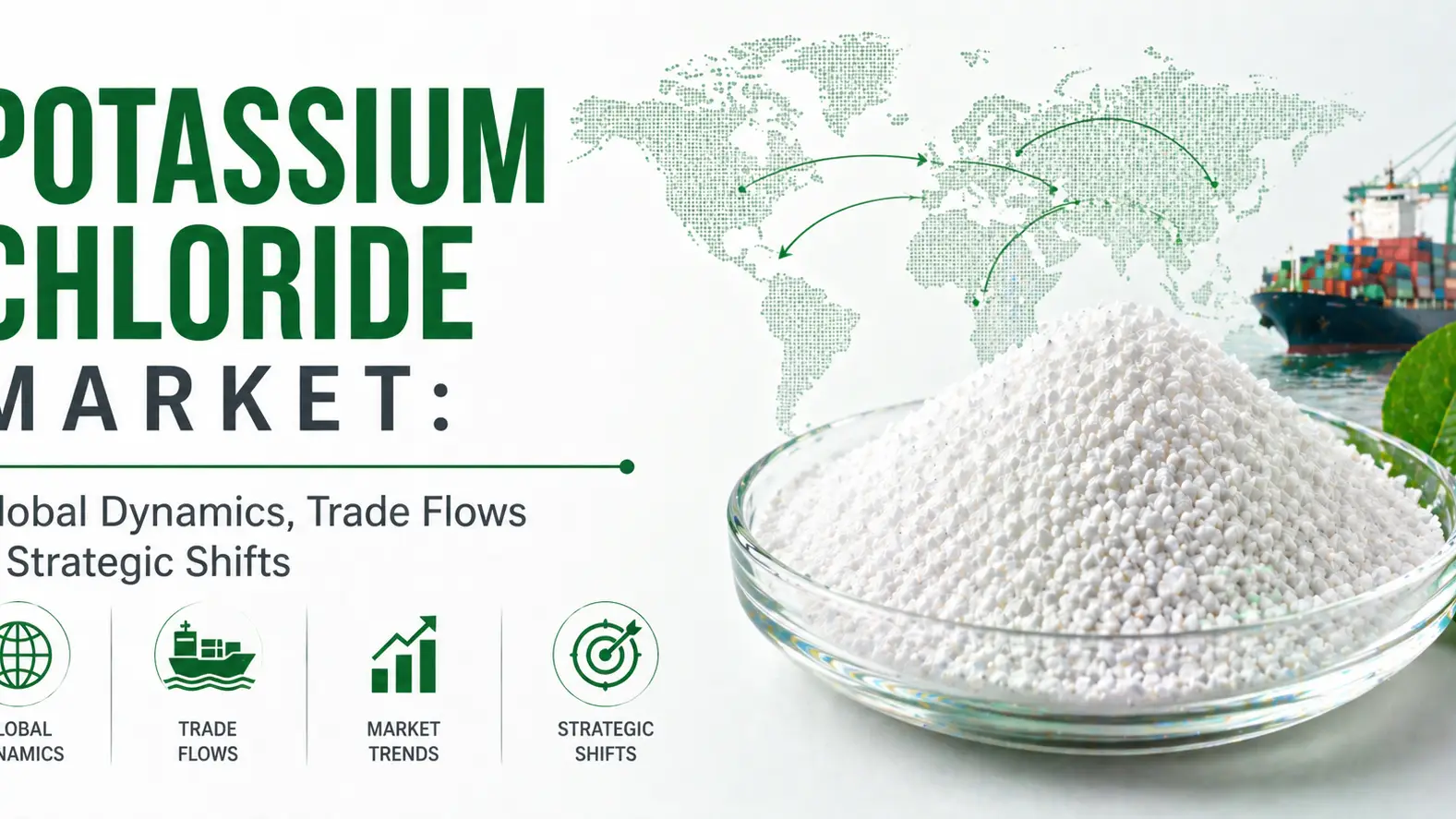
The global supply chain market for Potassium Chloride (KCl), commonly known as potash, sits at the intersection of agriculture, geopolitics, and industrial manufacturing. As a critical nutrient in fertilizer formulations, potassium chloride is indispensable for global food security. Its supply chain is not merely a distribution network but a strategically sensitive system shaped by mining geography, export controls, and fluctuating agricultural demand. With the global potassium chloride market projected to approach nearly USD 40 billion by 2033, the efficiency and resilience of its supply chain have become central to both producing and importing economies.
One defining characteristic of the potassium chloride supply chain is its highly concentrated production base. Major reserves are located in a limited number of countries such as Canada, Russia, and Belarus, making global supply heavily dependent on a few dominant exporters. This geographic concentration creates structural vulnerability in global trade flows, where disruptions in one region can rapidly influence pricing and availability worldwide.
Many importing nations, particularly in Asia-Pacific and North America, rely heavily on long-term contracts and strategic reserves to stabilize access. As a result, potash supply chains are often shaped more by geopolitical alignment than pure market efficiency. Import dependency also amplifies the importance of logistics coordination, especially in maritime transport routes and port infrastructure.
At the heart of the potassium chloride supply chain is its role in agriculture. Roughly the majority of global KCl consumption is directed toward fertilizer production, supporting staple crops such as wheat, rice, and corn. This makes the supply chain inherently seasonal and demand-sensitive, closely tied to planting cycles and global food consumption trends.
As global food demand rises due to population growth, agricultural systems are increasingly shifting toward high-efficiency farming practices. This structural transformation intensifies reliance on potash-based fertilizers, ensuring steady baseline demand even during economic slowdowns. Consequently, upstream mining operations and downstream distributors must maintain synchronized planning to meet fluctuating agricultural requirements without creating supply bottlenecks.
The potassium chloride supply chain is particularly exposed to logistics constraints and price volatility. Since production is geographically limited while demand is globally dispersed, long-distance maritime transport is essential. This creates sensitivity to shipping costs, port congestion, and fuel price fluctuations.
Additionally, trade policies and export restrictions in key producing countries can rapidly disrupt global supply balances. Historical market behavior shows that even minor geopolitical tensions can trigger significant price swings due to the commodity’s strategic importance in food production. Supply chain stakeholders increasingly rely on hedging strategies, diversified sourcing, and long-term contracts to mitigate these risks.
Technological improvements in mining and logistics are gradually improving efficiency, but the structural imbalance between supply concentration and demand dispersion remains a persistent challenge.
While agriculture dominates demand, potassium chloride is also expanding into industrial and chemical applications. It serves as a feedstock in potassium-based chemical production, water treatment processes, and even food-grade applications such as sodium reduction alternatives. This diversification is gradually reshaping supply chain priorities, pushing producers to allocate volumes across multiple end-use industries.
Industrial diversification also introduces new supply chain complexities. Unlike agriculture, which follows seasonal cycles, industrial demand is more stable but requires higher purity specifications and consistent quality standards. This shift is encouraging integration between mining operations and downstream processing facilities to ensure reliability and value-added production.
The potassium chloride supply chain market is a globally interconnected system shaped by concentrated production hubs, agricultural dependency, and evolving industrial applications. While demand remains structurally strong due to its role in food security, the supply chain continues to face challenges related to geopolitical concentration, logistics exposure, and price volatility.
Looking ahead, resilience will depend on diversification strategies, improved transport infrastructure, and deeper integration across the value chain. As demand intensifies, stakeholders increasingly require dependable sourcing partners capable of navigating both commodity cycles and geopolitical uncertainty.
In this evolving landscape, Tradeasia International emerges as a global solution provider supporting industrial buyers with streamlined sourcing, reliable distribution networks, and expertise in chemical supply chain management across multiple regions.
Sources:
We're committed to your privacy. Tradeasia uses the information you provide to us to contact you about our relevant content, products, and services. For more information, check out our privacy policy.


 English
 Indonesian
 简体字
简体字
 العربية
 Español
 Français
 Português
 日本語
日本語
 한국어
한국어
 Tiếng Việt



















