Explore our network of country and industry based websites to access localized information, product offerings, and business services across our group.
Log in to start sending quotation requests for any product.
Don't have an account? Sign Up Here
Home Sesame Seed Supply Chain and Global B2B Sourcing
Trade Insights | Supply Chain | 02 September 2026
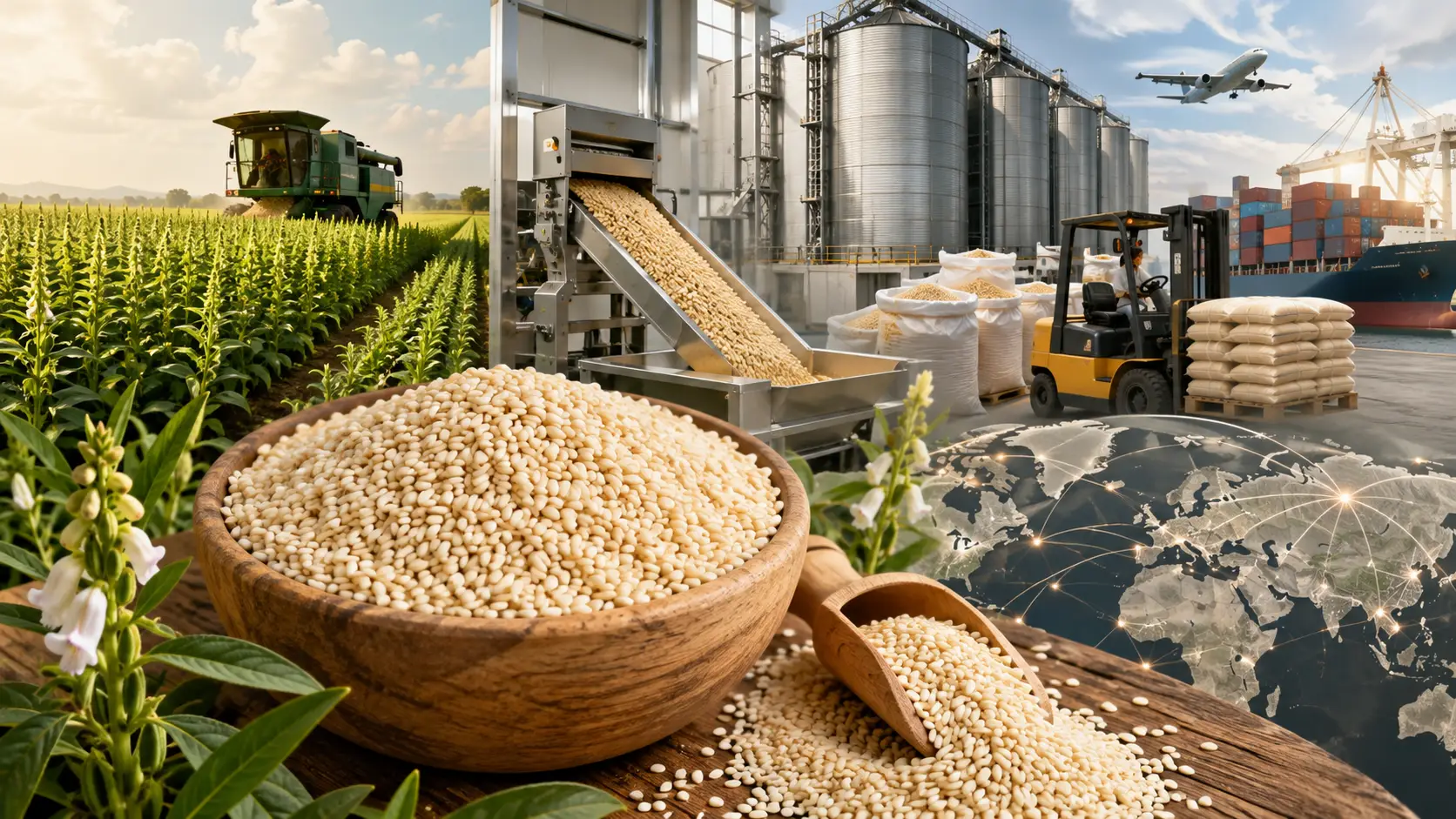
Sesame Seed Supply Chain Overview
Sesame Seed Cultivation and Primary Supply
Processing, Cleaning, and Quality Management
Applications Driving Sesame Seed Demand
International Trade and Distribution
B2B Buyers and Procurement Requirements
Strategic Sesame Seed Sourcing
Conclusion: Building a Reliable Sesame Seed Supply Network
Sources
Sesame Seed is an agricultural commodity with a supply chain that connects farming, aggregation, cleaning, processing, storage, logistics, distribution, and food-industry procurement. For B2B buyers, the commercial value of Sesame Seed depends not only on availability but also on the consistency and reliability of every stage between cultivation and final delivery.
The supply chain typically begins with agricultural production and moves through local collection networks before reaching processors, exporters, importers, distributors, and industrial users. Each transition can influence product condition, documentation, handling requirements, delivery timing, and the overall procurement experience for international buyers.
For procurement teams, visibility across the Sesame Seed supply chain helps establish a clearer understanding of supplier capabilities and purchasing risks. Buyers evaluating international sources commonly need to consider origin, product specifications, processing status, packaging, shipment arrangements, and the supplier's ability to support repeat orders.
A structured B2B sourcing approach therefore treats Sesame Seed as more than a commodity purchase. It involves coordinating product requirements with supplier qualification, quality expectations, commercial terms, transportation planning, and distribution requirements so that procurement decisions support continuity of supply.
The first commercial stage of the Sesame Seed supply chain is agricultural cultivation. Farm-level production determines the initial characteristics of the raw material entering collection and processing channels. Harvest timing, post-harvest handling, and storage practices can subsequently influence how effectively the product moves into commercial supply networks.
For B2B buyers, agricultural sourcing is therefore connected to downstream consistency. A procurement strategy that considers only the final delivered product without understanding the upstream supply structure may overlook factors that can affect availability, quality control, and the ability of suppliers to maintain regular commercial shipments.
After harvest, Sesame Seed commonly enters collection and aggregation networks that consolidate material from agricultural producers. These networks connect smaller production activities with processors and larger commercial buyers, creating an important bridge between farm-level supply and international trade.
Efficient aggregation can support more consistent commercial volumes and simplify procurement for industrial customers. For suppliers and distributors, the ability to coordinate collection, preliminary handling, storage, and shipment preparation becomes an important part of building a dependable Sesame Seed supply proposition for B2B customers.
Processing represents a critical transition between agricultural production and commercial distribution. Sesame Seed may require cleaning and preparation to meet the physical and quality specifications established by different buyers. The appropriate processing pathway depends on the intended application, customer requirements, and commercial specifications.
For food-industry procurement teams, processing capabilities can be an important supplier-selection criterion. Buyers may assess whether a supplier can consistently provide Sesame Seed in the required condition, packaging format, and specification while maintaining suitable handling procedures throughout preparation and dispatch.
Quality management is central to commercial Sesame Seed sourcing because industrial buyers need predictable material for their downstream operations. Specifications may address characteristics such as cleanliness, physical condition, packaging, moisture-related requirements, and other parameters relevant to the intended application and purchasing contract.
A reliable sourcing program should connect product specifications with inspection, documentation, storage, and shipment controls. This approach allows buyers and suppliers to establish clearer expectations before an order is placed and reduces the possibility of specification misunderstandings during international procurement.
Sesame Seed has an established role within food-ingredient supply chains, where it can serve as an ingredient across different food products and preparation formats. Its commercial relevance extends across food manufacturing, ingredient distribution, bakery-related procurement, and other applications requiring plant-based agricultural ingredients.
The diversity of potential applications creates different purchasing requirements. A food manufacturer may prioritize consistent physical quality and food-handling requirements, while a distributor may place greater emphasis on packaging, commercial availability, documentation, and the ability to serve multiple downstream customers.
For B2B suppliers, understanding applications helps position Sesame Seed according to the needs of specific customer segments rather than treating every buyer as having identical requirements. Application-driven sourcing can support better communication between suppliers, distributors, traders, and food manufacturers.
This is particularly relevant when procurement teams compare multiple sources. Instead of evaluating Sesame Seed only by headline price, buyers can assess whether the supplier's product format, quality controls, packaging, logistics capabilities, and commercial terms are appropriate for the final use.
International Sesame Seed trade requires coordination between suppliers and buyers across multiple commercial stages. Once the product is prepared for export, procurement teams must consider documentation, packaging, shipping arrangements, customs processes, delivery schedules, and destination-market requirements.
For importers and distributors, supply-chain coordination is particularly important because delays at any point can affect inventory planning. A supplier capable of communicating clearly about order preparation and shipment status can provide greater visibility for businesses managing customer commitments and downstream distribution.
Logistics planning connects the physical product with commercial demand. Sesame Seed shipments need to be managed according to the agreed packaging, transportation method, destination, and delivery requirements. Storage and handling also remain important because agricultural commodities must be managed appropriately throughout the distribution process.
From a B2B perspective, effective logistics is part of supplier value rather than a separate administrative function. Procurement teams can benefit from evaluating delivery reliability, communication practices, shipment documentation, and inventory coordination alongside product specifications when developing an international sourcing strategy.
The Sesame Seed B2B market can involve food manufacturers, ingredient distributors, traders, processors, wholesalers, and other commercial buyers. Each segment can approach procurement differently depending on its production requirements, customer base, order volumes, packaging preferences, and distribution model.
Food manufacturers generally require predictable supply and clearly defined specifications, while distributors may need flexible commercial arrangements that allow them to serve multiple customers. Traders and wholesalers can place additional emphasis on competitive sourcing, shipment coordination, and supplier responsiveness when managing international transactions.
A professional procurement assessment should consider product specification, supplier reliability, commercial terms, packaging, documentation, logistics, and consistency of future availability. Price remains important, but the lowest initial quotation does not necessarily represent the strongest overall sourcing option if other supply-chain variables create additional risk.
Supplier communication is another important consideration. Clear responses regarding specifications, order quantities, lead times, shipping arrangements, and documentation can help procurement teams compare offers more effectively and establish a stronger foundation for repeat business.
Strategic Sesame Seed procurement begins with supplier qualification. Buyers can evaluate the supplier's product portfolio, sourcing network, processing capabilities, quality procedures, commercial experience, and ability to meet defined specifications before committing to recurring purchases.
A qualified supplier relationship can create value beyond a single transaction. When the buyer and supplier establish consistent specifications and communication processes, subsequent orders can become more predictable, supporting purchasing efficiency and reducing unnecessary uncertainty throughout the procurement cycle.
Cost optimization should be considered alongside supply continuity. Sesame Seed procurement teams may compare quotations from different origins and suppliers, but meaningful comparison requires a broader assessment of specification compliance, logistics, packaging, documentation, delivery expectations, and commercial reliability.
This creates an opportunity for B2B marketplaces and international sourcing platforms to simplify supplier discovery and comparison. By connecting buyers with relevant suppliers and presenting commercial information in a structured environment, platforms can support more informed procurement decisions while helping suppliers reach qualified industrial customers.
The Sesame Seed supply chain connects agricultural production with cleaning, preparation, quality management, international logistics, distribution, and industrial consumption. For B2B buyers, understanding these interconnected stages provides a stronger foundation for evaluating suppliers and managing procurement requirements.
A resilient sourcing strategy should therefore focus on more than product availability. It should consider supplier qualification, specifications, documentation, logistics coordination, application requirements, and the potential for consistent repeat supply. These factors can influence the total commercial value of a Sesame Seed procurement relationship.
For businesses looking to develop or strengthen Sesame Seed sourcing channels, a structured international marketplace can help connect product requirements with appropriate commercial supply opportunities. Tradeasia / Chemtradeasia / Tradechem Marketplace can serve as a platform for businesses exploring supplier relationships, agricultural ingredient sourcing, and international B2B procurement.
By approaching Sesame Seed sourcing through a supply-chain perspective, procurement teams can make more informed decisions about suppliers, applications, logistics, and commercial requirements. This supports a more organized path from agricultural origin to industrial buyer while creating opportunities for longer-term B2B supply relationships.
We're committed to your privacy. Tradeasia uses the information you provide to us to contact you about our relevant content, products, and services. For more information, check out our privacy policy.


 English
 Indonesian
 简体字
简体字
 العربية
 Español
 Français
 Português
 日本語
日本語
 한국어
한국어
 Tiếng Việt



















