Explore our network of country and industry based websites to access localized information, product offerings, and business services across our group.
Log in to start sending quotation requests for any product.
Don't have an account? Sign Up Here
Home From Grapes to Global Supply: The Role of Tartaric Acid in Food Industry
Article | 24 November 2025
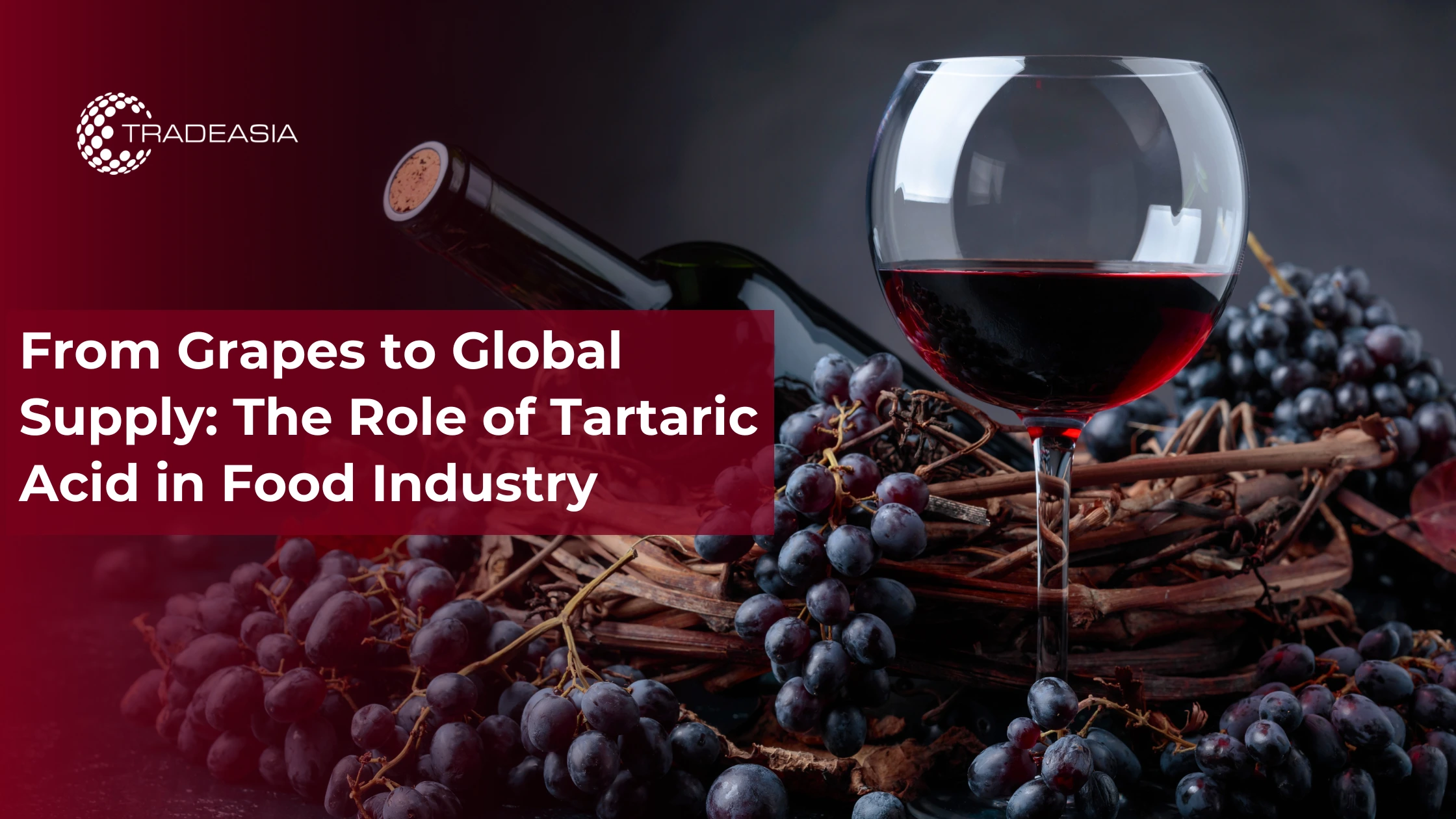
Tartaric acid is a naturally occurring organic acid that has been an essential ingredient in the food industry for centuries. Predominantly sourced from grapes, this versatile acid plays a critical role in enhancing the quality, stability, and sensory appeal of a wide range of food and beverage products. Understanding the journey from raw grapes to the global tartaric acid supply helps highlight the compound’s multifaceted benefits and applications, making it a cornerstone for many food manufacturers in 2025.
Tartaric acid naturally forms in significant quantities in grapes and certain other plants like tamarinds and bananas. It is primarily extracted from wine production byproducts, such as grape pomace and lees, through refined extraction techniques. This natural sourcing emphasizes sustainability and supports a circular economy approach by valorizing grape residues that would otherwise go to waste.
Tartaric acid is prized for its acidulant properties, working as a potent acidifier that controls the pH of food products and beverages. This acidification enhances flavor profiles, balances sweetness, and preserves food by preventing microbial growth. Its role as a stabilizer is particularly notable in fermented products like wine, where tartaric acid helps maintain consistent acidity and prevents unwanted chemical changes during aging.
In baking, tartaric acid is a core ingredient in baking powders—commonly referred to as cream of tartar—acting as a leavening acid that interacts with sodium bicarbonate to produce carbon dioxide, giving baked goods their characteristic rise and texture. This makes it indispensable in producing cakes, cookies, and pastries with uniform quality.
Wine and Beverages: Tartaric acid is critical in wine production for controlling acidity and enhancing flavor stability. It is also used in non-alcoholic beverages, fruit juices, and soft drinks to adjust pH and improve taste.
Bakery: As a leavening acid, tartaric acid contributes to desirable crumb texture and volume in baked goods.
Confectionery: Its acidity helps in flavor development and texture control in candies and chocolates.
Pharmaceutical and Nutraceutical: Tartaric acid acts as an excipient to improve drug solubility and bioavailability. It is also used in some dietary supplements and functional foods for its antioxidant properties.
Tartaric acid supports digestive health through its mild acidity and antioxidant potential. When consumed in regulated amounts, it aids in intestinal enzyme function and helps maintain mineral absorption. These benefits augment the appeal of food products fortified with natural ingredients derived from sustainably harvested sources.
Tartaric acid is globally recognized as a safe and effective food additive, classified as GRAS by regulatory agencies such as the FDA and EFSA. Its purity standards are stringent, with established benchmarks for food-grade and pharmaceutical-grade products. This regulatory clarity makes it a trusted additive in food formulations worldwide.
Source:
We're committed to your privacy. Tradeasia uses the information you provide to us to contact you about our relevant content, products, and services. For more information, check out our privacy policy.


 English
 Indonesian
 简体字
简体字
 العربية
 Español
 Français
 Português
 日本語
日本語
 한국어
한국어
 Tiếng Việt




















