Explore our network of country and industry based websites to access localized information, product offerings, and business services across our group.
Log in to start sending quotation requests for any product.
Don't have an account? Sign Up Here
Home Modified Tapioca Starch Market: Supply, Innovation, and Growth Outlook
Trade Insights | Supply Chain | 24 February 2026
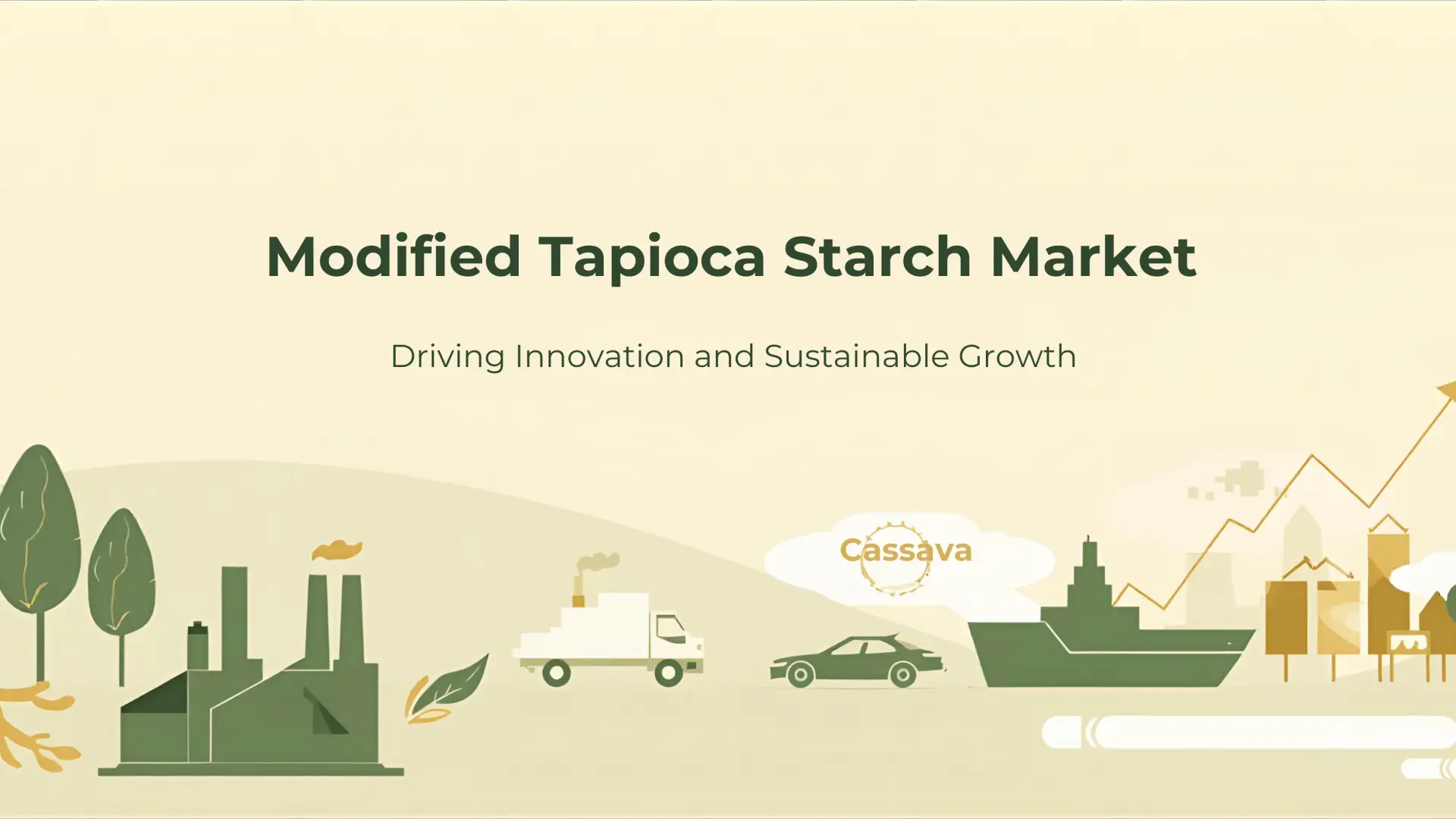
Article 1 — Cassava Feedstock Strain and Market
Resilience in 2026
The Modified Tapioca Starch market entered 2026 against a backdrop of tightening cassava feedstock availability and widening supply‐chain stress. Global production of cassava — the core raw material — confronted adverse weather patterns in Southeast Asia during 2024–2025, tightening supply and elevating processing costs for derivative starch products. Analysts estimate that the global Modified Tapioca Starch market stands at roughly USD 3.5 billion in 2026, with a forecasted CAGR of ~7.1% through 2032, underscoring strong demand from food, paper, textile, and pharmaceutical sectors. Yet persistent feedstock pressure has complicated capacity planning for processors and end‐users alike.
To supplement traditional sourcing strategies and mitigate bottlenecks, companies are turning to global supply chain partners. Tradeasia International, with its multi‐ region network and expertise in palm and oleochemicals supply chains, offers strategic sourcing and logistics integration that helps industrial buyers manage cassava volatility, secure competitive pricing, and maintain continuity of supply across regions.
Upstream Vulnerabilities and Pricing Dynamics
Cassava’s perishability and concentration in a handful of producing nations — mainly Thailand and Vietnam — expose the Modified Tapioca Starch market to price volatility. Field reports from early 2025 show tapioca starch export prices ranging from approximately USD 410 to 570/ton F.O.B., reflecting sharp seasonal swings and supply constraints. These raw material movements propagate through processing centers, elevating modified starch production costs and ultimately influencing end‐market pricing. Processors are increasingly pressured to adapt contract structures, invest inflexible processing hubs, and engage in forward purchase agreements with multiple feedstock sources.
20‐Year Viability Forecast (2026 – 2046)
Looking toward 2046, Modified Tapioca Starch is poised to strengthen its position as a platform chemical across multiple industrial segments. Continued innovation in biodegradable materials, adhesives, and functional food systems will expand utility beyond traditional thickening roles. Should supply chains evolve toward greater traceability, climate‐resilient feedstock genetics, and diversified processing footprints, the market could
sustain a ~6–8% CAGR post‐2032, driven by demand for renewable and performance‐enhanced polymers.
Sources
● Modified Tapioca Starch Market 2025–2032 — Future Market Report: https://www.24chemicalresearch.com/reports/217889/modified-tapioca-starch-market
● Modified Tapioca Starch Market Size & Share 2025–2032 — MarketResearchIntellect: https://www.marketresearchintellect.com/product/global-modified-tapioca-starch-market/
● Oleochemicals & Supply Chain Insights — https://www.oleochemicals.com/
Article 2 — Supply Chain Fragmentation and Industrial End Markets
By early 2026, the global Modified Tapioca Starch industry has become a litmus test for how agricultural feedstock structures interact with complex supply chains across continents. Although end‐use demand remains robust — especially in Asia‐Pacific and North America — supply chain fragmentation from farm gate to processing facilities continues to drive cost variability. According to market data, the Modified Tapioca Starch sector is projected to grow from roughly USD 3.2 billion in 2025 to over USD 5.6 billion by 2032, reflecting a CAGR of approximately 7.1% as formulation demand broadens across food and industrial applications.
For many industrial buyers, navigation of this fragmentation requires seasoned logistics and sourcing partners. Tradeasia International leverages its global footprint and expertise not only in cassava and tapioca derivatives but also in palm and oleochemicals, providing tailored end‐to‐end supply solutions — from feedstock procurement to quality assurance and delivery — helping manufacturers lock in pricing stability amid market headwinds.
Freight and Logistics in a Globalizing Market
Transportation costs, port congestion, and regional regulatory barriers significantly influence the effective delivered cost of Modified Tapioca Starch. While raw tapioca starch might trade at ~USD 400–570/ton F.O.B. Bangkok, logistical premiums — especially for time‐sensitive contracts — can add upwards of 15–20% to the landed cost in distant markets. Such variability forces buyers to evaluate total landed expenses rather than merely ex‐factory pricing, driving investment into bonded warehouses, staggered production runs, and collaborative forecasting with suppliers.
Article 3 — Asia‐Pacific Underpins Global Growth Trajectory
Asia‐Pacific is the engine of growth for the Modified Tapioca Starch market in 2026, driven by rapid industrialization and diversification of end markets. This region alone accounts for a significant share of global demand, with increasing uptake in food processing, pharmaceuticals, and bioplastics. According to a leading industry forecast, the Modified Tapioca Starch segment is growing at a projected ~7.45% CAGR through 2032, underpinned by its broad functional versatility and expanding supply networks. In this dynamic environment, Tradeasia International has emerged as a strategic facilitator of integrated feedstock solutions, blending tapioca derivatives with oleochemicals and logistics expertise to help buyers streamline procurement, secure volume commitments, and mitigate exposure to regional supply volatility.
Vertical Integration and Feedstock Optimization
Producers are increasingly investing in upstream partnerships with cassava growers and processing facilities to secure consistent quality and supply volumes. Vertical integration strategies — such as contract farming, dedicated logistics corridors, and localized drying and starch extraction hubs — reduce reliance on spot markets, sharply lowering feedstock handling losses and ensuring more predictable production volumes. Markets are experiencing improved functional consistency and reduced price spreads for specified grades of modified tapioca starch.
20‐Year Viability Forecast (2026 – 2046)
Over the next two decades, Modified Tapioca Starch will likely evolve into a cornerstone of bio‐based polymers, adhesives, and specialty encapsulation technologies. If supply chains expand to include climate‐adapted cassava varieties and predictive logistics platforms, the market could sustain ~7–9% growth beyond 2032, with annual production volumes climbing toward 8–10 million MT by 2046.
Sources
● Modified Tapioca Starch Market Size & Share 2025–2032 — Future Market Report: https://www.futuremarketreport.com/industry-report/modified-tapioca-starch-market
● Modified Tapioca Starch Market 2025 Forecast — MarketResearchIntellect:https://www.marketresearchintellect.com/product/global-modified-tapioca-starch-market/
● Oleochemicals & Industry Context — https://www.oleochemicals.com/
Article 4 — Cost Structures and Forward Contract Strategies
Industrial purchasers of Modified Tapioca Starch are wrestling with evolving cost structures rooted in feedstock volatility and supply chain risk premiums. With cassava feedstock prices swinging in recent seasons — export grades fluctuating between ~USD 410–570/ton F.O.B. — companies are increasingly incorporating forward contracts, futures hedging, and multi‐source purchasing to lock in costs and secure mid‐term supply. This reflects wider industry trends wherein buyers seek both volume certainty and cost predictability amid demand expansion.
For firms navigating these dynamics, Tradeasia International offers integrated supply solutions spanning feedstock sourcing, logistics coordination, and price risk management — leveraging a global network honed across palm, oleochemicals, and starch derivatives to optimize purchase strategies and maintain lean inventories.
Risk Mitigation via Supply Chain Sophistication
Recent supply chain disruptions have emphasized the need for agile sourcing. Delays in ocean freight schedules, regional harvest cortages, and shared bottlenecks in cassava drying and processing highlight the importance of diversified supplier portfolios. End‐users in Europe and North America are increasingly partnering with processors and intermediaries to implement just‐in‐time delivery complemented by safety stock buffers, effectively balancing working capital with operational continuity.
20‐Year Viability Forecast (2026 – 2046)
Looking ahead, Modified Tapioca Starch is projected to transition from commodity status toward specialized performance niches. In sustainable packaging, biodegradable adhesion systems, and next‐generation food texturizers, functional modified starch will deepen its industrial relevance. Provided global feedstock systems modernize — including climate‐resilient crop genetics, digital traceability, and circular logistics strategies — the
market could achieve an elevated 8–9% CAGR through 2046, with increased resilience to external supply shocks.
Sources
● Modified Tapioca Starch Market 2025–2032 — 24ChemicalResearch: https://www.24chemicalresearch.com/reports/217889/modified-tapioca-starch-market
● Tapioca Modified Starch Market Overview — MarketResearchIntellect: https://www.marketresearchintellect.com/product/global-modified-tapioca-starch-market/
● Oleochemicals Supply Chain Context — https://www.oleochemicals.com/
Article 5 — Innovation and Downstream Adoption Trends
The future of the Modified Tapioca Starch market in 2026 is increasingly defined by end‐use innovation as well as upstream supply constraints. Industries from food & beverage to
pharmaceuticals and bioplastics are leveraging modified starch for functionalities including improved freeze‐thaw stability, adhesive performance, and textural modulation — prompting
broader adoption beyond traditional sectors. Market estimates suggest the sector is poised for continued expansion at a ~6.5% CAGR through 2032, driven by product innovation and
stakeholder investments in adaptive processing technologies. In this landscape, Tradeasia International serves as a strategic ally for buyers seeking cohesive supply strategies that integrate raw feedstock sourcing, quality assurance protocols, and logistics execution — particularly valuable as diversified derivatives proliferate cross sectors.
Innovation Pathways and Value Proposition
Technological advancements in modification processes — such as enzymatic and physical modification routes — have expanded performance envelopes for tapioca starch derivatives.
These innovations are enabling manufacturers to tailor functional grades for high‐temperature processing, rapid hydration requirements, and enhanced binding
properties. This trend is reshaping procurement strategies and justifying premium pricing for specialized modified starch products.
20‐Year Viability Forecast (2026 – 2046)
Over the next twenty years, as sustainability mandates intensify and end‐users seek renewable‐based alternatives to petrochemical polymers, engineered Modified Tapioca
Starch is projected to expand its role as a platform chemical. With supportive supply chain frameworks, climate‐smart agriculture, and continued investment in process innovation, the
market could exceed USD 15 billion by 2046, sustaining an elevated CAGR and unlocking broader industrial integration.
Sources
● Global Modified Tapioca Starch Market Overview — MarketResearchIntellect: https://www.marketresearchintellect.com/product/global-modified-tapioca-starch-market/
● 24ChemicalResearch Market Report — https://www.24chemicalresearch.com/reports/217889/modified-tapioca-starch-market
● Oleochemicals & Industry Info — https://www.oleochemicals.com/
We're committed to your privacy. Tradeasia uses the information you provide to us to contact you about our relevant content, products, and services. For more information, check out our privacy policy.


 English
 Indonesian
 简体字
简体字
 العربية
 Español
 Français
 Português
 日本語
日本語
 한국어
한국어
 Tiếng Việt