Explore our network of country and industry based websites to access localized information, product offerings, and business services across our group.
Log in to start sending quotation requests for any product.
Don't have an account? Sign Up Here
Home Citric Acid Anhydrous in Food and Beverage: Applications and Buyer Demand
Trade Insights | Applications and Buyers | 07 May 2026
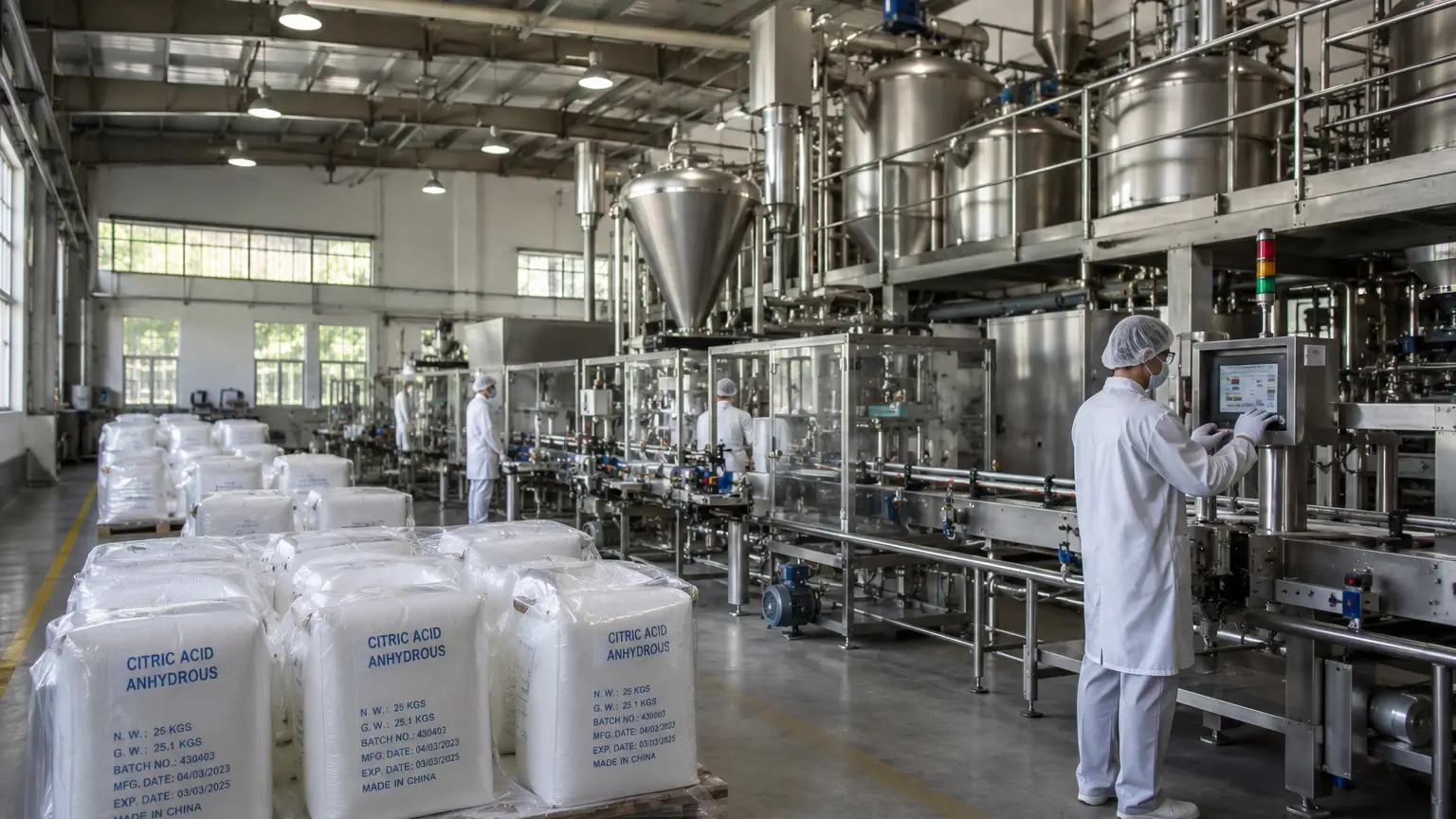
Food and beverage manufacturers account for roughly 65% of total global citric acid demand, and the anhydrous form captures the dominant share of that consumption, not because it is the cheapest option, but because it is the most functional one for dry-blend formulations, high-speed production lines, and moisture-sensitive applications. Understanding where and why this ingredient is used reveals a procurement story that extends well beyond basic acidulation.
Citric acid anhydrous (CAA) is the water-free crystalline form of citric acid (C₆H₈O₇), containing less than 0.5% moisture. It is produced commercially through microbial fermentation of carbohydrate substrates primarily corn-derived glucose and molasses using the fungus Aspergillus niger. The anhydrous designation matters to food manufacturers for one precise reason: in formulations where moisture control is critical, the monohydrate form introduces water into the mix, which can destabilize dry blends, accelerate caking, and reduce shelf life.
Approved under E330 in the European Union and classified as GRAS under 21 CFR 184.1033 in the United States, citric acid anhydrous carries a regulatory profile that makes it eligible for use across virtually all food and beverage categories globally. Its Kosher and Halal certifiability further broadens its reach into markets where those designations are purchase requirements, not optional attributes.
The anhydrous form also offers predictable dissolution behavior and strong flowability, which matters significantly in automated production environments. More than 52% of powdered beverage mixes globally incorporated 30–100 mesh anhydrous citric acid by 2024, specifically because of its uniform solubility within 15–20 seconds under standard processing conditions.
Carbonated beverages represent the single largest volume application for citric acid anhydrous within the food and beverage sector. Over 72% of carbonated soft drinks contain citric acid concentrations ranging from 0.05% to 0.3%, where it functions as the primary acidulant defining the product's tartness and overall flavor profile. In fruit-flavored and citrus-category drinks, it is the preferred choice over phosphoric acid because its sensory output matches consumer expectations for natural-tasting acidity.
In powdered drink mixes and energy drink sachets, the fastest-growing beverage segments as of 2026. The anhydrous form is the standard input precisely because liquid systems cannot be used. Beverage formulators also leverage citric acid anhydrous to bring the product pH into the 2.5–4.5 range, which contributes to microbial stability and enhances the effectiveness of co-preservatives such as potassium sorbate or sodium benzoate.
Confectionery is one of the highest-concentration use cases for citric acid anhydrous, with 47% of confectionery manufacturers using the anhydrous form specifically for sour flavoring applications. In hard candies, gummies, and coated sour snacks, citric acid anhydrous is applied as a surface dusting agent or incorporated into the candy mass, where its crystalline structure delivers the sharp, immediate sourness consumers associate with these categories.
The functionality extends beyond taste. In jelly and jam production, citric acid anhydrous assists in pectin gelation by adjusting pH to the narrow range required for proper gel structure, typically between 2.8 and 3.5. This role as a process-enabling ingredient, not just a flavoring additive. Makes it difficult to substitute without reformulation.
The processed food segment which includes canned goods, frozen meals, dairy-based products, sauces, and ready-to-eat items accounts for approximately 63% of total anhydrous citric acid utilization. In these applications, citric acid anhydrous serves a dual function: it extends shelf life by inhibiting microbial growth through acidification, and it acts as an antioxidant synergist by chelating trace metal ions that would otherwise catalyze oxidative rancidity.
In bakery applications, citric acid anhydrous improves dough pH stability and extends shelf life, with manufacturers reporting up to a 9% reduction in spoilage rates when incorporated at optimal concentrations. In plant-based dairy alternatives, one of the most active reformulation categories globally usage increased by approximately 12% in 2024, as formulators require precise pH adjustment without adding moisture to formulations that are already sensitive to water activity.
The RTD tea, coffee, sports drink, and vitamin water categories are expanding procurement of citric acid anhydrous as formulators manage two concurrent product pressures: clean-label positioning and flavor complexity. In these products, citric acid anhydrous does more than contribute acidity. It masks off-notes from botanical extracts and plant-based ingredients, balances high-intensity sweeteners like stevia and monk fruit (which often carry bitter aftertastes), and helps stabilize certain active ingredients like B vitamins that are sensitive to oxidation.
Beverage manufacturers in this category are increasingly specifying anhydrous grade explicitly in procurement documentation to avoid receiving monohydrate at a lower price point, a sourcing error that can introduce moisture inconsistencies into spray-dried or dry-blended stages of production.
The largest volume buyers of citric acid anhydrous in the food and beverage space are multinational and regional beverage producers companies running continuous high-throughput lines for carbonated drinks, juice concentrates, and powdered drink formats. These buyers typically operate on long-term supply contracts with quarterly price adjustment mechanisms, often indexed to Chinese corn futures given that China accounts for approximately 70% of global fermentation capacity for citric acid.
These buyers require ISO 9001, HACCP, FCC, and Kosher/Halal certification from their suppliers as baseline qualification. Procurement is centralized, and sourcing decisions are made based on total landed cost rather than ex-factory price, meaning logistics reliability, documentation quality, and lead time consistency carry significant weight alongside unit pricing.
Mid-market food processors, manufacturers of jams, sauces, canned goods, frozen foods, and confectionery form the second major buyer cluster. Their purchasing patterns tend to be more mixed between spot and contract procurement, with smaller annual volumes than beverage multinationals. These buyers are more likely to source through trading companies and chemical distributors rather than directly from producers.
For this segment, grade consistency and regulatory documentation are the primary decision drivers. A food processor supplying European retailers, for example, needs to verify the product's E330 compliance, and one supplying US grocery chains requires GRAS confirmation and often a letter of guarantee on allergen and GMO status.
The fastest-growing buyer segment in citric acid anhydrous demand within food and beverage is the plant-based and functional food manufacturing space. Brands producing oat milk, plant-based meat, protein powders, dietary supplements, and fortified snacks are increasing their procurement volumes as product lines scale from specialty retail into mainstream distribution.
This buyer segment is characterized by smaller order volumes, higher sensitivity to clean-label and sustainability documentation, and a preference for suppliers able to provide traceability data on fermentation feedstocks. They are also more likely to pay a moderate premium for certified organic or non-GMO variants where available.
Asia-Pacific dominates both production and consumption of citric acid anhydrous, with the region driven by China, India, and Indonesia's rapidly expanding processed food and beverage manufacturing bases. The buyer landscape in Asia is more fragmented than in Europe or North America, with a larger proportion of procurement handled through traders and local distributors. India's citric acid market is expected to sustain a CAGR of 4.3% through 2035, reflecting urbanization-driven growth in packaged food consumption.
In Europe, anti-dumping duties on Chinese citric acid reconfirmed after a 2021 expiry review, with individual duty rates ranging from 15.3% to 42.7% have shaped buyer sourcing strategies significantly. European food manufacturers either source from European producers such as Jungbunzlauer or from Chinese producers with established individual duty rates. Buyers sourcing through trading intermediaries without named producer disclosure face the blanket 42.7% duty rate, which makes supplier transparency a procurement requirement, not a preference.
North America's food and beverage market consumes approximately 0.18 million tonnes of anhydrous citric acid annually, with 65% of regional demand originating from food and beverage processing facilities. Import reliance stands at around 48%, primarily from Asia-Pacific producers, and domestic supply from ADM and Cargill covers a portion of the market at a cost premium over Asian imports.
The food-grade procurement landscape for citric acid anhydrous is currently characterized by an oversupplied global market, with Chinese exporters pricing competitively. Spot buyers benefit from this environment in the short term, but the structural conditions for rapid price reversal are present: any combination of Chinese environmental compliance shutdowns, a corn price shock exceeding 20%, or logistics disruption at key export ports such as Qingdao or Tianjin can tighten available supply within 30 to 60 days.
For food and beverage buyers consuming more than 200 tonnes annually, term contracts with quarterly price adjustment clauses indexed to feedstock benchmarks offer the best balance of cost visibility and supply continuity. Buyers should also evaluate whether their supplier can provide multiple grade formats: granular and fine mesh, given that different applications within the same production facility may require different dissolution specifications.
Tradeasia International supplies food-grade citric acid anhydrous to manufacturers across Asia, Europe, and the Middle East, offering multi-origin sourcing, full certification documentation (including Kosher, Halal, ISO, and HACCP), and both spot and contract procurement support. Buyers looking to establish a reliable supply channel or qualify a backup source can contact our team to discuss grade requirements, volume, and delivery terms.
Clean-label reformulation is the dominant structural force reshaping citric acid anhydrous demand in food and beverage. In 2024, clean-label demand influenced 44% of food and beverage product launches globally, with consumers in 67% of surveyed markets expressing preference for natural acidulants over synthetic alternatives. This trend directly benefits citric acid anhydrous, which carries a natural origin narrative: fermentation-based, biodegradable, and absent from restricted ingredient lists in major markets.
Two secondary demand drivers are worth watching. First, the plant-based food sector continues to create new application contexts for citric acid anhydrous in formulations that previously had no acidulant requirement. Second, the detergents and household cleaners segment, not traditionally classified as food and beverage procurement is increasingly crossing over as food manufacturers that also produce cleaning-in-place (CIP) formulations add citric acid to their procurement scope.
The global anhydrous citric acid market, valued at approximately USD 1.4 billion in 2025, is projected to grow to USD 2.2 billion by 2035 at a CAGR of 4.1%. Within that trajectory, food and beverage will remain the anchor demand segment, but its composition will shift: the fastest growth will come not from carbonated beverages, a maturing category, but from powdered nutrition products, functional RTD formats, and plant-based food manufacturing, where demand growth is still in its early structural phase.
What is citric acid anhydrous? Citric acid anhydrous is the water-free crystalline form of citric acid (C₆H₈O₇), produced through microbial fermentation of carbohydrate substrates. It contains less than 0.5% moisture, making it the preferred grade for moisture-sensitive food and beverage formulations.
What is citric acid anhydrous used for in food and beverage? It is used as an acidulant, flavor enhancer, preservative, and pH regulator. Key applications include carbonated soft drinks, powdered beverage mixes, confectionery, jams, canned goods, plant-based dairy alternatives, and ready-to-drink functional beverages.
Why do beverage manufacturers prefer anhydrous over monohydrate citric acid? The anhydrous form contains less than 0.5% moisture, which makes it suitable for dry-blend applications where the monohydrate's water content would destabilize formulations, cause caking, or reduce shelf life. It also offers more predictable dissolution behavior in automated dosing systems.
Is citric acid anhydrous approved for food use globally? Yes. Citric acid anhydrous is approved as E330 in the EU, classified as GRAS under 21 CFR 184.1033 in the US, and holds Kosher and Halal certifications applicable in most international markets.
Who are the main buyers of citric acid anhydrous in food and beverage? The primary buyers are large-scale beverage manufacturers, processed food producers, and increasingly, plant-based and functional food brands. Beverage multinationals typically purchase on long-term contracts, while mid-market food processors often use a mix of spot and contract procurement through distributors.
What is the current global market size for citric acid anhydrous? The global anhydrous citric acid market was valued at approximately USD 1.4 billion in 2025 and is projected to reach USD 2.2 billion by 2035, growing at a CAGR of 4.1%. Food and beverage applications account for approximately 63–65% of total demand.
Where can I find a reliable citric acid anhydrous supplier? Tradeasia International is a global chemical supplier and distributor of food-grade citric acid anhydrous, offering multi-origin sourcing, certified grades (Kosher, Halal, ISO, HACCP), and flexible procurement options. Visit our website and contact our team to request a quote or sample.
We're committed to your privacy. Tradeasia uses the information you provide to us to contact you about our relevant content, products, and services. For more information, check out our privacy policy.


 English
 Indonesian
 简体字
简体字
 العربية
 Español
 Français
 Português
 日本語
日本語
 한국어
한국어
 Tiếng Việt



















