Explore our network of country and industry based websites to access localized information, product offerings, and business services across our group.
Log in to start sending quotation requests for any product.
Don't have an account? Sign Up Here
Home Potassium Acetate Industrial Applications and Global Market Demand Outlook
Trade Insights | Applications and Buyers | 26 June 2026
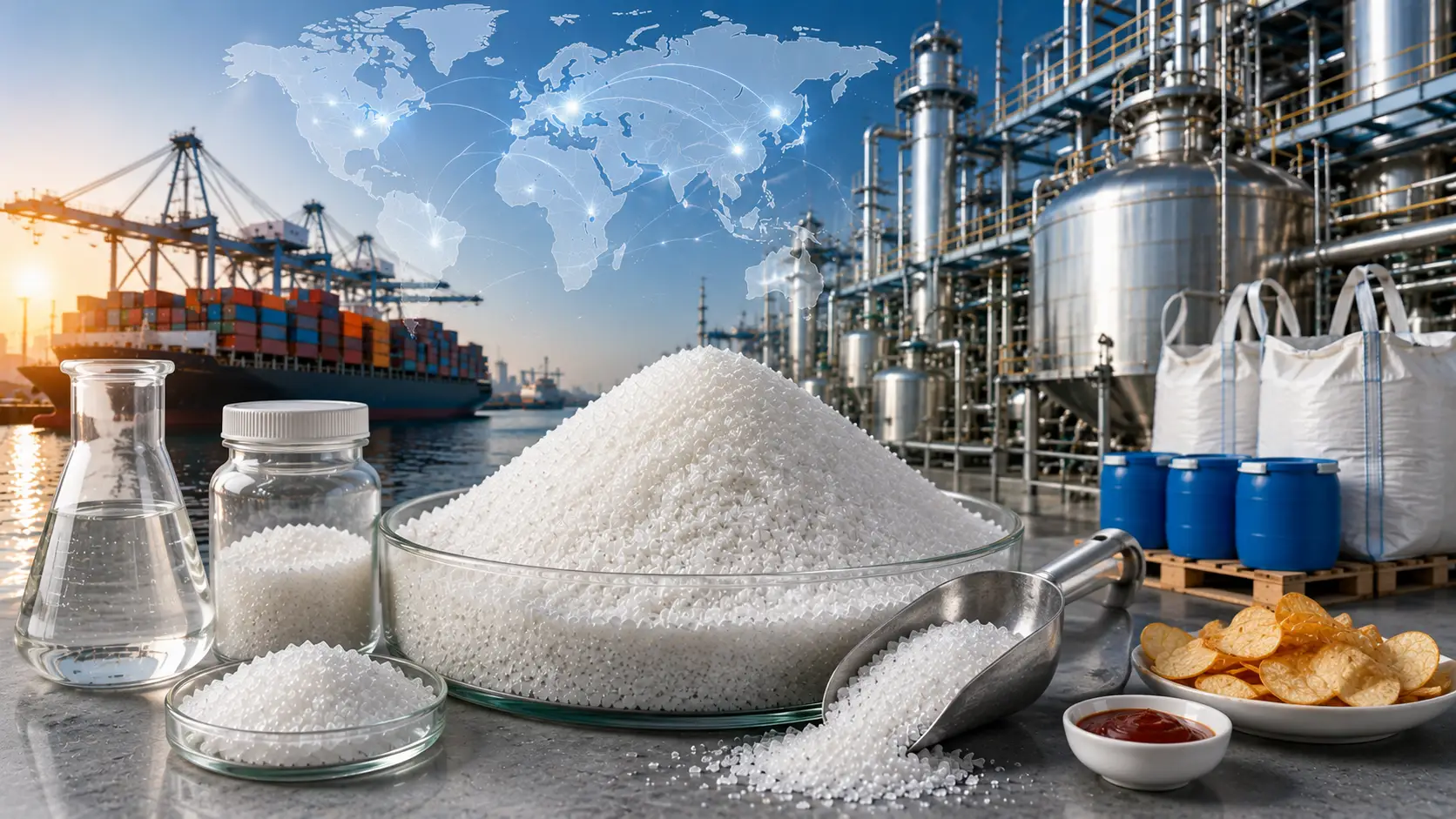
Global Market Overview of Potassium Acetate Demand
Key Industrial Applications Across Major Sectors
Food and Pharmaceutical Industry Usage and Compliance
Aviation Deicing Applications and Environmental Value
Supply Chain Dynamics and Manufacturing Considerations
Buyer Intent and Procurement Decision Factors
Commercial Positioning in B2B Chemical Trade
Potassium acetate is increasingly recognized as a versatile specialty chemical used across multiple industrial sectors. According to chemical property data from PubChem (NIH), it is a highly soluble acetate salt with strong buffering and deicing capabilities, making it valuable in both organic and industrial formulations.
Global demand is being shaped by its dual role as both an environmentally safer deicing agent and a functional chemical intermediate. Industries are gradually shifting toward alternatives with lower environmental impact, which supports potassium acetate adoption.
Market analysis published by industrial chemical research bodies highlights steady growth in acetate-based chemicals driven by aviation and food processing industries. This trend is expected to continue as regulatory pressure increases on conventional chlorinated deicers.
TradeAsia / Chemtradeasia / Tradechem Marketplace positions potassium acetate as a strategic bulk chemical for global B2B procurement, aligning suppliers with growing industrial demand.
The potassium acetate market is influenced by infrastructure expansion in aviation, cold-climate transportation, and food manufacturing industries. Based on industrial chemical market reports, demand is closely tied to seasonal deicing requirements and regulatory compliance.
Economic growth in emerging regions is also increasing consumption of specialty chemicals used in food preservation and pharmaceutical buffering systems. This contributes to a stable baseline demand beyond seasonal aviation usage.
Global supply chains are adapting to fluctuating raw material costs such as acetic acid and potassium hydroxide, which are key inputs in production. This impacts pricing strategies for distributors and manufacturers.
Overall, potassium acetate remains a strategically important chemical in global trade networks due to its multi-sector usability.
Potassium acetate is widely used as an intermediate in chemical synthesis and industrial formulations. According to technical references from PubChem (NIH), its high solubility and stability make it suitable for controlled reaction environments.
It is commonly utilized in manufacturing processes requiring buffering control, electrolyte balance, and solvent systems. Chemical producers rely on it for consistent performance in formulation chemistry.
Industrial demand is also linked to its role in specialty coatings and catalytic processes. These applications require high-purity grades supplied by reliable B2B distributors.
TradeAsia / Chemtradeasia supports manufacturers seeking stable bulk supply for continuous production cycles.
Beyond chemical manufacturing, potassium acetate is used in heat transfer fluids and specialty industrial systems. Based on engineering material references, its thermal properties make it suitable for temperature-controlled environments.
It also plays a role in laboratory reagents and analytical chemistry applications where precision is essential. This increases demand from research institutions and industrial labs.
Its adaptability across multiple systems enhances its commercial value as a multi-industry input chemical.
This broad application base strengthens its long-term global demand outlook.
Potassium acetate is approved as a food additive (E261) in several regulatory frameworks. According to the European Food Safety Authority (EFSA), it is used as a preservative and acidity regulator in processed foods.
It helps maintain product stability and extends shelf life in packaged food systems. The food industry values its effectiveness in controlling microbial growth and pH balance.
Its safety profile under regulated usage conditions has contributed to its adoption in food processing applications globally.
B2B suppliers must ensure compliance with food-grade specifications when serving this segment.
In pharmaceutical applications, potassium acetate is used in buffering solutions and formulation stabilization. Based on pharmaceutical chemistry references, it supports pH control in injectable and laboratory solutions.
Its role in electrolyte balance makes it useful in controlled medical environments and research formulations. This requires high-purity, pharma-grade production standards.
Regulatory oversight ensures that only certified grades are used in medical and pharmaceutical production chains.
This creates a premium segment within the potassium acetate market for qualified suppliers.
Potassium acetate is widely used as an environmentally preferred deicing agent in aviation. According to the U.S. Federal Aviation Administration (FAA), it is applied in runway and aircraft deicing systems due to its lower corrosion impact compared to chloride-based chemicals.
It is especially important in airport operations where safety and environmental compliance are critical. Its liquid form allows efficient application in cold weather conditions.
Airports prefer potassium acetate for reducing infrastructure corrosion and improving operational sustainability.
This drives consistent seasonal demand from aviation hubs globally.
Environmental agencies such as the U.S. Environmental Protection Agency (EPA) highlight the importance of reducing harmful runoff from deicing chemicals. Potassium acetate is considered a more environmentally responsible alternative in regulated zones.
It breaks down more safely in the environment compared to traditional deicing salts. This supports its adoption in airports near sensitive ecosystems.
Regulatory pressure continues to encourage substitution of older chemical systems with safer alternatives.
This positions potassium acetate as a key solution in sustainable aviation operations.
Potassium acetate is produced through the reaction of acetic acid with potassium hydroxide. According to chemical manufacturing references from PubChem (NIH), this process is straightforward but requires controlled conditions for purity management.
Raw material availability directly impacts production cost and global pricing trends. Acetic acid and potassium hydroxide markets therefore influence potassium acetate supply stability.
Manufacturers must maintain strict quality control for industrial, food, and pharmaceutical grades.
This creates segmentation in global supply chains based on purity levels and application requirements.
The potassium acetate supply chain is highly globalized, with production concentrated in chemical manufacturing hubs. Industrial trade reports indicate increasing reliance on integrated B2B marketplaces for efficient sourcing.
Distributors play a key role in bridging manufacturers and end-use industries such as aviation and food processing.
Logistics efficiency, packaging standards, and regulatory compliance are critical procurement factors.
TradeAsia / Chemtradeasia enables streamlined global sourcing for bulk buyers and industrial users.
Primary buyers include aviation service providers, food manufacturers, pharmaceutical companies, and industrial chemical processors. These industries require consistent bulk supply for operational continuity.
Procurement teams evaluate suppliers based on purity, certification, pricing stability, and delivery reliability.
Industrial buyers also prioritize compliance with food-grade or pharma-grade standards where applicable.
This makes supplier qualification a critical part of the purchasing process.
Buyers typically compare multiple suppliers to ensure cost efficiency and quality assurance. Key considerations include technical specifications, packaging formats, and supply reliability.
Long-term contracts are often preferred in aviation and manufacturing sectors to stabilize pricing.
Risk mitigation in supply chain disruptions is another major evaluation factor.
Marketplaces like TradeAsia / Chemtradeasia support informed procurement decisions through structured product sourcing.
Potassium acetate holds strong commercial value due to its multi-sector industrial applications. Its demand is driven by aviation safety requirements, food preservation needs, and chemical manufacturing processes.
This diversified demand base ensures stable long-term market relevance.
Its role in environmentally responsible deicing further strengthens its strategic importance.
Suppliers offering consistent quality gain competitive advantage in global trade networks.
Reliable sourcing is essential in ensuring uninterrupted industrial operations. Buyers depend on trusted distributors to maintain production continuity.
B2B marketplaces streamline procurement by connecting global buyers with verified suppliers.
TradeAsia / Chemtradeasia supports this ecosystem by enabling efficient bulk chemical trade flows.
This enhances accessibility, transparency, and scalability in potassium acetate sourcing.
Sources
We're committed to your privacy. Tradeasia uses the information you provide to us to contact you about our relevant content, products, and services. For more information, check out our privacy policy.


 English
 Indonesian
 简体字
简体字
 العربية
 Español
 Français
 Português
 日本語
日本語
 한국어
한국어
 Tiếng Việt



















