Explore our network of country and industry based websites to access localized information, product offerings, and business services across our group.
Log in to start sending quotation requests for any product.
Don't have an account? Sign Up Here
Home Quinoa Sourcing Opportunities Across the Global Food Industry
Trade Insights | Applications and Buyers | 11 August 2026
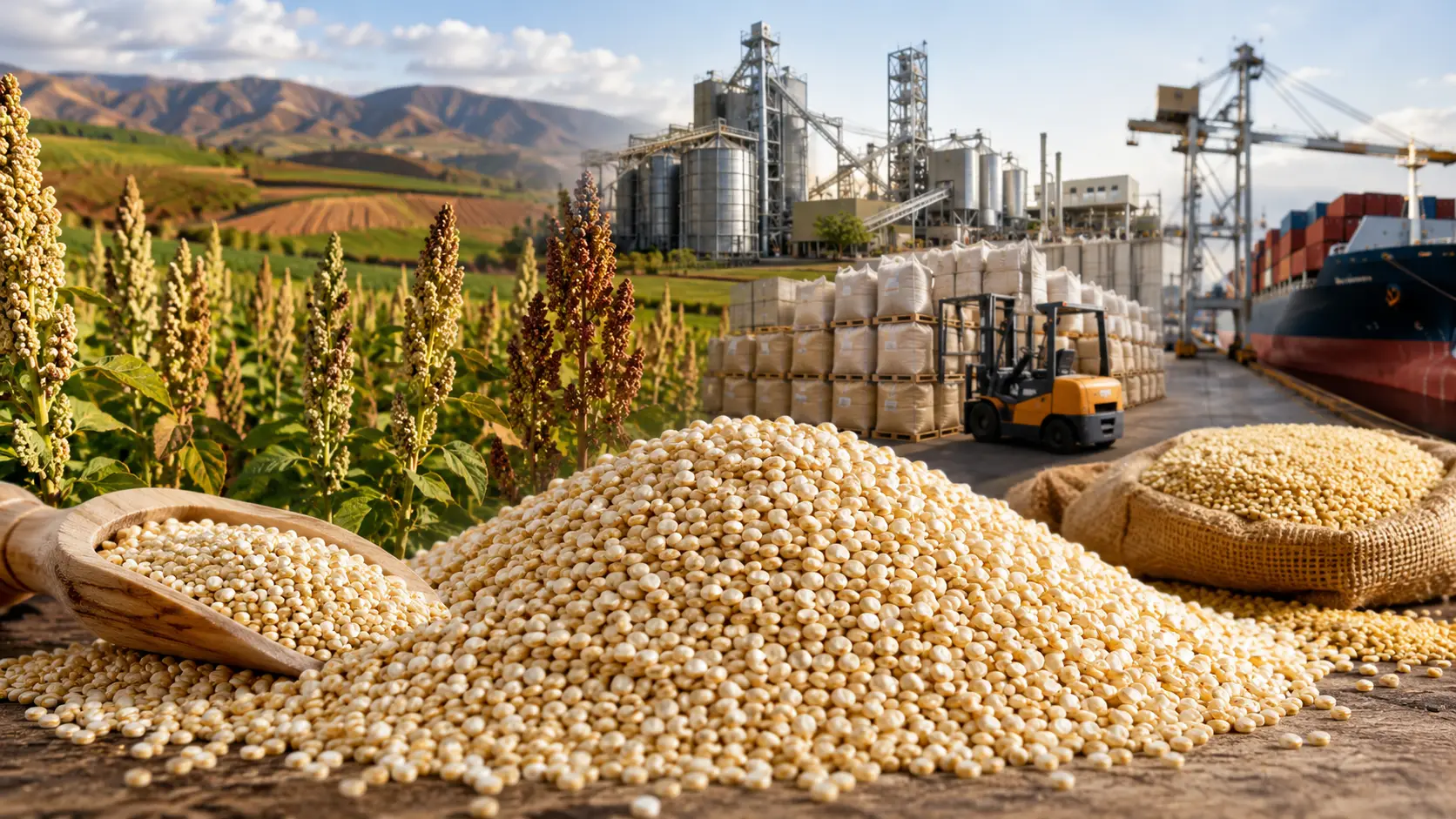
Introduction to Quinoa in B2B Food Markets
Quinoa Applications Across Food Manufacturing
Quinoa in Bakery, Cereal, and Pasta Products
Quinoa for Snacks and Functional Food Formulation
Key B2B Buyers and Procurement Requirements
Quinoa Sourcing and Supplier Considerations
Commercial Opportunities for Quinoa Buyers and Distributors
Conclusion: Quinoa as a Versatile Food Ingredient
Sources
Quinoa is a distinctive food ingredient with a strong position in modern food manufacturing because it can be consumed in whole form, processed into flour, incorporated into cereals, or used in formulated foods. Originating in the Andes, quinoa is recognized by the Food and Agriculture Organization as a nutritious crop with significant food-security and diversification potential. Its grain-like functionality gives processors several routes to develop finished food products.
For B2B buyers, the commercial relevance of quinoa comes from its versatility rather than from a single application. Food manufacturers can evaluate quinoa according to the product format they intend to manufacture, whether that involves whole-seed foods, flour-based products, cereal formulations, pasta, snacks, or other processed foods. This flexibility makes quinoa relevant to ingredient procurement teams seeking differentiated raw materials.
Quinoa also has characteristics that support its positioning in food applications. FAO describes it as light, tasty, easy to digest, and characterized by a delicate, nut-like flavor. USDA research likewise identifies quinoa as a high-protein, grain-like seed that can be incorporated into flour, bread, pasta, soups, cereals, and snacks.
From a procurement perspective, these characteristics create opportunities across multiple finished-product categories rather than restricting quinoa to one niche. Buyers can therefore assess the ingredient based on formulation requirements, processing suitability, quality consistency, supply continuity, and intended market positioning. The result is a broader commercial use case for quinoa within food ingredient sourcing.
Whole quinoa can be incorporated directly into prepared foods where its distinctive texture and flavor contribute to the finished product. FAO notes traditional and contemporary uses including soups and cereal-style foods, while USDA sources identify snack applications as another commercial use.
For manufacturers, whole quinoa can therefore serve as a visible ingredient rather than simply a processing input. This can be useful in products where the appearance, texture, and recognizable identity of the ingredient contribute to the product proposition. Buyers may consequently include quinoa in procurement programs for prepared foods, cereals, specialty foods, and other products requiring a differentiated grain-like ingredient.
Quinoa also has significant relevance when converted into intermediate ingredients. Traditional processing includes roasting and grinding quinoa into flour, while USDA research has demonstrated applications involving quinoa-based flatbreads, pasta, and snacks.
This processing flexibility expands the potential B2B customer base. Flour processors, bakery manufacturers, pasta producers, snack companies, and food formulators can all evaluate quinoa according to their specific production requirements. For ingredient distributors, this versatility can also support broader customer portfolios because one raw material can serve multiple downstream applications.
Quinoa flour provides a practical route for manufacturers seeking to incorporate quinoa into baked products. FAO records the traditional use of roasted quinoa flour in bread, while USDA Agricultural Research Service research has examined quinoa in flatbread formulations and other grain-based products.
Commercial bakery buyers can therefore consider quinoa in formulations where ingredient differentiation and nutritional positioning are important. The exact formulation depends on the finished product, processing conditions, and desired sensory characteristics, making technical evaluation important before large-scale procurement. Consistent raw-material specifications are particularly relevant when manufacturers need repeatable product performance.
Cereal and pasta represent additional application areas for quinoa. FAO identifies quinoa as suitable for cereal-style consumption and pasta production, while USDA research has documented quinoa-containing pasta and other formulated foods.
For B2B procurement teams, these applications create opportunities to develop products that move beyond conventional wheat- or rice-based formulations. Quinoa can function as a recognizable ingredient or as part of a broader formulation strategy. Buyers should nevertheless evaluate particle characteristics, processing compatibility, quality specifications, and supply consistency against the requirements of their individual manufacturing processes.
Quinoa's flavor, texture, and nutritional profile make it relevant to snack manufacturers. USDA research specifically identifies quinoa as a seed that can be used in snack foods, while research from the USDA Agricultural Research Service has explored quinoa and other ancient grains in snack and flatbread development.
For manufacturers, the ingredient can support product development in areas where consumers seek recognizable plant-based or grain-like ingredients. From a B2B perspective, this means quinoa may be evaluated by snack producers, food formulators, private-label manufacturers, and ingredient companies looking to diversify product portfolios. Application testing remains essential because processing conditions can influence texture, flavor, and final product characteristics.
Quinoa's nutritional attributes are another reason it attracts food-industry attention. FAO describes quinoa as a highly nutritious crop and notes its protein content relative to many other plant foods. USDA food-composition resources provide databases and analytical information that manufacturers can use when assessing nutritional composition and formulation requirements.
However, commercial buyers should distinguish between the inherent characteristics of the raw ingredient and claims that can legally be made on a finished product. Nutritional labeling, regulatory requirements, and market-specific claims should be verified for the destination market. This makes documentation and specification control important elements of professional quinoa procurement.
The buyer landscape for quinoa extends across several food-processing categories. Potential B2B customers include food manufacturers, bakery producers, cereal companies, pasta manufacturers, snack producers, ingredient distributors, and businesses developing specialty or health-oriented food products. FAO's discussion of value chains emphasizes the importance of understanding how food products move from producers through processing and distribution to consumers.
Each buyer group can have different technical and commercial priorities. A bakery manufacturer may focus on flour performance, while a cereal producer may prioritize whole-seed characteristics. A distributor may place greater emphasis on consistent specifications, packaging, documentation, and reliable supply. Understanding the application before purchasing is therefore central to effective B2B sourcing.
Quinoa buyers should establish clear specifications before entering a supply agreement. Relevant considerations can include product form, intended application, quality parameters, documentation, packaging requirements, storage conditions, and delivery expectations. These factors help procurement teams compare supplier offers on more than headline pricing.
Quality consistency is particularly important for manufacturers operating repeated production runs. A supplier capable of providing clearly defined specifications and appropriate documentation can reduce uncertainty during purchasing and production planning. For buyers serving multiple markets, regulatory and food-safety documentation may also become an important part of supplier qualification.
Quinoa sourcing requires consideration of both product quality and supply-chain capability. FAO notes that quinoa originated in the Andean region and that cultivation has expanded to numerous countries, reflecting the crop's ability to adapt to different agro-environmental conditions.
For B2B buyers, a supplier evaluation should therefore consider sourcing origin, product consistency, availability, documentation, packaging, and logistics capability. Procurement teams should also assess whether the supplier can support the required volume and application consistently. These factors become increasingly important when quinoa is incorporated into regular commercial production rather than purchased for occasional use.
A dependable quinoa sourcing program should connect product specifications with the buyer's downstream application. Instead of treating quinoa as a generic commodity, procurement teams can define requirements around the intended use and then evaluate suppliers against those requirements. This application-led approach helps manufacturers avoid purchasing material that does not match their processing needs.
For distributors and B2B marketplaces, the same principle supports more efficient customer matching. A clear product description, transparent specifications, suitable documentation, and reliable communication can help connect quinoa suppliers with buyers whose applications are commercially compatible. This is particularly relevant when serving international customers with different product and documentation expectations.
Quinoa's broad application range creates commercial opportunities for businesses that understand its downstream uses. Instead of targeting only one product category, suppliers and distributors can address multiple segments, including bakery, cereals, pasta, snacks, prepared foods, and specialty food formulations. FAO's documentation of quinoa's use in bread, soups, cereals, pasta, and traditional fermented products demonstrates the ingredient's long-established versatility.
For buyers, this versatility can support product diversification. A manufacturer may begin with one quinoa-based application and subsequently assess additional formulations using the same raw material. For suppliers, application knowledge can make product positioning more relevant to procurement teams because the conversation moves from simply selling quinoa to solving a specific ingredient requirement.
Digital B2B marketplaces can help simplify the connection between quinoa suppliers, distributors, processors, and manufacturers. A marketplace model allows buyers to evaluate product information while considering their intended application, sourcing requirements, and commercial specifications.
For Tradeasia / Chemtradeasia / Tradechem Marketplace, quinoa can therefore be positioned as a food-industry raw material with multiple downstream applications. The strongest commercial approach is to combine product visibility with clear application information, buyer-oriented specifications, and practical sourcing support. This enables procurement teams to move more efficiently from product discovery toward supplier evaluation and purchasing discussions.
Quinoa has evolved from a traditional Andean crop into a versatile ingredient relevant to modern food manufacturing. Its established uses include cereals, soups, flour, bread, pasta, and snacks, while its nutritional characteristics and adaptability continue to support interest across different food markets.
For B2B buyers, the most important opportunity is the breadth of applications rather than a single end use. Manufacturers can evaluate quinoa as a whole ingredient or as a processed material depending on their production requirements. This makes application-specific sourcing, quality control, and supplier qualification central to successful procurement.
Businesses seeking quinoa for commercial food production should approach sourcing with a clear understanding of application, specifications, documentation, and supply requirements. A reliable sourcing strategy can help buyers identify suitable material while giving suppliers and distributors a stronger basis for serving different food-processing segments.
As a global B2B sourcing platform, Tradeasia / Chemtradeasia / Tradechem Marketplace can provide a commercial channel for connecting buyers with food-industry supply opportunities. For procurement teams evaluating quinoa, an application-focused approach can make supplier discovery more efficient while supporting informed purchasing decisions across bakery, cereal, pasta, snack, and specialty food applications.
Food and Agriculture Organization of the United Nations — Quinoa
USDA Agricultural Research Service — Specialty Crop Could Get Bacteria Boost
We're committed to your privacy. Tradeasia uses the information you provide to us to contact you about our relevant content, products, and services. For more information, check out our privacy policy.


 English
 Indonesian
 简体字
简体字
 العربية
 Español
 Français
 Português
 日本語
日本語
 한국어
한국어
 Tiếng Việt



















