Explore our network of country and industry based websites to access localized information, product offerings, and business services across our group.
Log in to start sending quotation requests for any product.
Don't have an account? Sign Up Here
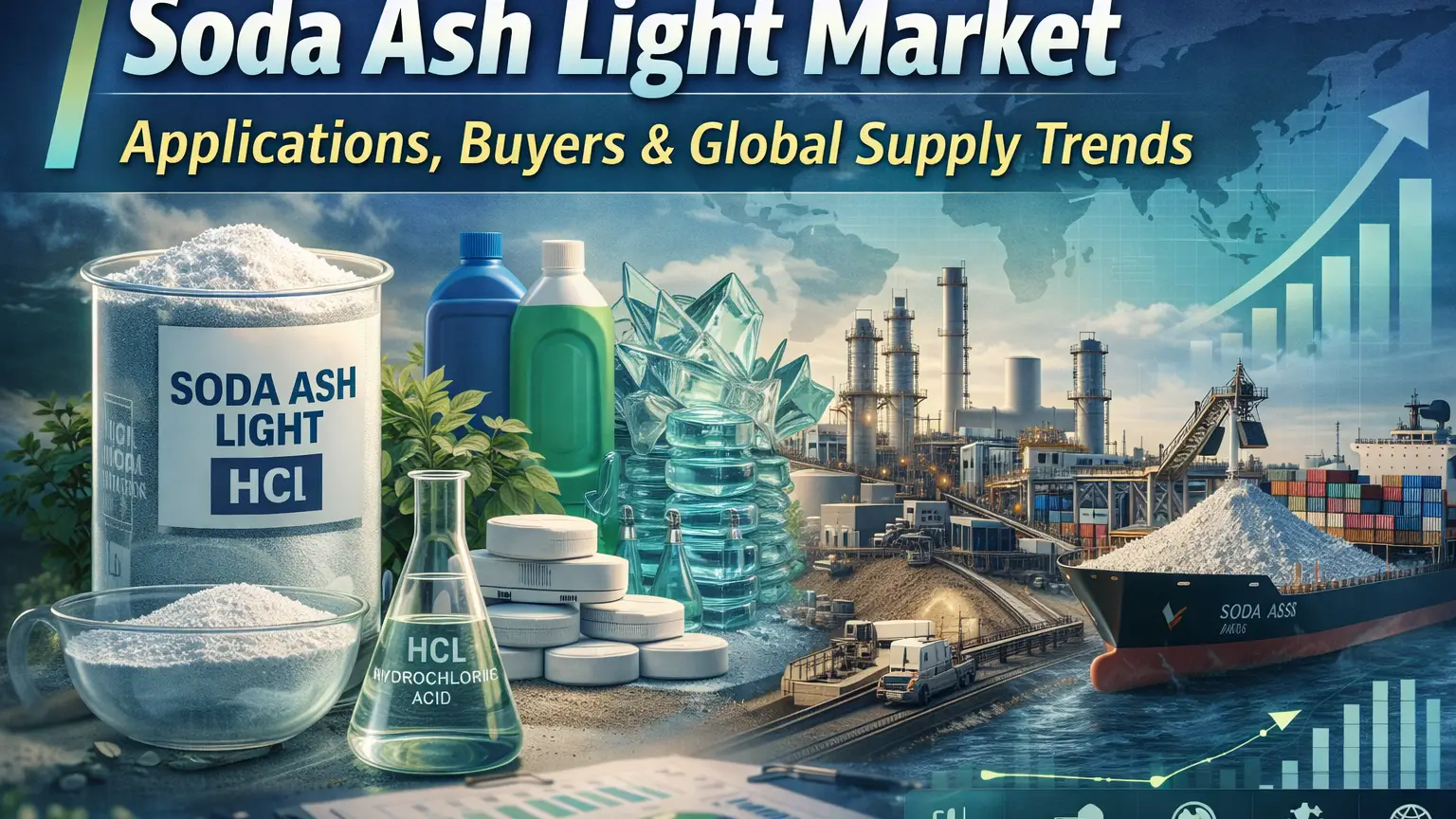
Home Soda Ash Light Demand: Industrial Applications and Buyer Strategy
Trade Insights | Applications and Buyers | 14 August 2026
Understanding Soda Ash Light and Its Commercial Role
Major Industrial Applications of Soda Ash Light
Soda Ash Light Applications Across Food and Process Industries
Key Buyers of Soda Ash Light
Global Soda Ash Light Market Outlook for B2B Buyers
Sourcing Soda Ash Light for B2B Requirements
Conclusion: Building a Reliable Soda Ash Light Buying Strategy
Sources
Soda Ash Light, chemically known as sodium carbonate (Na₂CO₃), is a white, water-soluble alkaline powder used as a functional raw material across multiple manufacturing sectors. Its relatively low bulk density and fine particle size distinguish it from Soda Ash Dense and make it particularly suitable for applications requiring rapid dissolution and effective mixing. Commercial specifications commonly target around 99% or higher Na₂CO₃ content, although exact parameters vary by producer and grade.
For procurement teams, the physical characteristics of Soda Ash Light are commercially important because they influence dosing, dissolution, handling and process performance. Solvay identifies light soda ash as having a bulk density of approximately 0.5 t/m³ and a particle median diameter of around 100 microns, characteristics that support detergent and chemical applications.
Soda Ash Light therefore functions less as a commodity with one universal use and more as a flexible process chemical whose suitability depends on application requirements. Buyers need to evaluate purity, bulk density, moisture, insoluble matter, chloride, sulfate and iron levels alongside packaging and delivery requirements.
For B2B sourcing, this makes product consistency particularly important. A buyer comparing suppliers should assess technical documentation, specification tolerances, grade suitability and supply reliability rather than evaluating quotations on price per metric ton alone.
Detergent manufacturing remains one of the most relevant application areas for Soda Ash Light. Its alkaline properties and water-soluble form support formulation processes where builders and pH control are required. The fine particle structure of the light grade also supports rapid incorporation into formulations.
Chemical manufacturers use sodium carbonate as an alkaline raw material and process reagent in the production of other sodium compounds and in pH-adjustment processes. Its versatility allows procurement teams to incorporate it into different formulations and reaction systems, subject to the required technical grade and purity.
The broader soda ash market demonstrates the importance of these industrial applications. One 2026 market assessment estimates the global light soda ash market at USD 5.26 billion in 2026, with projected growth to USD 8.70 billion by 2034, representing a 6.3% CAGR.
For suppliers, application diversity creates opportunities across detergents, chemicals, water treatment and other industrial formulations. For buyers, it means sourcing strategies should be built around technical requirements and end-use specifications rather than treating all Soda Ash Light offers as interchangeable.
Food-grade sodium carbonate can serve specific processing and formulation functions, including acidity regulation and other permitted applications depending on the applicable food regulations and product specification. Buyers in this segment require substantially stronger documentation and regulatory controls than industrial users.
The food sector should therefore be treated as a specification-driven market rather than simply another volume outlet. Procurement teams may need to verify food-grade status, applicable conformity documentation, purity parameters, contaminant limits, packaging suitability and traceability before approving a supplier.
Soda ash is also used in water treatment as an alkaline material for pH adjustment and water-softening processes. It can additionally support pH control in pulp and paper operations, demonstrating its role as a functional process chemical beyond consumer-product manufacturing.
For industrial buyers, the commercial advantage is flexibility: one procurement program can potentially support multiple process requirements, provided the selected grade meets each application's specifications. This creates opportunities for chemical distributors and manufacturers to consolidate sourcing while maintaining appropriate technical controls.
The strongest B2B buyer groups include detergent producers, chemical manufacturers, formulators and distributors that consume sodium carbonate as a recurring raw material. These buyers generally prioritize consistent purity, reliable availability, appropriate particle characteristics and predictable delivery schedules.
Food processors requiring compliant sodium carbonate, as well as water-treatment companies, pulp and paper producers and industrial formulators, represent additional buyer segments. Their purchasing criteria can differ considerably, making grade documentation and application-specific technical support important elements of supplier evaluation.
Procurement teams should also distinguish between buyers seeking spot cargoes and those requiring scheduled contract supply. The former may prioritize market availability and competitive offers, while the latter typically place greater weight on consistency, logistics planning and supplier reliability.
For distributors, Soda Ash Light can offer additional commercial value because its broad industrial applicability allows sales across several downstream sectors. A well-defined product portfolio can therefore serve both direct manufacturers and regional resellers.
Current market research points to continued expansion in soda ash consumption, supported by glass, detergents and chemical manufacturing. The broader soda ash market was estimated at USD 15.02 billion in 2025 and is projected to reach USD 26.54 billion by 2034, while Asia Pacific represented approximately 62.05% of the market in 2025.
Natural soda ash supply is also geographically concentrated. USGS-derived 2025 estimates indicate natural soda ash production of approximately 12 million metric tons in the United States and 6 million metric tons in Türkiye, illustrating the importance of producer geography in global sourcing decisions.
For international buyers, these supply characteristics make supplier diversification and forward procurement planning increasingly relevant. Freight costs, regional availability, production conditions, energy considerations and downstream demand can all influence delivered cost.
The commercial objective should therefore be to establish a sourcing strategy that balances price, specification, logistics and continuity. Buyers that evaluate suppliers through this broader framework are better positioned to manage fluctuations while protecting production schedules.
A professional sourcing process should begin with the technical specification. Typical parameters include Na₂CO₃ concentration, bulk density, moisture, chlorides, sulfates, iron and water-insoluble matter. Tata Chemicals, for example, publishes a light soda ash specification with minimum 99.0% total alkalinity as Na₂CO₃ and bulk density of 550–720 kg/m³.
Buyers should then compare certificates of analysis, technical data sheets, safety documentation, packaging configurations and applicable regulatory documentation. This approach reduces the risk of selecting a product that appears commercially attractive but does not perform consistently in the intended process.
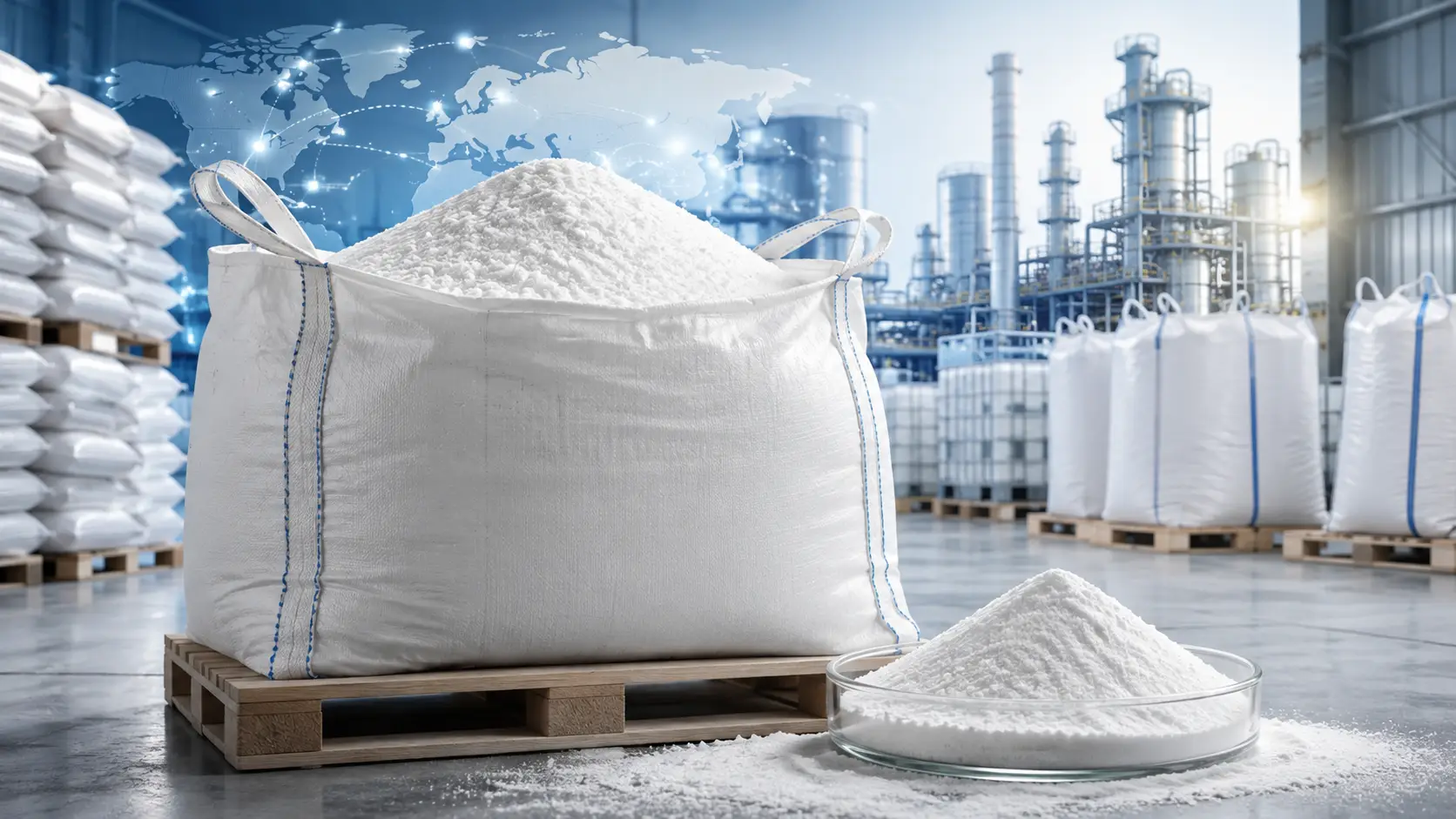
Soda Ash Light is commonly supplied in woven bags with liners and larger bulk packaging formats, depending on the supplier and market. Packaging selection should reflect storage conditions, handling equipment, order volume and transport requirements.
For international procurement, buyers should also assess container utilization, port options, lead times and delivery terms. Tradeasia, Chemtradeasia and Tradechem Marketplace can serve as commercial channels for connecting industrial buyers with chemical supply opportunities while supporting a more structured approach to product and supplier comparison.
Soda Ash Light is a versatile B2B chemical serving detergent, chemical, food-processing, water-treatment, pulp-and-paper and other industrial applications. Its fine particle structure, alkaline functionality and broad application base make specification and supply consistency central to procurement decisions.
As the soda ash market continues to develop, buyers increasingly need more than a competitive quotation. They need dependable specifications, application relevance, transparent commercial information and sourcing options aligned with production requirements. Tradeasia / Chemtradeasia / Tradechem Marketplace can support this process by connecting buyers, suppliers and distributors within a broader international chemical sourcing environment.
Fortune Business Insights – Light Soda Ash Market
We're committed to your privacy. Tradeasia uses the information you provide to us to contact you about our relevant content, products, and services. For more information, check out our privacy policy.


 English
 Indonesian
 简体字
简体字
 العربية
 Español
 Français
 Português
 日本語
日本語
 한국어
한국어
 Tiếng Việt