Explore our network of country and industry based websites to access localized information, product offerings, and business services across our group.
Log in to start sending quotation requests for any product.
Don't have an account? Sign Up Here
Home Tapioca Starch Applications in 2026: Clean-Label Foods to Industrial Use
Trade Insights | Applications and Buyers | 13 May 2026
The Evolving Landscape of Tapioca Starch Uses
Driving Innovation in Clean-Label Formulations
Advancing Nutrition with Resistant Starch Profiles
Expanding Beyond Food into Industrial Manufacturing
Identifying Key B2B Consumer Demographics
Strategic Procurement and the Future Trade Outlook
By mid-May 2026, the primary commercial narrative surrounding the overarching tapioca starch market 2026 has decisively shifted from simple agricultural pricing constraints to incredibly dynamic functional versatility. Corporate procurement teams are actively recognizing that this specific biopolymer is no longer just a basic commodity thickener; it is a critical, application-flexible foundational ingredient driving multiple global sectors. This fundamental evolution is pushing international buyers to secure massive volumes to support highly specialized, high-margin manufacturing processes.
According to market analysis published by Innova Market Insights, the sheer breadth of modern tapioca starch applications is actively insulating the commodity from standard cyclical price depreciations. Because the material is simultaneously pulled by both mainstream nutritional systems and complex heavy manufacturing sectors, baseline commercial demand remains remarkably strong across all major continents. Global supply chains must now accommodate a fundamentally diverse consumer base that aggressively competes for the exact same premium agricultural outputs.
Exploring the diverse tapioca starch uses reveals exactly why this refined powder commands such strict market valuations during the current procurement quarter. Manufacturers prize its neutral taste profile, exceptional clarity, and incredibly strong binding capabilities, making it the premier choice for highly sensitive processing environments. Whether deployed as a stabilizing agent or a primary structural component, the technical performance of this specific root extract consistently outperforms heavily processed synthetic alternatives.
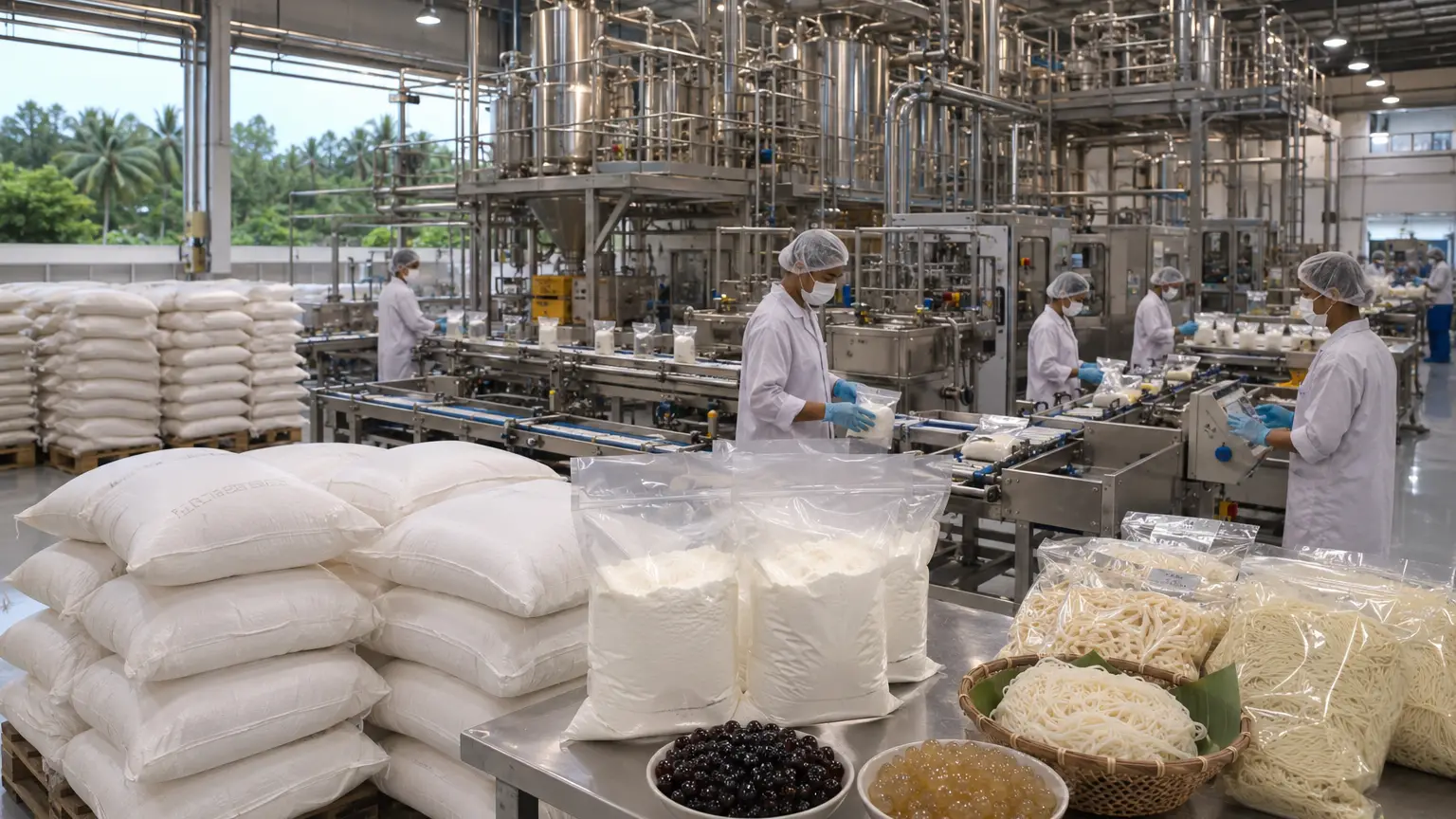
Consequently, securing reliable volumes of premium tapioca starch Thailand is absolutely paramount for enterprises seeking to capitalize on these expansive functional properties. Integrating high-grade Southeast Asian raw materials ensures that both delicate culinary formulations and rigorous mechanical operations proceed without critical quality failures. This strategic regional sourcing directly supports the expansive growth of tapioca starch for food industry deployments worldwide.
The modern consumer landscape heavily dictates that global consumer packaged goods companies aggressively reformulate their legacy portfolios to feature highly recognizable, naturally derived ingredients. This immense commercial pivot has aggressively accelerated overarching tapioca starch clean label requirements across vast networks of Western grocery retailers. Food scientists are actively utilizing this unmodified agricultural extract to completely replace controversial chemical stabilizers, thickeners, and artificial texturizers that modern shoppers definitively reject.
Based on industry data from the Institute of Food Technologists (IFT), replacing chemically modified additives with natural root-based polymers allows international brands to legally claim cleaner, more transparent nutritional labels. This stringent regulatory and consumer-driven compliance ensures that top-tier processing facilities easily command premium market valuations for their meticulously refined agricultural outputs. Consequently, multinational food conglomerates are aggressively locking in multi-year procurement contracts to safeguard their most lucrative, health-focused retail product lines.
For modern tapioca starch food manufacturers, the technical advantages of utilizing this specific ingredient extend far beyond mere regulatory compliance into genuine organoleptic superiority. The biopolymer provides a exceptionally smooth mouthfeel, brilliant visual clarity in fruit fillings, and remarkable freeze-thaw stability required for complex frozen ready-to-eat meals. These distinct performance metrics guarantee that end-users experience a premium dietary product that fundamentally looks and tastes superior to items relying on cheaper corn or wheat derivatives.
Furthermore, this functional flexibility directly enables the rapid expansion of highly profitable tapioca starch gluten free applications across the global retail sector. Procuring specialized agricultural outputs, such as verified tapioca starch India, allows formulation teams to create entirely wheat-free product architectures without compromising essential structural integrity. This meticulous sourcing strategy empowers enterprise brands to successfully capture the lucrative, health-conscious dietary demographic dominating modern grocery channels.
A highly notable application-development angle dominating the second quarter of 2026 is the exponential commercial interest in extracting and utilizing tapioca starch resistant starch for advanced nutritional engineering. This specialized carbohydrate structural variant physically resists early digestion, allowing it to function similarly to dietary fiber within the human gastrointestinal tract. Consequently, formulators are eagerly deploying this unique material to develop groundbreaking high-fiber and drastically low-carb product architectures that directly appeal to modern wellness trends.
According to nutritional research published by the American Journal of Clinical Nutrition, incorporating these specialized resistant biopolymers into daily dietary consumption directly supports improved metabolic health and enhanced glycemic control. Because consumers are actively seeking functional foods that provide distinct physiological benefits beyond basic caloric intake, manufacturers are heavily incentivized to integrate these premium ingredients. This clinical validation fundamentally transforms standard agricultural powders into highly lucrative, scientifically backed nutraceutical components.
The integration of these complex carbohydrates is particularly transformative when evaluating modern tapioca starch for bakery processing lines aiming to reduce net carbohydrate counts. By substituting traditional high-glycemic flours with resistant tapioca derivatives, industrial bakers can successfully market keto-friendly and diabetic-conscious breads that still possess exceptional crumb structure and crucial moisture retention. This precise chemical functionality is an absolute necessity for producing commercially viable health foods that genuinely mimic standard consumer expectations.
Similarly, deploying highly refined tapioca starch for dairy alternatives solves persistent textural challenges plaguing the booming plant-based beverage and vegan cheese sectors. The starch acts as an incredibly effective natural emulsifier and thickening agent, imparting the rich, creamy mouthfeel that consumers strictly demand from oat, almond, and soy-based liquids. Without this specialized botanical stabilization, alternative dairy products frequently suffer from rapid phase separation and an unappealing, watery consistency on retail shelves.
While culinary and nutritional deployments dominate retail headlines, the massive tonnages required for heavy tapioca starch for industrial use represent a fundamentally critical pillar of overarching global consumption. The exact same adhesive strength and binding capabilities that stabilize complex food sauces also make this biopolymer exceptionally valuable for intense mechanical manufacturing processes. Global industrial conglomerates aggressively acquire vast quantities of this natural material to optimize heavy machinery operations and significantly improve final non-edible product durabilities.
Market analysis published by the Technical Association of the Pulp and Paper Industry (TAPPI) heavily underscores the indispensable role these natural polymers play in modern, high-speed automated manufacturing environments. Because the extracted powder exhibits exceptionally high purity and consistent viscosity under intense mechanical shear, factory engineers confidently rely on it to streamline complex production lines. This heavy industrial reliance creates a massive, non-cyclical demand vacuum that consistently absorbs excess agricultural output globally.
The most voluminous industrial application remains the massive integration of tapioca starch for paper industry manufacturing, where it is utilized extensively during complex surface sizing and internal binding procedures. Applying a specialized starchy coating to raw paper significantly enhances its overarching tensile strength, drastically reduces surface fuzz, and directly improves modern ink printability. This crucial chemical treatment ensures that large-scale cardboard and premium printing paper manufacturing operates with maximal mechanical efficiency.
Likewise, implementing highly modified tapioca starch for textile industry operations protects delicate raw yarns from catastrophic mechanical breakage during high-speed commercial weaving. The starch forms a protective, flexible film around the textile threads during the crucial warp sizing process, significantly reducing friction and factory loom downtime. Once the weaving is completed, the natural biopolymer is easily washed away, leaving behind a perfectly woven fabric structurally prepared for commercial dyeing and retail finishing.
To expertly navigate this complex commercial environment, sophisticated traders must accurately map the diverse tapioca starch buyers currently competing for limited international export volumes. The market is firmly driven by a highly fragmented coalition of multinational consumer packaged goods brands, specialized health-food startups, heavy paper mill operators, and massive textile conglomerates. This incredibly broad demographic base ensures that procurement pricing remains persistently competitive, as multiple distinct industries constantly bid against one another for the identical raw agricultural material.
According to consumer goods reporting published by NielsenIQ, the most aggressive purchasing momentum is currently originating from highly capitalized B2B entities explicitly prioritizing clean-label regulatory compliance and sustainable industrial manufacturing. Because these massive corporations cannot effortlessly substitute their foundational biopolymers without triggering catastrophic downstream production failures, their quarterly purchasing mandates are incredibly rigid. This extreme operational inflexibility strongly protects upstream extraction facilities from unexpected demand shocks or sudden order cancellations.
Understanding the incredibly strict technical specifications required by massive tapioca starch industrial buyers is absolutely crucial for successfully executing modern bulk chemical supply contracts. Factory engineers demand exhaustive analytical data detailing exact viscosity curves, precise moisture contents, and specific gelatinization temperatures before approving any multi-ton maritime delivery. Merely offering the lowest spot-market price is completely insufficient if the physical material fails to meet the rigid mechanical tolerances required by high-speed processing equipment.
To thoroughly evaluate these critical chemical parameters and confidently validate complex supply chain decisions, corporate procurement teams require immediate access to verified laboratory documentation. We strongly encourage all B2B purchasing professionals to utilize our specialized download center to acquire the comprehensive safety data sheets and technical specification records necessary for precise enterprise formulation. Leveraging these authoritative commercial resources ensures that your multinational manufacturing operations proceed with absolute mechanical and regulatory certainty.
As the second commercial quarter matures, the overarching enterprise trade outlook heavily favors sophisticated purchasing departments capable of supporting highly diverse, cross-industry applications. The definitive mid-May landscape proves that global biopolymer demand is structurally supported by both premium nutritional trends and massive industrial processing requirements. Corporate procurement officers must intelligently leverage this distinctly firm market environment to permanently fortify their enterprise logistical networks and carefully negotiate highly favorable freight terms.
According to macroeconomic forecasts published by Bloomberg Professional Services, securing versatile biopolymers will remain a critical strategic priority for any global enterprise looking to maintain operational continuity throughout 2026. Multinational corporations must proactively engineer their logistical networks to pivot seamlessly between different geographic origins to expertly balance their overall financial risk profiles. True commercial success inherently requires adopting highly disciplined, long-term procurement frameworks designed to maximize cost efficiency while guaranteeing uncompromising material quality.
To successfully safeguard your factory's continuous operations from sudden regional supply shocks, integrating highly reliable tapioca starch Thailand logistics alongside supplementary tapioca starch India shipments is a deeply strategic maneuver. Establishing these diversified, multi-nodal sourcing networks acts as the ultimate corporate defense against the relentless upward pricing trajectories occasionally defining the international export market. Companies that proactively lock down their quarterly volume allocations today will successfully avoid the chaotic spot-market bidding wars anticipated later in the fiscal year.
We actively encourage all corporate formulation teams and industrial engineers to review the extensive technical documentation available within our global download center to finalize their precise raw material requirements. To establish a highly secure, customized supply contract tailored strictly to your downstream manufacturing parameters, please contact us directly to consult with our dedicated B2B chemical trading specialists. Partnering with experienced global distributors guarantees that your enterprise successfully navigates the complex 2026 biopolymer market with absolute commercial confidence.
We're committed to your privacy. Tradeasia uses the information you provide to us to contact you about our relevant content, products, and services. For more information, check out our privacy policy.


 English
 Indonesian
 简体字
简体字
 العربية
 Español
 Français
 Português
 日本語
日本語
 한국어
한국어
 Tiếng Việt