Explore our network of country and industry based websites to access localized information, product offerings, and business services across our group.
Log in to start sending quotation requests for any product.
Don't have an account? Sign Up Here
Home Tapioca Starch as a Gluten-Free Ingredient in Southeast Asia
Trade Insights | Applications and Buyers | 18 May 2026
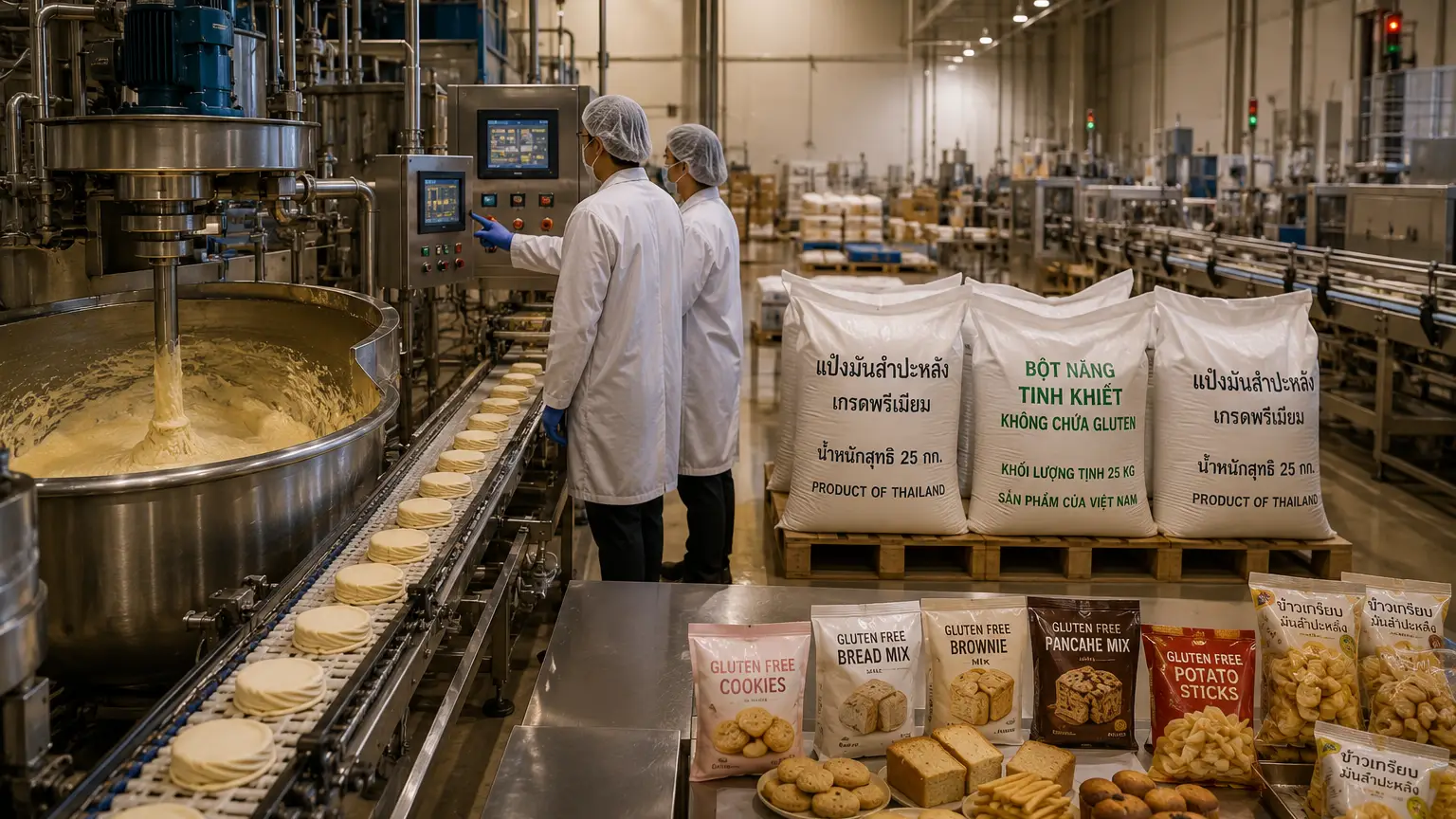
Southeast Asia is simultaneously the world's largest producer of tapioca starch and one of its fastest-growing consumer markets, yet the two dynamics are driven by very different forces. On the supply side, Thailand and Vietnam together account for the bulk of global tapioca starch exports, with Thailand processing over 4 million metric tons of cassava starch annually. On the demand side, a structurally different trend is taking hold: food manufacturers across Indonesia, Malaysia, the Philippines, and Vietnam are reformulating product lines to meet rising consumer and export-market demand for gluten-free, clean-label, and allergen-free ingredients. Tapioca starch sits at the center of both shifts. The global tapioca starch market was valued at approximately USD 4.7 billion in 2023 and is forecast to reach USD 8.1 billion by 2033, growing at a CAGR of 5.6% (Market.us, 2025), with food applications accounting for close to 58% of total global consumption.
For food manufacturers sourcing gluten-free ingredients in Southeast Asia, tapioca starch offers a combination of functional performance, regional supply proximity, and cost competitiveness that no imported wheat-starch alternative can match. Understanding how it performs across specific application categories, and what procurement specifications matter in each, is essential for procurement teams building gluten-free product lines.
Tapioca starch displaced wheat starch in gluten-free formulation across Southeast Asia not primarily because of health marketing, but because its functional properties align closely with what food manufacturers already need. Its near-zero amylose content in the native waxy form produces clear, cohesive gels with high viscosity, properties that perform better in tropical humidity conditions than potato or corn starch alternatives. It carries no discernible flavor, which matters in a region where processed food formulations are flavor-sensitive and where off-notes from starch can disrupt final product quality. It is naturally non-GMO, as no commercially viable GMO cassava cultivar exists, which simplifies certification processes for manufacturers targeting export markets in Europe and North America.
The clean-label transition in Southeast Asian food manufacturing accelerated after 2020, when large contract manufacturers in Thailand, Indonesia, and Vietnam began receiving reformulation mandates from European and North American brand owners requiring allergen-free ingredient declarations. Tapioca starch qualified without modification. In Southeast Asia, online gluten-free product listings across e-commerce platforms grew by 35% in 2023 alone (Market Growth Reports, 2024), signaling that demand was building at the retail level simultaneously with the industrial reformulation push.
Gluten-free bakery is the most technically demanding application for tapioca starch because wheat gluten serves structural functions that no single starch can replicate alone. In bread formulations, tapioca starch is blended with rice flour or cassava flour to approximate the elasticity and crumb structure that gluten provides. On its own, tapioca starch contributes chewiness, crust development, and moisture retention, the latter being particularly important in high-humidity markets like Indonesia and the Philippines, where shelf life degradation is a key challenge for packaged bakery products.
In biscuits and crackers, food-grade tapioca starch functions as both a binder and a crisping agent when used in extruded or baked formats. Manufacturers in Thailand and Vietnam supplying private-label gluten-free biscuits to European retail chains use tapioca starch as the primary starch base, often specifying native food-grade material with moisture content below 13% and viscosity in the 600-800 BU range to ensure consistent batch performance. For snack extrudates, particularly the rice cracker and cassava chip formats popular in Southeast Asian convenience retail, tapioca starch controls expansion ratio and surface texture during high-temperature extrusion.
The bakery segment represents the largest single application volume for gluten-free tapioca starch in Southeast Asia. Thailand's export-oriented bakery ingredient manufacturers, supplying to Japan, South Korea, and Australian retail, are among the most technically sophisticated buyers of specification-grade tapioca starch in the region.
In yogurt production, tapioca starch prevents syneresis, the separation of liquid whey from the gel matrix during storage, which is the most commercially damaging quality defect in ambient and chilled dairy formats. It produces a glossy, smooth gel texture when used at concentrations of 1-3% of total formulation weight, and its neutral flavor does not interfere with cultured dairy profiles the way corn starch can.
The more significant growth in Southeast Asia, however, is in dairy alternative applications. Plant-based milk production, particularly oat, almond, and coconut milk formats sold through modern trade channels in Indonesia, Malaysia, and Singapore, uses tapioca starch as a suspension stabilizer and viscosity modifier. Without a starch stabilizer, plant-based milks separate rapidly in tropical temperatures, making shelf life a commercial impossibility without refrigerated distribution. Modified tapioca starch, specifically acetylated distarch adipate (E1422), is preferred in this application for its superior stability across temperature and pH ranges, and for its resistance to syneresis after freeze-thaw cycling in cold-chain distributed products.
Indonesia is the fastest-growing market for plant-based dairy alternatives in Southeast Asia, with modern trade retail channels expanding rapidly in Java and Sumatra. Procurement teams at Indonesian dairy alternative manufacturers increasingly specify tapioca starch from Thailand with HALAL certification and documented traceability to the processing mill, reflecting both domestic regulatory requirements and the export compliance standards of the brand owners they supply.
Southeast Asia's snack manufacturing sector is the region's most volume-intensive buyer of tapioca starch outside commodity food production. Extruded snacks, coated peanuts, fish crackers (kerupuk in Indonesia, kropek in the Philippines), and cassava-based chips all rely on tapioca starch to control expansion, adhesion, and surface texture. In coated snack formats, tapioca starch forms the binding layer between the nut or protein core and the flavoring coat, replacing wheat flour in manufacturers seeking to produce gluten-free certified products for modern trade and export channels.
The kerupuk category alone represents a multi-billion-rupiah domestic market in Indonesia, with hundreds of small to mid-scale producers sourcing tapioca starch on spot terms from local traders rather than through direct supply agreements. This fragmented procurement pattern means price sensitivity is high and specification tolerance is broader than in dairy or pharmaceutical applications. Industrial-grade tapioca starch, with typical moisture content below 14% and whiteness above 90%, is the standard for this segment.
The more commercially significant trend is the entry of large Indonesian and Malaysian snack manufacturers into export-oriented gluten-free snack categories. Companies supplying halal-certified, gluten-free extruded snacks to Middle Eastern, Australian, and European retail channels require food-grade tapioca starch with full allergen documentation, HALAL certification, and COA batch traceability. This segment is where procurement is shifting from spot to contract purchasing, as export brand owners impose supplier qualification requirements that small local traders cannot meet.
The single most common procurement error for tapioca starch in food applications is specifying by price tier rather than by functional grade. Native tapioca starch performs well in bakery blends and dry snack applications but is inadequate for chilled dairy products or acidic sauce formulations, where modified grades with enhanced freeze-thaw stability and acid resistance are technically required.
Four grade categories are commercially relevant to Southeast Asian food manufacturers:
Native food-grade tapioca starch, the most widely traded form, covers bakery blends, dry snack applications, and general food thickening where processing conditions are mild and pH is neutral to mildly acidic. Moisture content below 13% and viscosity above 500 BU are standard procurement parameters.
Pre-gelatinized (cold-water swelling) tapioca starch dissolves without heat and is used in instant food formulations, including instant noodle seasoning coatings, instant soup bases, and dry-mix products. This grade commands a price premium over native starch and is produced by drum drying or spray drying native starch.
Waxy tapioca starch, with amylopectin content approaching 100%, produces exceptionally clear and elastic gels preferred in high-clarity dessert and confectionery applications, and in dairy stabilizer systems where gel transparency is a product quality criterion.
Modified tapioca starch, covering acetylated, hydroxypropylated, and cross-linked variants, serves applications requiring acid stability, freeze-thaw resistance, or high-temperature processing stability. Modified starches are the highest-value segment and are used disproportionately in dairy alternative, canned food, and export-grade processed food production.
Buyers evaluating suppliers across these grade categories should prioritize documentation capability, specifically COA batch records, HALAL and food safety certifications, and moisture, viscosity, and whiteness test results, over unit price comparisons. Procurement teams seeking a verified Southeast Asia-region tapioca starch supplier with consistent grade documentation and multi-country distribution capability can review Tradeasia International's tapioca starch product portfolio for specification sheets, available grades, and sourcing inquiries. Tradeasia International's regional network spans Thailand, Vietnam, and Indonesia, the three primary production centers for food-grade tapioca starch in Southeast Asia.
Tapioca starch buyers in Southeast Asia split into three structurally distinct procurement tiers. The first tier is large export-oriented food manufacturers in Thailand, Indonesia, Malaysia, and Vietnam, supplying branded and private-label products to Japan, South Korea, Australia, the Middle East, and Europe. These buyers purchase on annual supply agreements, specify food-grade or modified grades, and require full documentation packages. They represent a minority of buyer count but the majority of value.
The second tier is mid-scale domestic food processors, including dairy producers, snack manufacturers, and bakery ingredient companies, primarily serving domestic modern trade and foodservice channels. This group purchases on quarterly or semi-annual agreements, is more price-sensitive than the first tier, and typically specifies native food-grade starch without demanding the full documentation stack required for export compliance.
The third tier is the highly fragmented small-scale food production sector: artisanal snack producers, traditional food manufacturers (kerupuk, mochi, bánh cuốn), and street food input suppliers. This group buys on spot terms through local traders and is almost entirely price-driven.
The most commercially significant structural shift underway is the migration of second-tier buyers into first-tier procurement behavior, driven by export ambitions and modern retail compliance requirements. As Indonesian and Filipino food manufacturers expand their export presence in halal-certified and health-positioned food categories, their procurement specifications are upgrading to match export-market requirements, creating volume demand for documented, certified tapioca starch grades that local spot-market traders are not equipped to supply.
Thailand and Vietnam together supply the majority of food-grade tapioca starch traded in Southeast Asia, with Thailand ranking as the world's largest exporter despite Nigeria producing the most raw cassava globally. This concentration creates a seasonal supply risk: cassava harvest cycles in Thailand peak between October and March, and procurement teams sourcing outside this window face reduced availability and higher spot prices, particularly for specialty modified grades where processing capacity is limited.
Weather events affecting cassava yields in Thailand's Nakhon Ratchasima and Chaiyaphum provinces, the country's primary starch-producing regions, can transmit within weeks into regional price movements. Thai Wah's 2024 announcement of a USD 40 million investment in a new Vietnam processing facility with 200,000 mt annual capacity signals that the industry recognizes the need to diversify production geography. For procurement teams, this means multi-country sourcing, splitting volumes between Thai and Vietnamese origins, is a practical risk mitigation strategy rather than a purely cost optimization exercise.
HALAL certification is a non-negotiable procurement requirement for food manufacturers supplying Muslim-majority markets, including Indonesia, Malaysia, and Middle Eastern export channels. Tapioca starch is inherently plant-derived and HALAL-compliant, but the processing facility certification and supply chain documentation must be in place. Buyers should verify that supplier certificates are current and issued by recognized certifying bodies (MUI in Indonesia, JAKIM in Malaysia) before committing to supply agreements.
The structural demand growth for gluten-free tapioca starch in Southeast Asia is not primarily driven by domestic celiac disease prevalence, which remains underdocumented across the region, but by export-market compliance requirements and the domestic clean-label movement converging simultaneously. As Southeast Asian food manufacturers deepen their positions in export categories requiring allergen-free documentation, and as domestic modern trade retailers in Indonesia, Thailand, and Vietnam expand their health-positioned private label ranges, the volume of specification-grade tapioca starch required by the regional food industry will grow faster than the overall market.
The next phase of demand will be led by Indonesia and Vietnam rather than Thailand, which already has a mature domestic starch processing and supply infrastructure. Indonesia's expanding class of export-oriented food manufacturers, combined with the government's food industry development programs, is creating a new industrial buyer base for certified, documented tapioca starch that regional suppliers and international trading companies are only beginning to serve systematically. For procurement teams and ingredient distributors positioning for this shift, establishing documented supply chains now, before export compliance requirements become standard practice across the Indonesian food industry, is the commercially rational move.
We're committed to your privacy. Tradeasia uses the information you provide to us to contact you about our relevant content, products, and services. For more information, check out our privacy policy.


 English
 Indonesian
 简体字
简体字
 العربية
 Español
 Français
 Português
 日本語
日本語
 한국어
한국어
 Tiếng Việt



















