Explore our network of country and industry based websites to access localized information, product offerings, and business services across our group.
Log in to start sending quotation requests for any product.
Don't have an account? Sign Up Here
Home Vital Wheat Gluten: Key Applications and B2B Buyer Insights
Trade Insights | Applications and Buyers | 12 August 2026

Understanding Vital Wheat Gluten in Commercial Food Manufacturing
Vital Wheat Gluten Applications in Bakery Products
Applications Beyond Traditional Bakery
Key Industries and Commercial Buyers
Buyer Priorities When Sourcing Vital Wheat Gluten
Supply and Procurement Considerations
Choosing a B2B Sourcing Partner
Conclusion: Vital Wheat Gluten as a Strategic Food Ingredient
Sources
Vital Wheat Gluten is a wheat-derived protein ingredient used by food manufacturers where functional protein performance is important to the finished formulation. Unlike ingredients selected only for basic composition, Vital Wheat Gluten can be incorporated into formulations where dough characteristics, structure, elasticity, and protein functionality influence manufacturing performance. This makes it commercially relevant to processors seeking consistency across production batches.
For procurement teams, understanding the functional role of Vital Wheat Gluten is important before evaluating suppliers. The ingredient is particularly relevant when manufacturers need to manage formulation performance while maintaining an efficient raw-material portfolio. Its role should therefore be considered alongside the technical requirements of the final product rather than treated simply as another commodity ingredient.
In commercial food production, ingredient functionality can directly influence processing efficiency and finished-product characteristics. Vital Wheat Gluten is therefore of interest to manufacturers that require an ingredient capable of supporting specific formulation objectives. The value proposition is linked not only to the material itself but also to its consistency, suitability for the intended application, and compatibility with established production processes.
This creates a practical purchasing distinction between simply buying wheat protein and strategically sourcing Vital Wheat Gluten for a defined manufacturing purpose. Buyers need to consider the intended food application, formulation requirements, handling conditions, documentation, and supply expectations before selecting a commercial source.
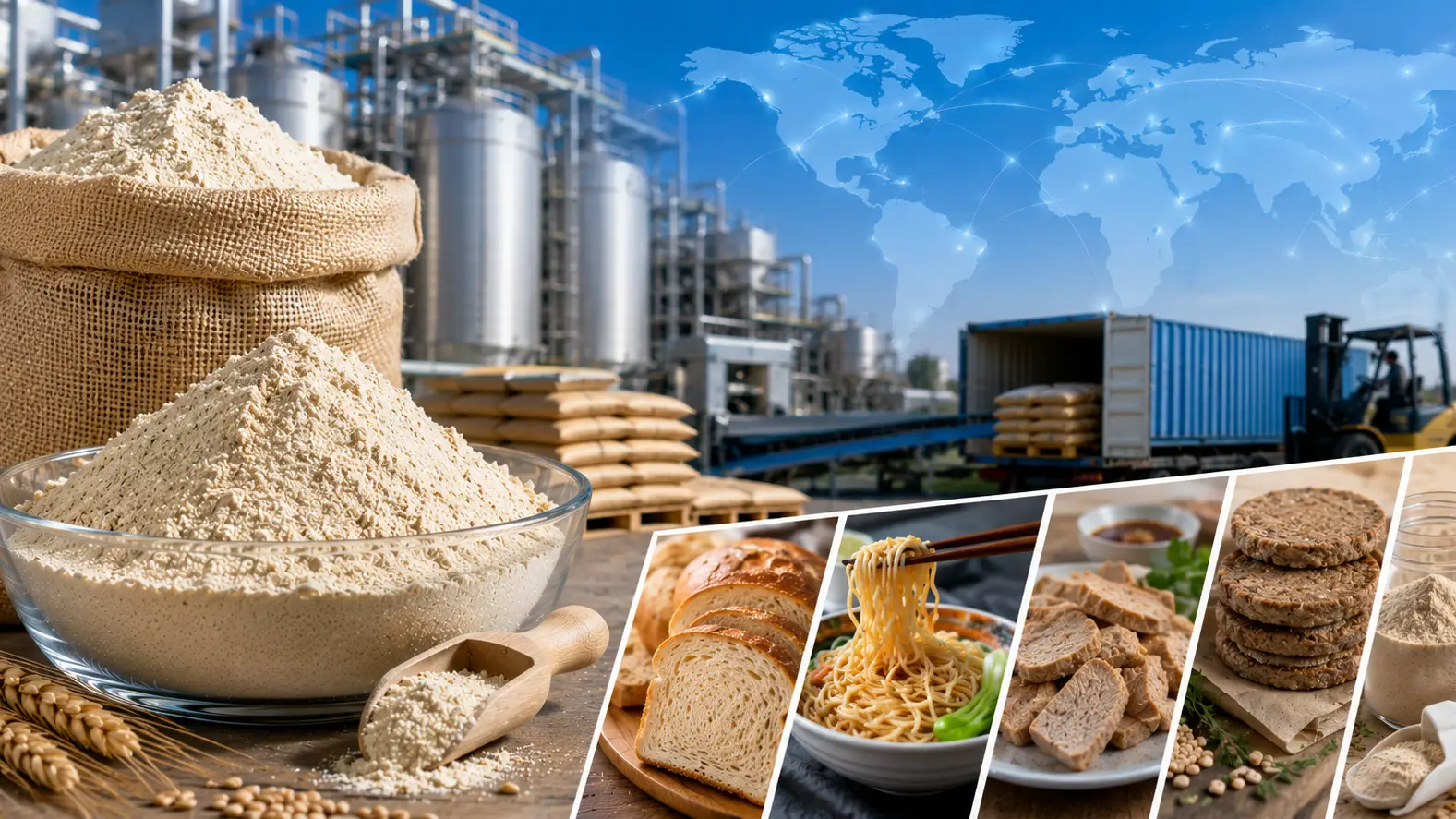
Bakery remains one of the most commercially relevant application areas for Vital Wheat Gluten. Manufacturers can use it in dough formulations where protein functionality and dough performance are important considerations. Commercial bakeries, industrial bread producers, flour processors, and prepared-bakery manufacturers may therefore evaluate Vital Wheat Gluten as part of their ingredient strategy.
For large-scale bakery operations, consistency is especially important because formulations are often produced repeatedly across multiple production runs. A suitable Vital Wheat Gluten supply can help procurement and technical teams maintain a predictable ingredient specification while supporting established processing requirements. This makes supplier reliability an important consideration alongside price.
Vital Wheat Gluten can also be relevant to bread and other flour-based products where manufacturers seek to optimize formulation performance. Its application can be assessed according to the product's desired texture, structure, processing behavior, and overall formulation requirements. The exact inclusion level and processing approach remain dependent on the manufacturer's recipe and technical specifications.
For flour mills and industrial bakery ingredient buyers, Vital Wheat Gluten can consequently represent a targeted formulation ingredient rather than a universal additive. Procurement decisions should be connected to the technical purpose of the material, expected production volumes, quality specifications, and compatibility with the manufacturer's existing flour and ingredient systems.
Vital Wheat Gluten has commercial relevance beyond conventional bakery because wheat protein can be incorporated into food formulations where a protein-based ingredient is required. Plant-based food manufacturers may evaluate it for formulations where wheat protein functionality contributes to the intended product structure. This makes the ingredient relevant to manufacturers developing or producing wheat-protein-based food products.
For buyers in this segment, application suitability is particularly important because product developers must balance ingredient functionality with the characteristics of the finished formulation. Procurement teams may therefore work closely with technical departments to assess specification, processing behavior, supply consistency, and suitability for the targeted product category before committing to larger-volume purchasing.
Processed food manufacturers may also consider Vital Wheat Gluten when developing formulations that require wheat protein as part of the ingredient system. Its commercial relevance depends on the formulation objective and the technical requirements of each finished product. This allows buyers to approach sourcing according to application rather than relying on a one-size-fits-all purchasing model.
From a procurement perspective, this creates opportunities for suppliers that can communicate product specifications clearly and support buyers with consistent commercial documentation. Manufacturers generally need to understand what they are purchasing, how it fits into their formulation, and whether the material can be integrated into their existing production workflow.
Food manufacturers represent a broad buyer group because Vital Wheat Gluten can serve different formulation purposes across food categories. Large processors may purchase through structured procurement programs, while specialized manufacturers may source according to specific formulation or production requirements. In both cases, the buying decision extends beyond the nominal product name.
Procurement teams typically need to align ingredient selection with technical specifications, expected volumes, production schedules, storage requirements, and commercial terms. This means that a supplier's ability to provide clear product information and dependable communication can be as important as the initial quotation when establishing a sustainable B2B supply relationship.
Ingredient distributors and trading companies can also represent an important commercial buyer segment. These businesses may source Vital Wheat Gluten for onward supply to bakeries, food processors, manufacturers, or regional customers. Their requirements can differ from those of direct users because they may prioritize supply continuity, packaging formats, documentation, market coverage, and commercial flexibility.
For distributors, supplier selection is therefore closely connected to downstream customer requirements. A dependable source can help distributors maintain their own product portfolio while responding efficiently to customer inquiries. Clear specifications and transparent commercial communication are particularly valuable when a material is being supplied across multiple markets or customer segments.
Product specification is one of the first considerations for professional buyers. Before purchasing Vital Wheat Gluten, procurement teams should establish the technical parameters required by their formulation and manufacturing process. The specification should be clear enough for purchasing, quality assurance, research and development, and production teams to evaluate the same material against consistent criteria.
This approach reduces the risk of selecting a product based only on price while overlooking application suitability. For recurring purchases, buyers can also use the agreed specification as a reference point for future orders, supplier evaluations, and quality-control procedures. A clearly defined requirement creates a stronger foundation for long-term sourcing.
Consistency is another important consideration for industrial buyers because food manufacturers need predictable raw materials across production cycles. Variations in a functional ingredient can create additional technical work when formulations or processing conditions need to be adjusted. Buyers should therefore evaluate whether a potential supplier can support consistent commercial supply and provide the documentation required for internal approval.
Documentation also supports communication between procurement and technical departments. Product specifications, quality information, packaging details, and other relevant commercial documents can help buyers compare suppliers more efficiently. In B2B food ingredient procurement, transparent documentation contributes to confidence before an order is finalized.
Commercial buyers should evaluate Vital Wheat Gluten requirements according to expected consumption rather than individual purchase orders alone. Food manufacturers with recurring production schedules can benefit from forward planning that connects ingredient demand with production requirements. This can help procurement teams manage purchasing cycles and reduce the risk of reactive sourcing.
Volume planning is also relevant for distributors and traders because customer demand can fluctuate between markets and applications. Establishing realistic purchasing requirements allows buyers to approach suppliers with clearer commercial expectations. It also creates a stronger basis for discussing packaging, shipment planning, delivery schedules, and recurring supply arrangements.
Price is naturally an important component of sourcing, but professional buyers generally need to assess total commercial suitability rather than selecting the lowest quoted price automatically. Product specification, supply consistency, documentation, delivery capability, packaging, and communication can all influence the practical value of a supplier relationship.
A structured comparison can help procurement teams distinguish between short-term purchasing opportunities and suppliers capable of supporting longer-term requirements. For Vital Wheat Gluten, this is especially relevant when the ingredient forms part of a recurring manufacturing process. Reliable sourcing can reduce procurement friction and provide greater predictability for production planning.
A suitable B2B supplier should be able to communicate Vital Wheat Gluten specifications clearly and understand the commercial requirements of food-industry buyers. Procurement teams benefit from suppliers that can respond efficiently to product inquiries, provide relevant documentation, and discuss supply requirements according to the buyer's intended application.
Supplier capability is ultimately demonstrated through the complete purchasing process rather than through a product description alone. Responsiveness, transparency, consistency, and the ability to understand buyer requirements all contribute to a stronger sourcing experience. These factors can become increasingly important as purchase volumes and customer requirements grow.
A B2B marketplace can provide a practical route for buyers seeking to evaluate ingredient suppliers and identify sourcing opportunities. For Vital Wheat Gluten, marketplace visibility can connect food manufacturers, distributors, traders, and procurement teams with suppliers serving commercial ingredient requirements.
For buyers, the objective should be to move from product discovery toward qualified sourcing. This means defining the application, specification, required volume, documentation expectations, and commercial terms before evaluating potential supply options. A structured B2B marketplace approach can make that process more organized while supporting communication between buyers and suppliers.
Vital Wheat Gluten occupies a useful position within commercial food manufacturing because its relevance extends from bakery formulations to other food applications requiring wheat protein functionality. Its value to manufacturers depends on how effectively the ingredient supports a defined formulation and production objective. This makes application knowledge an important part of professional sourcing.
For buyers, the strongest purchasing decisions connect technical requirements with commercial realities. Instead of viewing Vital Wheat Gluten solely as a raw material, procurement teams can evaluate it according to application, specification, supply consistency, documentation, and long-term purchasing requirements. This approach supports more informed sourcing decisions across food manufacturing and distribution channels.
As food manufacturers and ingredient distributors manage increasingly structured procurement processes, reliable access to suitable raw materials becomes an important part of operational planning. Vital Wheat Gluten buyers can benefit from comparing suppliers according to both product suitability and commercial capability, particularly when the ingredient is intended for recurring production.
Tradeasia / Chemtradeasia / Tradechem Marketplace can serve as a commercial platform for connecting buyers with relevant ingredient sourcing opportunities. By bringing product requirements, supplier communication, and B2B procurement needs into a structured marketplace environment, the platform can support food-industry businesses seeking practical sourcing solutions for Vital Wheat Gluten.
Codex Alimentarius — Standard for Wheat Protein Products Including Wheat Gluten
We're committed to your privacy. Tradeasia uses the information you provide to us to contact you about our relevant content, products, and services. For more information, check out our privacy policy.


 English
 Indonesian
 简体字
简体字
 العربية
 Español
 Français
 Português
 日本語
日本語
 한국어
한국어
 Tiếng Việt