Explore our network of country and industry based websites to access localized information, product offerings, and business services across our group.
Log in to start sending quotation requests for any product.
Don't have an account? Sign Up Here
Home Cashew in Global Trade: From Origin Farms to International Processing Hubs
Market Insight | 25 November 2025
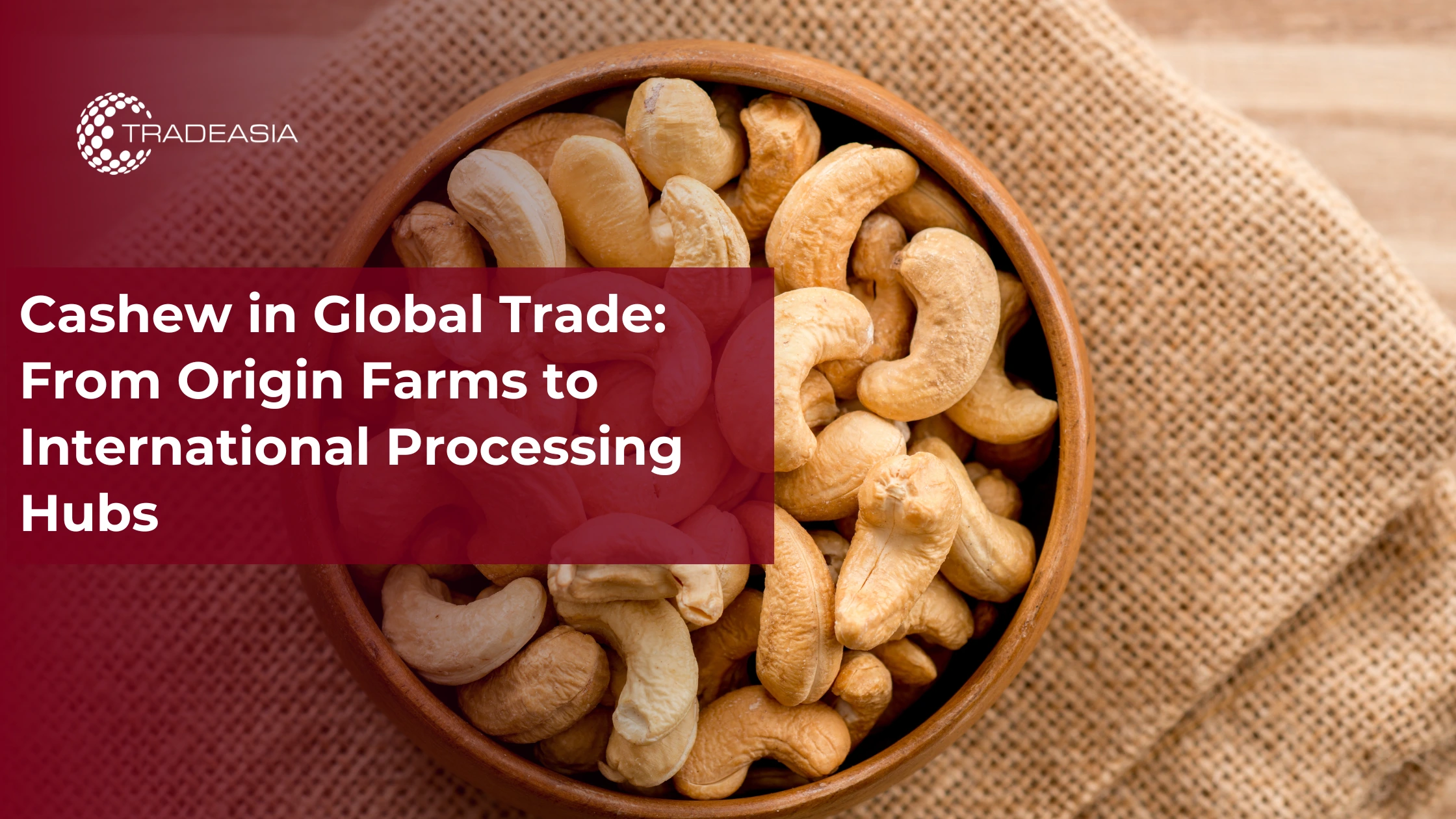
Cashew nuts embody an intricate global journey that begins in tropical farms and culminates in sophisticated processing hubs, reflecting a complex value chain shaped by diverse actors, regional expertise, and evolving market demands. By 2025, understanding the pathway from raw cashew cultivation to international trade and consumption is essential for traders, manufacturers, and investors seeking to navigate the dynamic global cashew market.
Cashew trees thrive in tropical climates, with West Africa, India, Vietnam, and parts of Latin America serving as leading production zones. Côte d'Ivoire, Ghana, Nigeria, and Benin dominate African output, producing over 1 million metric tons collectively in recent years. India and Vietnam contribute substantial volumes, with India’s monsoon-dependent harvest variably reaching around 780,000 tonnes, while Vietnam plays an outsized role as a processing and export powerhouse.
Farmers grapple with climatic uncertainties, labor-intensive harvesting, and post-harvest challenges. In response, many countries have introduced government programs to support seedling distribution, price guarantees, and agricultural training, boosting yields and initial quality.
A distinctive feature of the global cashew value chain is the heavy reliance on international processing hubs, primarily Vietnam and India. Vietnam, renowned for mechanized shelling and high processing capacity, handled roughly 730,000 tons of cashew exports in 2024—including nuts sourced from Africa. This accounted for over 80% of global processed cashew kernel exports, generating export revenues exceeding $4.3 billion.
While Africa produces the majority of raw nuts, local processing remains limited—only about 10% of raw cashews are processed within the continent. Challenges include infrastructure gaps, high labor costs, and capital constraints. Nevertheless, initiatives like the Prosper Cashew project are gradually enhancing processing yields and promoting value addition closer to farms.
The international cashew trade involves multiple interconnected markets. Vietnam’s role as a major exporter is pivotal, with key trading partners such as the United States, China, the Netherlands, Turkey, and Germany representing primary destinations. U.S. wholesalers and organic food retailers show strong demand, while China’s expanding middle-class and snack industry fuel rapid import growth.
Market prices reflect a mix of supply-demand balance, quality premiums, tariff regimes, and emerging consumption patterns. In 2024-2025, the average price for Vietnamese cashew kernels hovered above $6,000 per ton, driven by demand for whole white kernels and specialty grades.
Meanwhile, new processing facilities in the Middle East, notably in Dubai and Riyadh, contract multi-year supply agreements, ensuring steady inventory aligned with growing regional demand for premium, plant-based protein snacks.
Climate volatility—such as droughts or irregular rainfall—remains a significant risk factor affecting farm productivity and pricing. Supply chain complexities, geopolitical risks, and evolving trade policies require stakeholders to adopt agile sourcing and risk management strategies.
Investments in mechanization, digital traceability platforms, and sustainability certifications are becoming industry standards to boost competitiveness and transparency. Stakeholders emphasize collaborative value chain models to enhance livelihoods while meeting global quality expectations.
Source:
https://www.mordorintelligence.com/industry-reports/global-cashew-market
https://www.cognitivemarketresearch.com/cashew-nuts-market-report
We're committed to your privacy. Tradeasia uses the information you provide to us to contact you about our relevant content, products, and services. For more information, check out our privacy policy.


 English
 Indonesian
 简体字
简体字
 العربية
 Español
 Français
 Português
 日本語
日本語
 한국어
한국어
 Tiếng Việt