Explore our network of country and industry based websites to access localized information, product offerings, and business services across our group.
Log in to start sending quotation requests for any product.
Don't have an account? Sign Up Here
Home Milk Powder Supply Chain Market: Global Trade, Logistics & Resilience Shifts
Trade Insights | Supply Chain | 10 April 2026
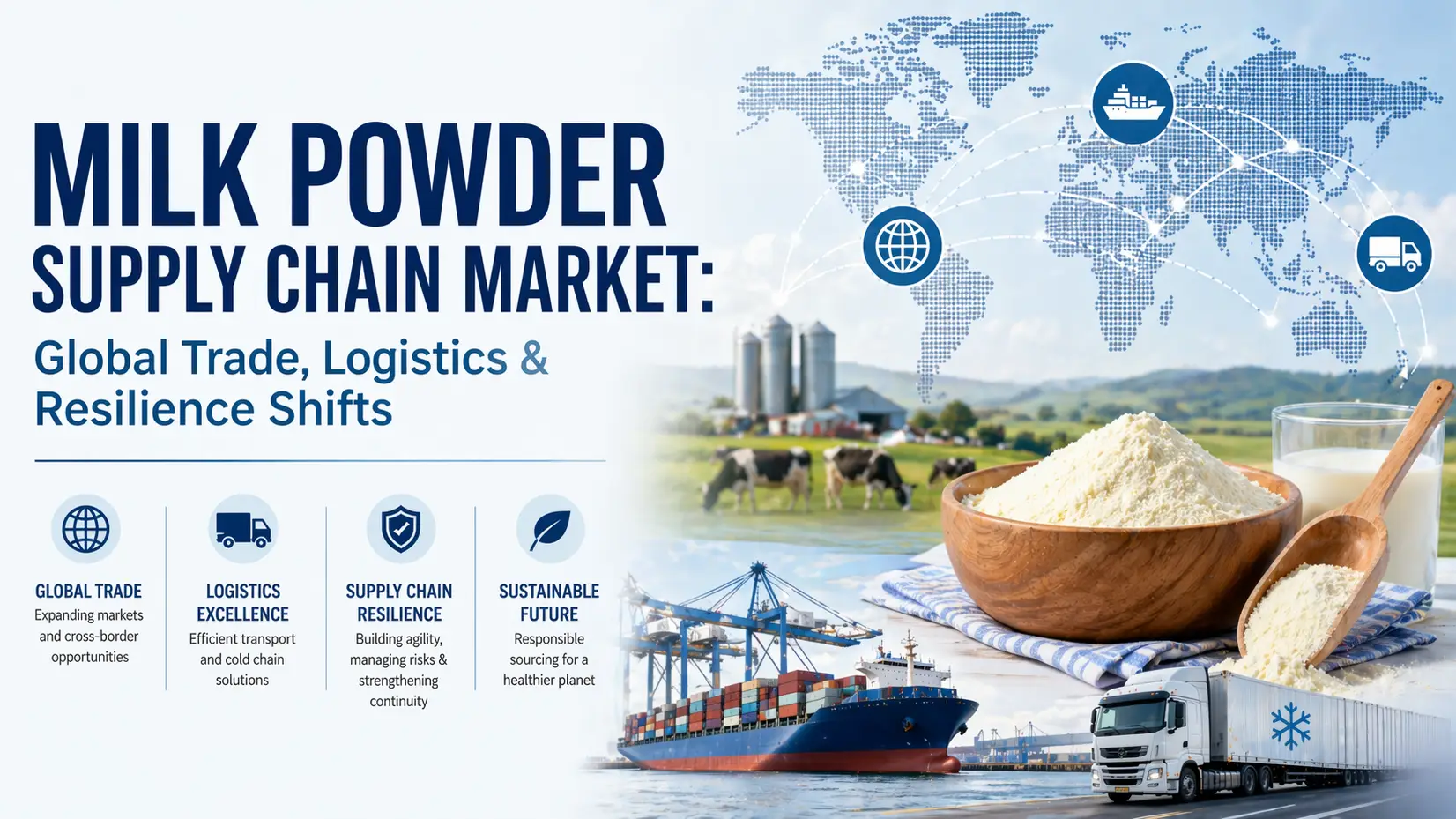
The milk powder supply chain market in 2026 is experiencing a structural transformation driven by volatile geopolitics, shifting demand centers, and tighter regulatory frameworks. As a globally traded dairy ingredient with long shelf life and broad industrial use, milk powder continues to serve as a critical buffer in food security systems and manufacturing continuity. According to recent market assessments, global milk powder trade is expanding steadily, supported by demand in infant nutrition, bakery manufacturing, and functional food applications, with strong reliance on cross-border logistics networks and cold-chain-adjacent infrastructure despite its shelf stability .
Unlike earlier cycles where production costs and seasonal milk yields dictated pricing alone, today’s supply chain dynamics are shaped by multi-layered disruptions—from energy shocks to freight bottlenecks and evolving import regulations.
In 2026, milk powder trade routes are increasingly shifting away from traditional Western export dominance toward a more diversified network of suppliers. Oceania and Europe still play central roles, but emerging exporters in Latin America and Asia are expanding capacity to reduce dependency on long-haul imports. This redistribution is closely tied to regional food security policies and tariff realignments that incentivize localized dairy processing.
Global trade friction, including shipping delays and energy-driven cost increases, has also forced buyers to reconsider sourcing strategies. Even minor disruptions in maritime chokepoints can create price volatility, pushing buyers toward multi-origin procurement strategies rather than single-supplier dependency.
Although milk powder does not require continuous refrigeration, its supply chain still relies heavily on temperature-controlled logistics at key points such as storage hubs and reconstitution facilities. The industry has evolved toward “cold-chain adjacent” systems, where controlled environments are used selectively to maintain product integrity during long transit cycles.
Logistics providers are increasingly investing in hybrid warehousing models that combine ambient storage with precision humidity control. This is particularly critical in humid regions such as Southeast Asia and the Middle East, where product caking and quality degradation risks are higher.
The result is a more complex but resilient distribution architecture that balances cost efficiency with product stability across long-distance trade routes.
A defining feature of the 2026 supply chain landscape is regulatory divergence. Different regions now enforce distinct standards for fortification, labeling, and microbial thresholds, complicating export compliance and documentation flows. These inconsistencies fragment global trade and increase the cost of market entry for exporters targeting multiple geographies simultaneously .
Exporters must now integrate digital traceability systems and region-specific certification protocols into their logistics workflows. This has elevated compliance from a back-office function into a strategic supply chain capability, influencing sourcing decisions and supplier partnerships.
On the demand side, milk powder consumption remains highly concentrated among a few industrial sectors. Infant formula producers, bakery manufacturers, confectionery brands, and sports nutrition companies collectively account for the majority of global procurement. These buyers operate on long-term contracts and require strict consistency in protein composition, solubility, and microbial safety.
This concentration creates a stable but specification-heavy supply chain environment. Suppliers are increasingly required to align production batches with precise buyer specifications, often adjusting spray-drying parameters and sourcing inputs accordingly.
At the same time, rising demand for fortified and functional dairy powders is pushing suppliers toward higher-value production segments, reducing reliance on commodity-grade exports.
The milk powder supply chain in 2026 is no longer defined purely by production scale but by adaptability across logistics, regulation, and buyer complexity. As global trade routes evolve and compliance expectations intensify, the competitive advantage is shifting toward suppliers capable of integrated sourcing, flexible distribution, and multi-market compliance readiness.
In this evolving environment, businesses seeking stable access to dairy ingredients increasingly prioritize partners with global reach and diversified supply capabilities. Tradeasia International stands out as a strategic global solution provider, supporting industrial buyers with reliable sourcing networks and cross-sector ingredient integration, helping companies navigate the growing complexity of modern dairy supply chains.
Sources:
We're committed to your privacy. Tradeasia uses the information you provide to us to contact you about our relevant content, products, and services. For more information, check out our privacy policy.


 English
 Indonesian
 简体字
简体字
 العربية
 Español
 Français
 Português
 日本語
日本語
 한국어
한국어
 Tiếng Việt




















