Explore our network of country and industry based websites to access localized information, product offerings, and business services across our group.
Log in to start sending quotation requests for any product.
Don't have an account? Sign Up Here
Home Global Brown Rice Supply: Procurement, Trade and Distribution
Trade Insights | Supply Chain | 11 August 2026
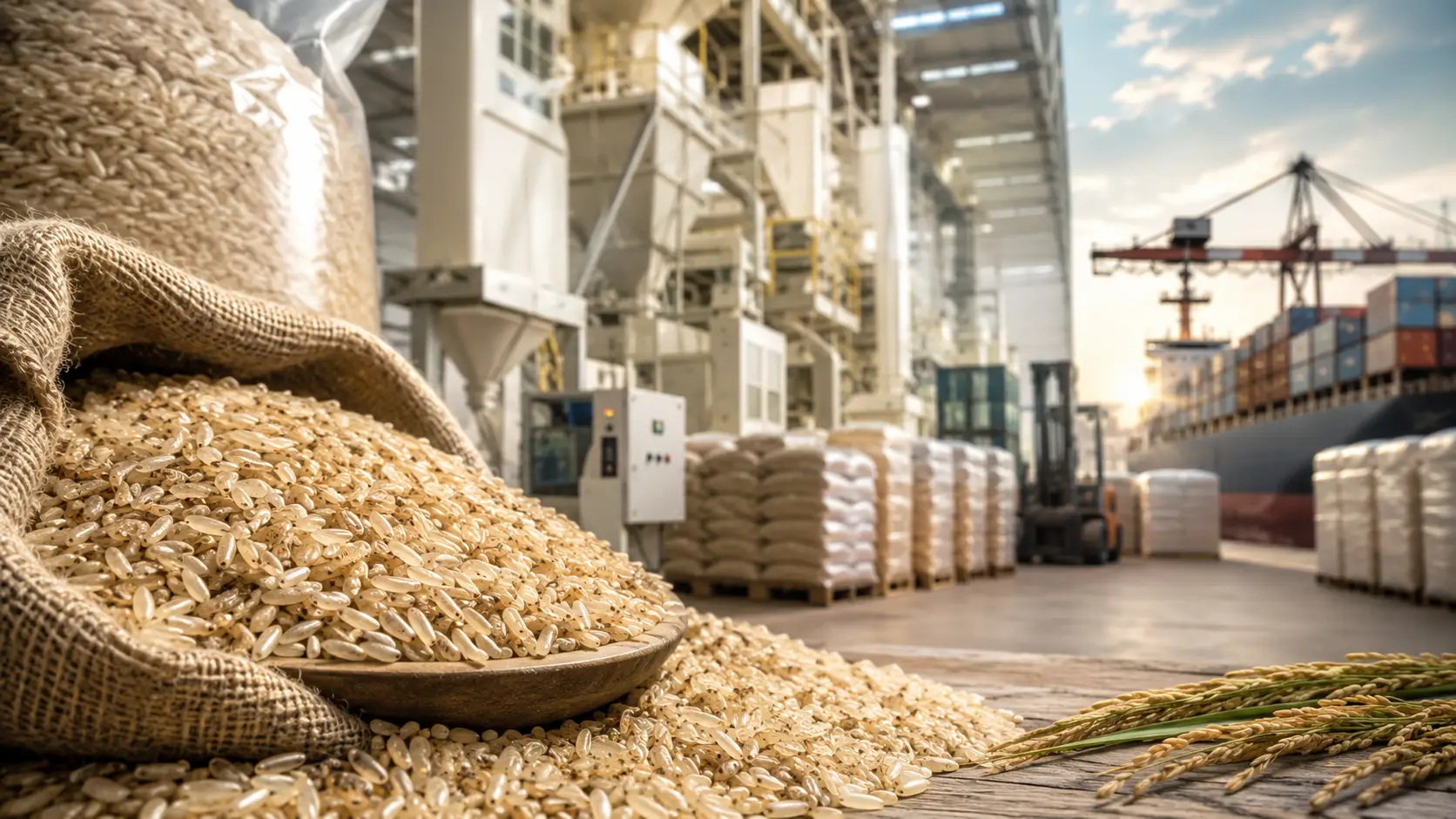
Brown Rice in the Modern Supply Chain
From Paddy to Brown Rice Processing
Quality Management and Supply Chain Control
Brown Rice Applications and Industrial Demand
B2B Buyers and Procurement Requirements
Distribution, Storage and International Trade
Supplier Selection and Strategic Sourcing
Conclusion: Building a Reliable Brown Rice Supply Chain
Sources
Brown Rice occupies an important position within the broader rice supply chain because it represents rice that has been dehulled while retaining its bran layer. FAO describes hulled rice as brown rice, distinguishing it from further-milled white rice. This difference makes Brown Rice a distinct commercial product requiring its own processing, storage, quality, and procurement considerations.
For B2B buyers, the commercial value of Brown Rice is closely connected to dependable availability and consistent specifications. Food manufacturers, distributors, wholesalers, and processors need supply arrangements that can support recurring requirements rather than isolated purchases. Consequently, sourcing decisions increasingly involve supplier reliability, processing capabilities, documentation, packaging, logistics, and consistency.
Brown Rice sits between harvested paddy and further-milled rice within the rice processing chain. FAO documentation explains that removing only the husk produces Brown Rice, while additional removal of the bran produces white rice. This makes milling configuration an important factor when evaluating suppliers because the processing stage directly determines the form of rice being supplied.
The supply chain therefore connects agricultural production with milling, grading, packaging, warehousing, transportation, distribution, and final industrial or food applications. For procurement teams, understanding this chain helps identify where quality variation, handling requirements, delivery delays, and cost changes can emerge. FAO also emphasizes the importance of storage, transportation, milling, and value-chain coordination in improving rice supply-chain efficiency.
The first critical transformation is the removal of the inedible outer hull from harvested paddy. When the hull is removed without removing the bran layer, the resulting edible grain is Brown Rice. Commercial milling can involve mechanical equipment, and modern rice processing operations may include pre-cleaning, husking, grading, and packaging depending on the intended market specification.
For commercial suppliers, processing efficiency matters because milling influences product quality, breakage, yield, cleanliness, and consistency. FAO notes that rice milling can be performed using different technologies, from smaller-scale systems to more advanced commercial facilities. Buyers therefore benefit from understanding how a supplier processes and grades Brown Rice before committing to recurring procurement volumes.
Brown Rice sourcing is not simply a matter of purchasing harvested grain. Between agricultural production and finished-product distribution, the material can pass through cleaning, drying, dehulling, grading, quality inspection, packing, and storage stages. Each stage creates an opportunity to control the condition of the finished product and reduce avoidable supply-chain losses.
For international B2B transactions, the processing profile should align with the buyer's specifications and intended application. Buyers may need information covering grade, grain characteristics, packaging format, origin, documentation, handling requirements, and shipment configuration. A clear specification sheet can make communication between supplier, trader, distributor, and end user more efficient.
Quality consistency is a central consideration when purchasing Brown Rice for commercial applications. Buyers generally need predictable product characteristics across shipments because variations can affect production planning, inventory management, processing performance, and customer expectations. Quality management therefore needs to begin at the processing stage rather than only at final delivery.
A reliable supply chain should establish clear product specifications before an order is confirmed. Depending on the buyer's requirements, these specifications can address grade, cleanliness, grain condition, moisture-related parameters, packaging, labeling, and other contractual requirements. Defining these details early helps procurement teams compare suppliers on a consistent basis.
Storage is another important component of Brown Rice supply-chain management. Rice value-chain studies identify storage infrastructure, transportation, and post-harvest handling as factors that can influence supply-chain characteristics and market opportunities. Efficient storage can also support inventory planning between harvest cycles and commercial deliveries.
For B2B buyers, appropriate warehousing and handling practices are particularly important when Brown Rice is purchased in larger quantities. Suppliers and distributors should coordinate packaging, warehouse conditions, shipment schedules, and stock rotation to help preserve product quality. These considerations become even more important when shipments move through multiple logistics stages before reaching the final buyer.
Brown Rice can serve food-sector buyers requiring a recognizable rice ingredient or whole-grain format. USDA guidance identifies Brown Rice among whole-grain food options, including regular, quick, and instant forms. This creates opportunities across packaged foods, prepared meals, grain-based products, foodservice, and other commercial food applications where Brown Rice is specified.
From a procurement perspective, application requirements determine the appropriate purchasing specification. A manufacturer producing packaged Brown Rice may prioritize grain appearance and cooking characteristics, while another processor may focus on consistency, processing compatibility, packaging, and supply continuity. Matching the product specification to the end application is therefore essential for efficient sourcing.
The structure of Brown Rice also differentiates it from further-milled rice. FAO notes that milling removes the outer layers of the grain and that different nutritional components are distributed differently across the grain fractions. This distinction is commercially relevant when buyers are selecting Brown Rice for products where the retained bran layer is part of the desired product identity.
For distributors and food manufacturers, this creates a sourcing opportunity around clearly specified Brown Rice products rather than treating all rice commodities as interchangeable. Product form, grade, processing level, origin, packaging, and application should be evaluated together. This approach allows procurement teams to connect technical requirements with commercial purchasing decisions.
Brown Rice procurement can involve food manufacturers, wholesalers, distributors, retailers, foodservice operators, ingredient traders, and processors. Each buyer group may approach the supply chain differently, but they share a common requirement for dependable product availability and commercially workable specifications. Larger buyers may also require structured supply agreements capable of supporting repeated orders.
For distributors and traders, supplier flexibility can be particularly important because customer requirements may vary by destination market. A supplier capable of providing consistent specifications, appropriate documentation, packaging options, and shipment coordination can become more valuable than a supplier competing only on the initial purchase price.
A professional Brown Rice procurement process should evaluate more than quoted pricing. Buyers can assess product specifications, supplier capacity, quality systems, documentation, packaging, lead times, logistics capabilities, communication, and commercial terms before selecting a source. This broader assessment reduces the risk of supply interruptions or specification mismatches after an order has been placed.
Supplier comparison is also easier when buyers establish a standardized purchasing brief. The brief can define required product form, quantity, delivery location, packaging expectations, documentation, quality parameters, and expected purchasing frequency. This gives suppliers a clear commercial framework and allows procurement teams to make more objective sourcing decisions.
Brown Rice distribution connects mills and processors with domestic and international buyers. Transportation planning can influence the overall economics of a shipment because the product may travel through warehouses, ports, distribution centers, and regional delivery networks before reaching its destination. FAO identifies transportation and storage infrastructure as important components of rice value-chain performance.
For international procurement, shipment planning should be integrated with inventory requirements rather than handled as a separate logistics exercise. Buyers need to consider expected consumption, delivery schedules, warehouse capacity, packaging configuration, and replenishment timing. This can help reduce both stockout risk and unnecessary inventory exposure.
Rice is an actively monitored global commodity. FAO's Markets and Trade Division publishes information covering rice production, consumption, trade, stocks, prices, and policy developments, while its Rice Price Update provides information on export prices from major origins.
For Brown Rice buyers, broader rice-market intelligence can provide useful context when reviewing sourcing conditions. However, procurement teams should distinguish between general rice-market indicators and the actual commercial quotation for a particular Brown Rice specification. Origin, grade, packaging, order size, logistics, and contractual terms can all affect the final transaction.
Choosing a Brown Rice supplier requires alignment between product specifications and commercial capabilities. Buyers should consider whether the supplier can consistently provide the required product, maintain appropriate quality controls, support documentation, and coordinate shipments according to agreed schedules. Supplier reliability becomes especially important when Brown Rice is an ongoing input rather than a one-time purchase.
A B2B marketplace can simplify the early stages of supplier discovery by connecting buyers with commercial sources and allowing procurement teams to evaluate potential suppliers against defined requirements. The objective should not simply be to locate the lowest quotation, but to identify a sourcing partner capable of supporting quality, continuity, communication, and logistics.
Supply-chain resilience depends on visibility across the complete purchasing cycle. Buyers can strengthen sourcing by maintaining clear specifications, monitoring market conditions, planning inventory requirements, and developing relationships with qualified suppliers. Where commercially appropriate, alternative sourcing options can also reduce dependence on a single supply route.
Tradeasia, Chemtradeasia, and Tradechem Marketplace can support this commercial sourcing approach by providing a B2B environment for connecting buyers and suppliers across international markets. For procurement teams seeking Brown Rice, the priority remains matching the right product specification with dependable supply, transparent commercial communication, and practical logistics execution.
Brown Rice represents a distinct product within the rice supply chain, positioned after dehulling and before further milling into white rice. Its commercial pathway encompasses agricultural production, processing, quality control, storage, transportation, distribution, and final food-sector use. Understanding these interconnected stages allows buyers to approach procurement as a complete supply-chain decision rather than a simple commodity purchase.
For B2B decision-makers, successful Brown Rice sourcing depends on balancing product quality, specification consistency, supplier capability, logistics, inventory planning, and commercial terms. Market intelligence from organizations such as FAO can provide broader context on rice trade and pricing conditions, while direct supplier evaluation remains essential for transaction-specific decisions.
As international food supply chains become increasingly focused on efficiency and reliability, structured B2B sourcing can help buyers identify commercially suitable Brown Rice suppliers and distribution partners. A marketplace approach can also improve supplier discovery by bringing product requirements and sourcing opportunities into a more organized procurement environment.
For companies seeking Brown Rice for food manufacturing, distribution, wholesale, or related commercial applications, Tradeasia International and its marketplace platforms can serve as a practical starting point for international supplier connections. The strongest sourcing strategy remains one built around clearly defined specifications, reliable supply, transparent communication, and long-term supply-chain coordination.
We're committed to your privacy. Tradeasia uses the information you provide to us to contact you about our relevant content, products, and services. For more information, check out our privacy policy.


 English
 Indonesian
 简体字
简体字
 العربية
 Español
 Français
 Português
 日本語
日本語
 한국어
한국어
 Tiếng Việt



















