Explore our network of country and industry based websites to access localized information, product offerings, and business services across our group.
Log in to start sending quotation requests for any product.
Don't have an account? Sign Up Here
Home Cashew B2B Sourcing Guide: Global Supply, Processing and Logistics
Trade Insights | Supply Chain | 10 August 2026
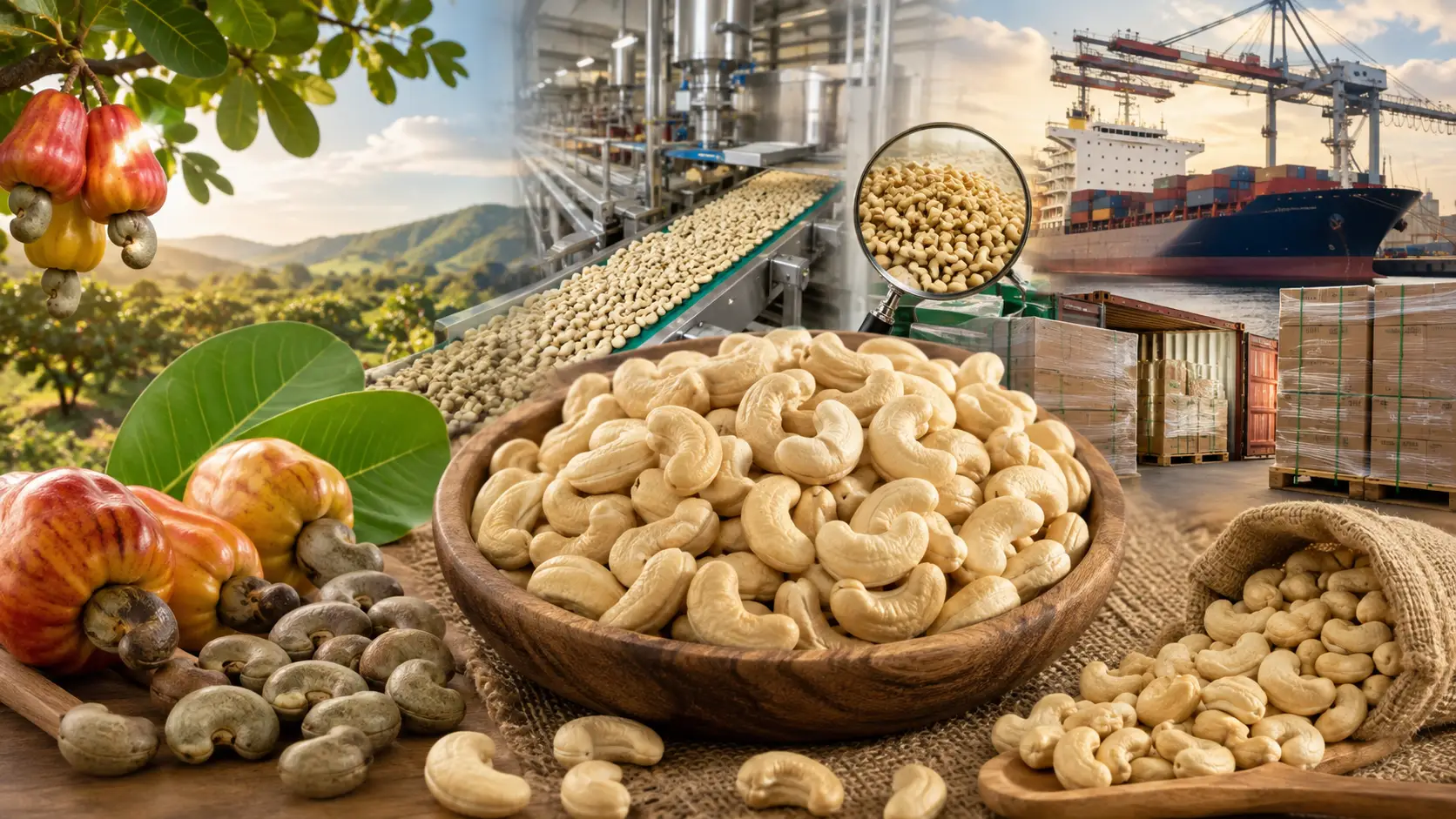
Understanding the Global Cashew Supply Chain
Cashew Production and Supply Origins
Processing and Value-Added Supply
Quality Control and Procurement Standards
Logistics and International Cashew Trade
B2B Buyers and Sourcing Strategies
Market Risks and Supply Chain Resilience
Conclusion: Building a Reliable Cashew Supply Network
Sources
Cashew is a globally traded agricultural commodity whose commercial supply chain connects growers, collectors, processors, exporters, distributors, food manufacturers, and industrial buyers. For B2B procurement teams, understanding this structure is important because the commercial value of cashew depends not only on agricultural output but also on harvesting, post-harvest handling, processing, grading, storage, and international distribution.
The supply chain begins at farms and moves through collection and aggregation channels before reaching processing facilities. At each stage, handling practices can influence the condition and commercial usability of the product. FAO guidance emphasizes that effective harvesting and post-harvest practices are essential for maintaining cashew quality, making upstream supply-chain management an important consideration for professional buyers.
For importers and food manufacturers, supply-chain visibility helps connect purchasing decisions with availability, quality requirements, delivery schedules, and market-access considerations. A supplier capable of coordinating these stages can provide greater consistency than a procurement model focused only on transactional purchasing.
International trade data can also help buyers evaluate potential sourcing markets, competing suppliers, demand patterns, and market-access requirements. The International Trade Centre's Trade Map and Market Access Map provide tools for assessing trade flows, tariffs, and other market-access information relevant to international procurement.
Cashew production is concentrated across tropical agricultural regions, particularly in parts of Africa and Asia. The crop's geographical distribution creates a diversified sourcing environment, allowing international buyers to evaluate multiple origins rather than relying exclusively on a single production market. FAO identifies cashew as an important agricultural value chain in countries where production supports rural incomes and export activity.
Origin selection can influence procurement planning because harvest timing, local collection structures, infrastructure, processing capacity, and export arrangements differ between producing regions. Recent FAO work in Guinea-Bissau, for example, highlights efforts to strengthen productivity, sustainable production practices, local processing, and value creation within the country's cashew value chain.
Cashew procurement requires attention to agricultural seasonality and the movement of raw material from farms into collection and processing channels. Buyers therefore benefit from planning purchasing requirements ahead of expected supply periods rather than treating cashew as a continuously available commodity with identical conditions throughout the year.
A structured procurement strategy can combine origin diversification with supplier communication, inventory planning, and shipment scheduling. For large-volume buyers, this approach can reduce dependence on short-term spot purchasing and provide better coordination between raw-material availability, processing capacity, finished-product requirements, and international delivery schedules.
Processing is a central stage in the cashew supply chain because raw cashew nuts require controlled handling before they become commercially traded kernels or other value-added products. Processing operations can include drying, conditioning, shell removal, peeling, grading, inspection, and packing, depending on the product specification and intended market.
The processing stage also creates opportunities for greater value retention within producing countries. FAO's recent work on the Guinea-Bissau cashew value chain specifically identifies local processing as an area for increasing productivity, sustainability, and economic value.
Cashew processing can generate commercially relevant by-products in addition to edible kernels. Cashew nut shell liquid, for example, has been recognized as a higher-value by-product within the broader cashew production chain. This creates an additional dimension for companies evaluating the complete commercial potential of cashew processing rather than focusing exclusively on the primary edible product.
For B2B buyers, understanding processing configuration is therefore useful when evaluating suppliers. Procurement teams should distinguish between raw-material suppliers, processors, exporters, and integrated supply partners because their capabilities, product specifications, quality systems, and logistics responsibilities can differ substantially.
Quality management begins well before a cashew shipment reaches the buyer. Harvesting, drying, storage, handling, processing, grading, and packing can all influence final product condition. FAO's technical guidance specifically links high-quality cashew production with thorough harvesting and post-harvest practices, reinforcing the importance of upstream quality management.
For commercial procurement, buyers should establish clear specifications before confirming an order. These specifications can define the required product form, grade, packaging configuration, acceptable quality parameters, documentation, and shipment requirements. Clear specifications reduce ambiguity between supplier and buyer and provide a stronger basis for inspection and acceptance.
Supplier evaluation should extend beyond price quotations. B2B buyers can assess processing capability, sourcing transparency, consistency of specifications, documentation practices, export experience, packaging systems, and ability to meet agreed shipment schedules. This approach helps procurement teams distinguish between nominal availability and dependable commercial supply.
Traceability is also increasingly relevant to professional food-ingredient procurement. A buyer that understands the origin and movement of material through the supply chain can better evaluate supply continuity and manage quality-related risks. For international sourcing, trade intelligence platforms can complement supplier assessments by providing information on exporting and importing markets and competitive trade flows.
International logistics connects producing regions with processors, distributors, food manufacturers, and other commercial users. Shipment planning must account for collection schedules, processing completion, packaging, inland transportation, port operations, documentation, transit times, and destination requirements.
The logistics model should be aligned with the commercial specification rather than considered separately from procurement. A competitively priced product can lose its purchasing advantage if shipment timing, documentation, handling, or inventory requirements create unexpected costs or delays. Effective supply planning therefore connects purchasing, warehousing, transportation, and delivery schedules.
Cross-border cashew trade also requires attention to market-access conditions. Depending on the destination market, buyers may need to evaluate tariff structures, customs classifications, sanitary or technical requirements, certificates, origin documentation, and other import conditions. The International Trade Centre provides dedicated tools for reviewing tariffs, trade flows, market-access requirements, and international demand indicators.
For B2B procurement teams, documentation should be reviewed before shipment rather than after cargo arrival. Establishing document requirements during supplier qualification can reduce administrative friction and help coordinate exporters, freight partners, customs representatives, and receiving facilities.
Cashew can serve a broad range of food-sector buyers, including snack manufacturers, food processors, ingredient distributors, bakery businesses, confectionery producers, foodservice suppliers, and companies developing products containing nuts. Each buyer segment may require different specifications, packaging formats, volumes, and delivery arrangements.
The commercial sourcing decision therefore depends on the application and purchasing model. A manufacturer with recurring production requirements may prioritize consistent specifications and scheduled supply, while a distributor may focus more heavily on product flexibility, packaging, market coverage, and inventory availability.
A reliable sourcing strategy should evaluate supplier capability across product quality, origin management, processing, documentation, logistics coordination, and commercial responsiveness. Price remains important, but it should be considered alongside the total procurement cost and the operational consequences of inconsistent supply.
For international buyers, a B2B marketplace can simplify supplier discovery by connecting procurement requirements with commercial supply channels. Tradeasia International can support this sourcing process by helping businesses explore international supply opportunities and coordinate procurement requirements across markets, while buyers retain responsibility for confirming product specifications and applicable regulatory requirements.
Cashew supply is influenced by agricultural conditions, seasonal availability, processing capacity, logistics, and international demand. These variables can affect procurement timing and commercial availability. A resilient purchasing strategy therefore avoids excessive dependence on a single origin, supplier, or shipment window where practical.
Supply-chain resilience can be strengthened through advance procurement planning, qualified alternative suppliers, appropriate inventory strategies, and regular communication with supply partners. FAO's work on cashew value chains demonstrates the importance of improving production practices, processing capabilities, and value-chain coordination in producing regions.
Long-term sourcing relationships can provide greater visibility into expected availability, specifications, shipment planning, and commercial requirements. Instead of repeatedly searching for suppliers after inventory becomes constrained, procurement teams can establish qualified sourcing channels and periodically reassess their performance.
Trade intelligence can support this process by helping buyers monitor international trade performance and identify alternative markets. ITC notes that its market-analysis tools provide indicators covering export performance, international demand, competitive markets, and importing and exporting companies.
The cashew supply chain extends from agricultural production and collection through processing, quality control, logistics, international trade, and final B2B distribution. For commercial buyers, the most effective sourcing approach is therefore one that evaluates the complete supply network rather than focusing exclusively on purchase price.
A disciplined procurement model combines supplier qualification, product specifications, origin assessment, quality controls, documentation review, logistics planning, and market intelligence. These factors can help buyers improve supply continuity while creating a more transparent framework for evaluating suppliers and commercial opportunities.
Cashew remains a significant agricultural commodity within international food supply chains, with value created across production, processing, trading, and distribution. For businesses purchasing cashew at commercial scale, dependable sourcing depends on understanding how each stage contributes to final product availability and quality.
Tradeasia International can serve as a sourcing and supply-chain partner for businesses seeking to connect with international commodity and ingredient markets. By combining supplier access with procurement coordination and global trade knowledge, the objective is to help B2B buyers build more structured, transparent, and dependable sourcing channels for cashew.
Food and Agriculture Organization of the United Nations
FAO — Guide to Harvesting and Post-Harvest Handling of Cashew Nuts
We're committed to your privacy. Tradeasia uses the information you provide to us to contact you about our relevant content, products, and services. For more information, check out our privacy policy.


 English
 Indonesian
 简体字
简体字
 العربية
 Español
 Français
 Português
 日本語
日本語
 한국어
한국어
 Tiếng Việt



















