Explore our network of country and industry based websites to access localized information, product offerings, and business services across our group.
Log in to start sending quotation requests for any product.
Don't have an account? Sign Up Here
Home China’s Phosphoric Acid Supply: Policy and Export Impact
Trade Insights | Supply Chain | 27 March 2026
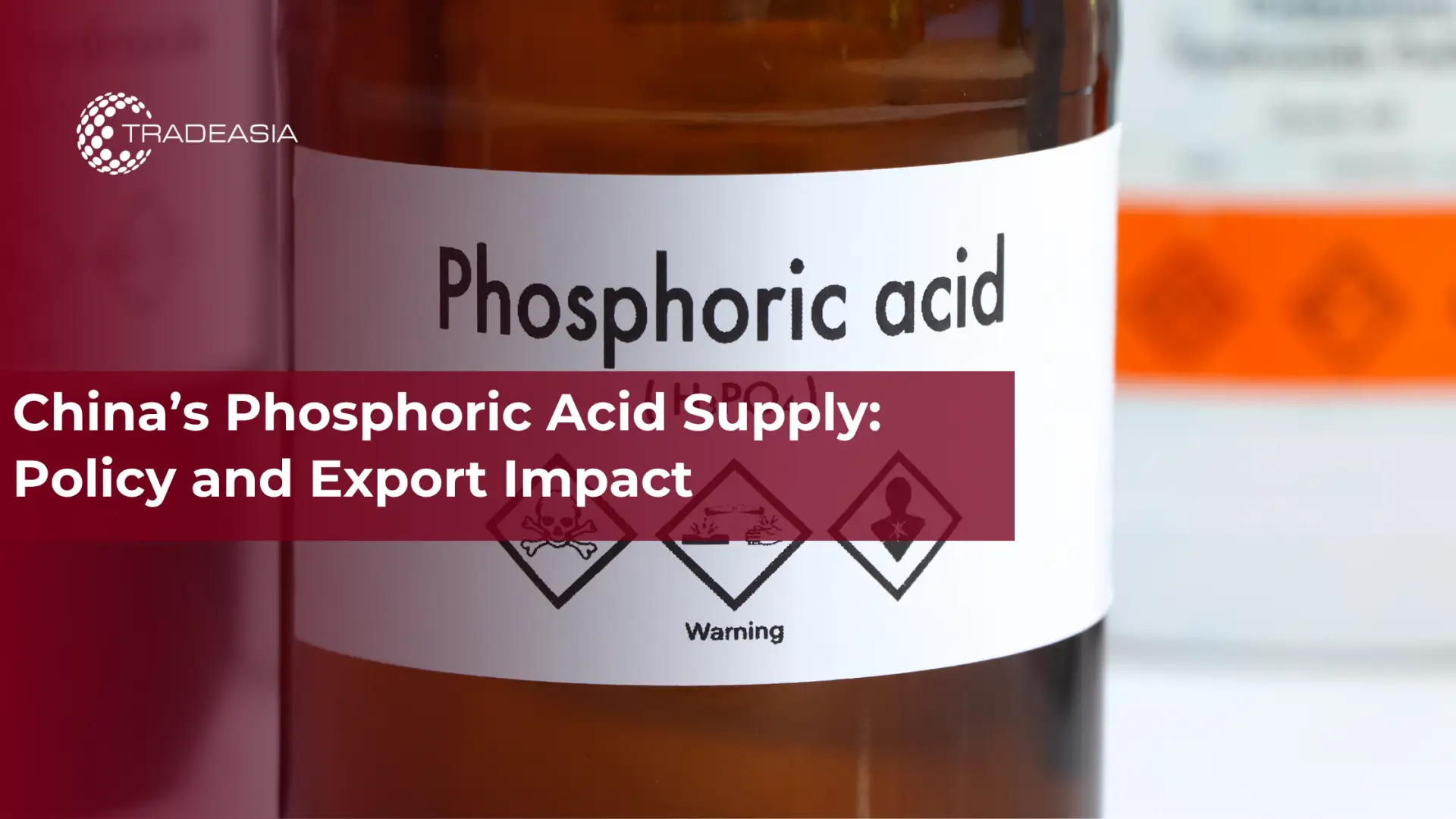
In the global phosphate value chain, few countries exert as much influence as China, particularly in the production and export of phosphoric acid and its downstream derivatives. As one of the largest producers of phosphate rock and processed phosphates, China has become a central node in the supply chain for a wide range of industries, including fertilizers, food processing, and industrial chemicals. Among these products, phosphoric acid (85%) occupies a critical position due to its extensive applications in beverages, food preservation, and chemical manufacturing.
However, China’s role in the global phosphoric acid market is not defined solely by its production capacity. Instead, it is shaped by a complex interplay of government policies, environmental regulations, and domestic economic priorities. Over the past decade, China has implemented a series of regulatory measures aimed at reducing environmental impact, optimizing industrial efficiency, and securing domestic supply. These measures have had profound implications for global markets, influencing production levels, export availability, and pricing dynamics.
For international buyers and manufacturers, understanding China’s policy-driven approach to phosphoric acid supply is essential. Changes in export controls, environmental compliance requirements, and industrial restructuring can lead to sudden shifts in market conditions, creating both risks and opportunities. The concentration of production in China further amplifies these effects, as disruptions within the country can have ripple effects across global supply chains.
This article provides a comprehensive analysis of China’s role in the phosphoric acid supply chain, focusing on the impact of environmental regulations, export policies, and production capacity shifts. It examines how these factors interact to shape global trade dynamics and explores the strategic implications for stakeholders operating in this critical market.
China’s prominence in the phosphate industry is the result of decades of investment in mining, chemical processing, and industrial infrastructure. The country is one of the world’s largest producers of phosphate rock, which serves as the primary raw material for phosphoric acid production. In addition, China has developed a highly integrated value chain, encompassing mining, beneficiation, acid production, and downstream chemical manufacturing.
This vertical integration provides significant advantages in terms of cost efficiency and supply control. By managing multiple stages of the production process, Chinese producers can optimize operations, reduce dependency on external inputs, and respond quickly to changes in market demand. As a result, China has become a major exporter of phosphoric acid and related products, supplying markets across Asia, Europe, and beyond.
The scale of China’s production capacity also plays a critical role in shaping global supply dynamics. Large volumes of phosphoric acid are produced using the wet-process method, which is widely used for both fertilizer-grade and food-grade applications. While food-grade phosphoric acid requires additional purification steps, the availability of raw acid from large-scale production facilities supports downstream processing and export.
However, this dominance also creates a degree of dependency among global buyers. Many countries rely on Chinese exports to meet their phosphoric acid needs, particularly in regions where domestic production is limited. This reliance makes the global market highly sensitive to policy changes and production shifts within China.
One of the most significant factors influencing China’s phosphoric acid supply is the country’s evolving environmental policy framework. Over the past decade, the Chinese government has intensified its efforts to address environmental challenges associated with heavy industry, including pollution, resource depletion, and greenhouse gas emissions.
Phosphate mining and phosphoric acid production are inherently resource- and energy-intensive processes that generate waste and emissions. In response, Chinese authorities have introduced stricter regulations governing emissions, wastewater treatment, and waste disposal. These regulations have required producers to invest in cleaner technologies and improve operational efficiency.
As a result of these measures, many smaller and less efficient plants have been forced to shut down or consolidate. This process of industrial restructuring has led to a reduction in overall production capacity, particularly among low-cost producers that were unable to meet new environmental standards. While larger, more advanced facilities have continued to operate, the net effect has been a tightening of supply.
Environmental inspections and enforcement actions have also contributed to short-term disruptions in production. Periodic crackdowns on non-compliant facilities can lead to temporary shutdowns, affecting output and creating uncertainty in the market. These disruptions are often unpredictable, making it difficult for buyers to anticipate changes in supply.
The emphasis on environmental sustainability reflects a broader shift in China’s industrial policy, prioritizing quality and efficiency over sheer production volume. While this transition supports long-term sustainability, it also introduces constraints that can impact global supply chains.
In addition to environmental regulations, China’s export policies play a crucial role in shaping the availability of phosphoric acid in international markets. The government has historically used a range of tools, including export tariffs, quotas, and licensing requirements, to manage the flow of phosphate products.
These measures are often designed to ensure adequate supply for domestic industries, particularly the fertilizer sector, which is critical for agricultural production and food security. During periods of high domestic demand or supply shortages, export restrictions may be implemented to prioritize internal consumption.
For example, export tariffs on phosphate products can increase the cost of exports, reducing their competitiveness in global markets. In some cases, temporary export bans or quotas may be introduced, leading to sudden reductions in supply for international buyers. Such actions can create significant price volatility and disrupt established trade relationships.
The impact of export controls is particularly pronounced for specialized products such as food-grade phosphoric acid (85%). Unlike bulk fertilizer-grade acid, which is produced in large volumes, food-grade acid requires additional processing and quality control. As a result, supply is more limited, and disruptions can have a greater impact on availability.
China’s approach to export management reflects a balancing act between supporting domestic industries and maintaining its role as a global supplier. While export controls can stabilize local markets, they also introduce uncertainty for international buyers, who must navigate changing policy landscapes.
The combination of environmental regulations and export policies has led to significant shifts in China’s phosphoric acid production capacity. As smaller plants exit the market and larger facilities expand, the industry is becoming more consolidated and technologically advanced.
This consolidation has several implications for the global market. On one hand, it can lead to improved product quality and greater consistency, as larger producers invest in advanced technologies and quality control systems. On the other hand, it reduces the number of suppliers, increasing market concentration and potentially limiting competition.
Capacity shifts also influence pricing dynamics. Reduced production capacity, combined with strong demand, can lead to upward pressure on prices. Conversely, periods of capacity expansion may result in increased supply and more competitive pricing.
The transition toward higher-value products is another notable trend. As China moves up the value chain, there is a growing focus on producing specialized and high-purity phosphates, including food-grade phosphoric acid. This shift reflects changing market demands and the increasing importance of quality and compliance.
However, these developments also require significant investment, which can increase production costs. For international buyers, this means that price competitiveness may be affected, particularly in comparison to alternative suppliers.
China’s central role in phosphoric acid production means that changes within its domestic market have far-reaching effects on global trade dynamics. When Chinese exports are reduced due to policy measures or production constraints, buyers in importing regions must seek alternative sources, often at higher costs.
This can lead to shifts in trade flows, with increased reliance on other producing regions such as Morocco or the United States. However, these alternatives may not fully compensate for reduced Chinese supply, particularly in the short term, leading to supply tightness and price increases.
Logistical factors also play a role in shaping trade dynamics. Changes in shipping costs, port operations, and transportation infrastructure can influence the competitiveness of Chinese exports. For example, rising freight rates can increase the delivered cost of phosphoric acid, affecting purchasing decisions.
The interconnected nature of global supply chains means that disruptions in China can have cascading effects across multiple industries. For food manufacturers, beverage producers, and chemical companies, these disruptions can impact production planning, cost management, and market competitiveness.
In an environment characterized by policy-driven volatility, buyers and manufacturers must adopt proactive strategies to manage risk and ensure supply continuity. Diversification of sourcing is a key approach, reducing dependence on a single country and enhancing resilience against disruptions.
Building strong relationships with suppliers can also provide greater visibility into market conditions and facilitate more effective planning. Long-term contracts and strategic partnerships can help stabilize supply and mitigate price fluctuations.
Monitoring regulatory developments in China is essential for anticipating changes in supply conditions. By staying informed about environmental policies, export controls, and industrial trends, companies can adjust their strategies and respond to emerging challenges.
Investments in supply chain transparency and flexibility can further enhance resilience. This includes maintaining inventory buffers, optimizing logistics networks, and exploring alternative sourcing options.
China’s role in the global phosphoric acid supply chain is both dominant and dynamic, shaped by a complex interplay of environmental regulations, export policies, and production capacity shifts. These factors have transformed the industry, introducing new challenges and opportunities for global stakeholders.
While China’s efforts to improve environmental performance and industrial efficiency support long-term sustainability, they also contribute to supply volatility and market uncertainty. Export controls and domestic prioritization further influence global trade dynamics, affecting availability and pricing.
For buyers and manufacturers, understanding these dynamics is critical for navigating the complexities of the phosphoric acid market. By adopting strategic sourcing practices, investing in resilience, and staying informed about policy developments, companies can better manage risks and maintain competitiveness in an evolving global landscape.
As demand for phosphoric acid continues to grow across food, beverage, and industrial sectors, China’s influence will remain a defining factor in the market. The ability to adapt to policy-driven changes will be essential for ensuring stable and sustainable supply chains in the years ahead.
We're committed to your privacy. Tradeasia uses the information you provide to us to contact you about our relevant content, products, and services. For more information, check out our privacy policy.


 English
 Indonesian
 简体字
简体字
 العربية
 Español
 Français
 Português
 日本語
日本語
 한국어
한국어
 Tiếng Việt



















