Explore our network of country and industry based websites to access localized information, product offerings, and business services across our group.
Log in to start sending quotation requests for any product.
Don't have an account? Sign Up Here
Home Crude Coconut Oil B2B Supply: Sourcing and Trade Insights
Trade Insights | Supply Chain | 19 August 2026
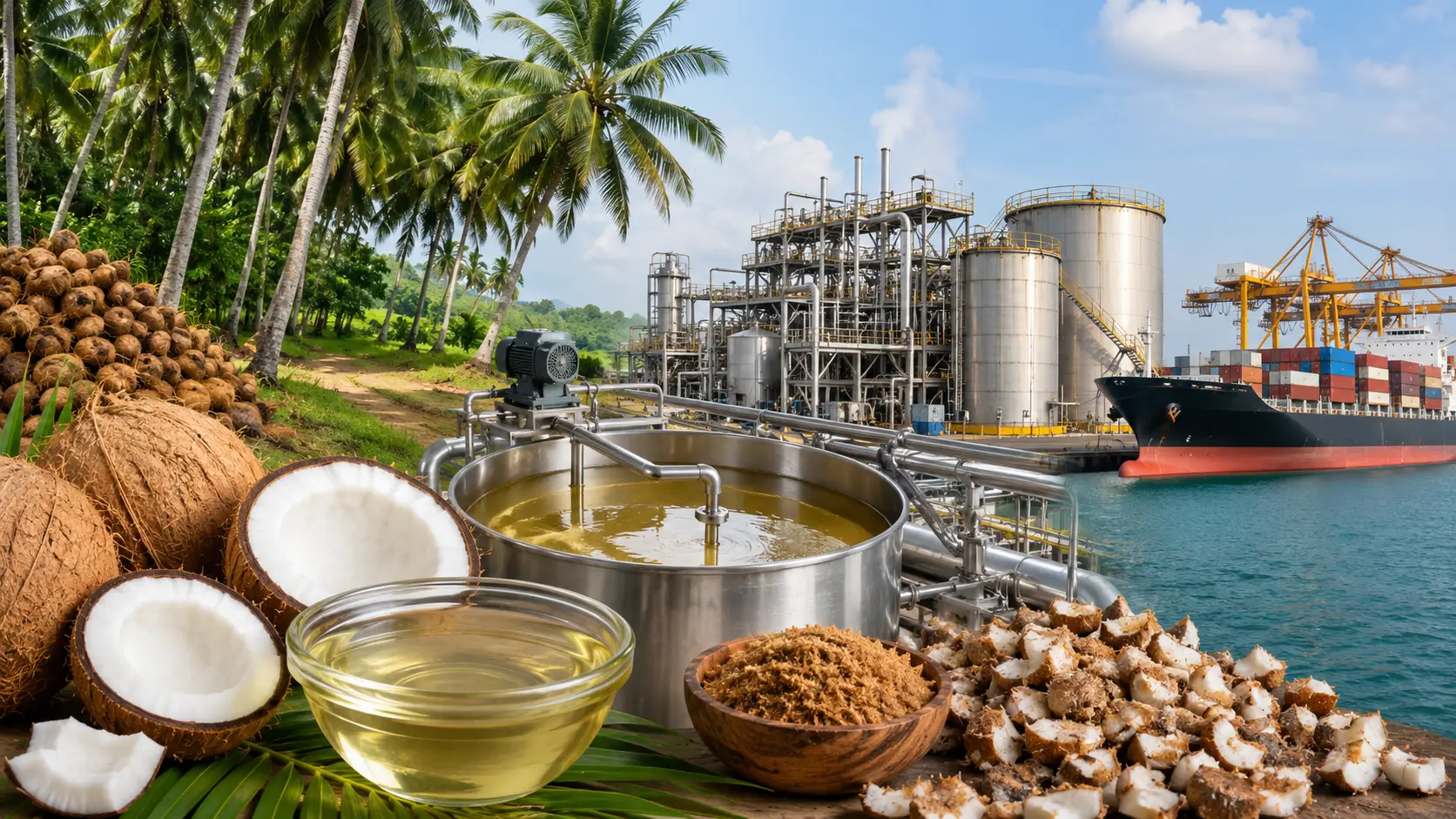
Crude Coconut Oil Supply Chain Overview
Coconut Production and Raw Material Availability
Processing and Crude Coconut Oil Production
Global Trade and Logistics
Industrial Applications and Buyer Demand
Procurement and Supplier Selection
Market Outlook and Supply Chain Strategy
Conclusion: Building Reliable Crude Coconut Oil Supply
Sources
Crude Coconut Oil occupies an important position within the global coconut value chain because it connects agricultural production with downstream food, oleochemical, personal care, and specialty manufacturing industries. Its supply chain begins with coconut cultivation and harvesting, followed by the conversion of coconut material into copra or other oil-bearing feedstock before extraction and commercial distribution. For B2B buyers, understanding this chain is essential because availability, quality, freight conditions, and origin can directly affect procurement decisions.
The supply structure is particularly influenced by the concentration of coconut production in tropical regions. The Philippines and Indonesia remain major participants in global coconut and coconut oil trade, while other producing countries contribute to regional and international supply. The International Coconut Community reports that its member countries account for more than 90% of world coconut production and exports of coconut products, illustrating how geographically concentrated the industry is.
Unlike annual oilseed crops that can respond relatively quickly to changes in market demand, coconut is produced from perennial trees. This creates a supply structure that can be slower to adjust when demand increases or harvest conditions deteriorate. Aging plantations, weather disruptions, farm productivity, and competition for coconuts from other coconut-derived products can therefore influence the amount of raw material available for oil processing.
For procurement teams, this makes supply-chain visibility more than a logistics consideration. Buyers need to evaluate origin, processing capacity, export availability, shipping schedules, documentation, and supplier consistency together. A reliable Crude Coconut Oil sourcing strategy therefore begins with understanding where the material originates and how agricultural conditions can influence downstream availability.
The first major stage of the Crude Coconut Oil supply chain is agricultural production. Coconuts are harvested in tropical growing regions, with Southeast Asia playing a particularly important role in international supply. The Philippines and Indonesia are prominent sources, while India, Sri Lanka, and other coconut-producing countries also contribute to global availability. The geographic distribution of production creates opportunities for diversified sourcing but also exposes buyers to regional weather and agricultural risks.
Raw material availability is closely linked to coconut yields and the condition of plantations. Coconut trees require long production cycles, meaning that structural changes in supply cannot always be addressed immediately. When production falls, processors may face tighter feedstock availability, while exporters and international buyers can encounter higher competition for available volumes.
For conventional coconut oil production, copra can serve as an important feedstock for oil extraction. However, coconut is also processed into products such as coconut milk, desiccated coconut, and virgin coconut oil. Competition between these uses can influence the amount of coconut material ultimately directed toward oil production. This creates an important link between agricultural economics and crude oil availability.
The International Coconut Community has highlighted aging coconut palms, slow replanting, and competition for fresh coconuts from higher-value products as structural factors affecting copra availability. For B2B buyers, this means that sourcing should consider not only current supplier quotations but also the underlying availability of raw material in the producing region.
Once suitable coconut raw material is available, processing converts the oil-bearing material into crude coconut oil. The industrial chain can involve drying, preparation of copra, mechanical or solvent-assisted extraction depending on the processing configuration, separation of solids, and handling of the resulting crude oil. The objective at this stage is to recover oil efficiently while maintaining the characteristics required for subsequent refining or industrial use.
Processing capacity and operating standards can differ between suppliers and origins. Consequently, buyers should not assume that products from different suppliers will automatically have identical specifications. Commercial procurement should instead evaluate agreed technical parameters, handling requirements, packaging or bulk shipment conditions, and documentation before finalizing a supply contract.
Quality management is important because crude material may subsequently enter refining or downstream manufacturing processes. Factors such as moisture, impurities, free fatty acid levels, color, odor, and other agreed specifications can affect suitability for different applications. Buyers should establish a clear product specification with suppliers and ensure that quality documentation is consistent with the purchase agreement.
Traceability is also becoming increasingly important in international agricultural commodity supply chains. The International Coconut Community's standardized coconut sorting manual emphasizes quality consistency, traceability, sustainability, and environmental responsibility across the coconut value chain. For industrial buyers, stronger quality controls can reduce the risk of rejected shipments, processing interruptions, and inconsistent downstream performance.
After processing, Crude Coconut Oil enters domestic distribution channels or international trade flows. Export-oriented supply chains generally involve processors, traders, freight providers, port operators, importers, distributors, and end users. The Philippines and Indonesia are especially relevant to global coconut oil trade, making their export performance an important consideration for international procurement teams.
Recent International Coconut Community data illustrates the volatility that can occur in the trade environment. Its 2026 outlook describes improving coconut oil production and export availability compared with the exceptionally tight conditions of 2025, while still noting structural constraints within the industry. This demonstrates why buyers should monitor both production and trade availability rather than relying on demand indicators alone.
International logistics can materially influence the delivered cost of Crude Coconut Oil. Ocean freight availability, port congestion, vessel schedules, insurance, customs clearance, storage requirements, and destination handling all contribute to the final landed cost. A competitive product price at origin does not necessarily translate into the lowest total procurement cost.
For B2B procurement, delivery planning should therefore consider both price and supply continuity. Buyers may benefit from establishing shipment schedules, agreed Incoterms, documentation requirements, inspection procedures, and contingency options before large-volume purchasing. These measures can help reduce disruptions when freight conditions or export availability change unexpectedly.
Crude Coconut Oil is connected to the food sector through refining and downstream processing into oils and ingredients suitable for specific manufacturing requirements. Food processors, ingredient companies, and manufacturers may evaluate coconut-derived oils based on functionality, supply reliability, processing suitability, and the technical specifications required for their finished products.
Demand from food-related industries can influence procurement patterns across the coconut oil supply chain. Bakery, confectionery, food manufacturing, and ingredient applications may require dependable deliveries and consistent material characteristics. For these buyers, procurement is therefore not simply a matter of purchasing the lowest-priced oil; it involves maintaining continuity between raw material sourcing and production schedules.
Coconut oil is also relevant to oleochemical processing, where fatty acids and related derivatives can be incorporated into a broad range of industrial products. Personal care and cosmetics manufacturers similarly participate in the wider coconut-derived ingredient ecosystem. These sectors can create demand that competes with food uses for available coconut-derived feedstock.
The International Coconut Community's 2026 market outlook identifies food processing, confectionery, bakery, oleochemical, cosmetics, and personal care among the major demand areas supporting coconut oil consumption. For suppliers and buyers, this diversified demand base means that market conditions can be influenced by developments across several downstream industries rather than by food demand alone.
Selecting a Crude Coconut Oil supplier requires more than comparing quoted prices. Procurement teams should examine production origin, processing capability, quality controls, export experience, shipment flexibility, documentation, and ability to maintain agreed specifications over repeated orders. Supplier reliability becomes particularly important when coconut supply is affected by weather, harvest variability, or changes in export economics.
A B2B sourcing process should also distinguish between one-time spot availability and dependable commercial supply. A supplier offering an attractive price for a single shipment may not provide the same value as a supplier capable of supporting scheduled deliveries. Procurement decisions should therefore evaluate total supply performance, including responsiveness, quality consistency, logistics coordination, and commercial transparency.
Price is naturally an important factor in Crude Coconut Oil procurement, but price volatility can make purely price-driven purchasing risky. The International Coconut Community's published market information shows that coconut oil prices can change significantly as production, exports, and regional supply conditions shift.
A stronger purchasing strategy combines market monitoring with supplier diversification and inventory planning. Buyers can compare origins, assess alternative suppliers, establish realistic delivery windows, and monitor relevant coconut and lauric-oil market indicators. This approach can provide greater resilience when supply conditions change and can help procurement teams make purchasing decisions based on total commercial exposure rather than headline price alone.
The Crude Coconut Oil market is entering 2026 with signs of improved supply compared with the tight conditions experienced during 2025. The International Coconut Community expects production and exports to recover as conditions improve in major producing countries, although output remains affected by longer-term structural constraints.
This environment creates a more complex procurement landscape. Improving availability can provide buyers with greater sourcing opportunities, but it does not eliminate the risks associated with perennial crop production. Weather, plantation productivity, competing coconut products, and changes in export economics can continue to affect supply. Buyers should therefore treat improving availability as an opportunity to strengthen procurement rather than as a reason to reduce supply-chain oversight.
The outlook suggests that commercial buyers can benefit from closer monitoring of origin-level supply, international trade flows, and price movements. ICC market data published in June 2026, for example, showed different domestic coconut oil prices across the Philippines, Sri Lanka, and India, demonstrating the importance of distinguishing between origin markets rather than treating coconut oil as a single uniform price market.
For B2B procurement teams, the most effective strategy is to combine competitive sourcing with technical due diligence and logistics planning. A marketplace approach can help buyers compare potential suppliers, communicate specifications, evaluate commercial terms, and develop alternative sourcing channels. This becomes particularly valuable when supply conditions remain dynamic and manufacturers need predictable raw-material availability.
Crude Coconut Oil is part of a supply chain shaped by agriculture, processing, international trade, logistics, and diversified industrial demand. Its commercial value therefore extends beyond the physical product: dependable supply requires visibility into origin, quality, production conditions, export availability, and delivery execution.
For buyers, a well-managed sourcing strategy can reduce supply interruptions while improving procurement transparency. Evaluating suppliers according to quality, commercial reliability, logistics capability, and long-term availability can provide a stronger foundation than purchasing decisions based solely on spot price.
As global coconut oil markets continue to respond to changing production and trade conditions, B2B buyers benefit from access to structured sourcing channels that connect commercial requirements with suitable suppliers. Tradeasia, Chemtradeasia, and the Tradechem Marketplace can serve as a commercial platform for businesses seeking to evaluate and source industrial raw materials according to their procurement requirements.
For manufacturers, distributors, ingredient companies, and industrial buyers, the priority is ultimately reliable supply backed by appropriate specifications, transparent commercial communication, and practical logistics coordination. In a supply chain where agricultural availability and international trade can change quickly, disciplined sourcing remains central to maintaining competitive and resilient operations.
We're committed to your privacy. Tradeasia uses the information you provide to us to contact you about our relevant content, products, and services. For more information, check out our privacy policy.


 English
 Indonesian
 简体字
简体字
 العربية
 Español
 Français
 Português
 日本語
日本語
 한국어
한국어
 Tiếng Việt



















