Explore our network of country and industry based websites to access localized information, product offerings, and business services across our group.
Log in to start sending quotation requests for any product.
Don't have an account? Sign Up Here
Home Hydrolysed Vegetable Protein Liquid for B2B Food Ingredient Supply
Trade Insights | Supply Chain | 26 August 2026
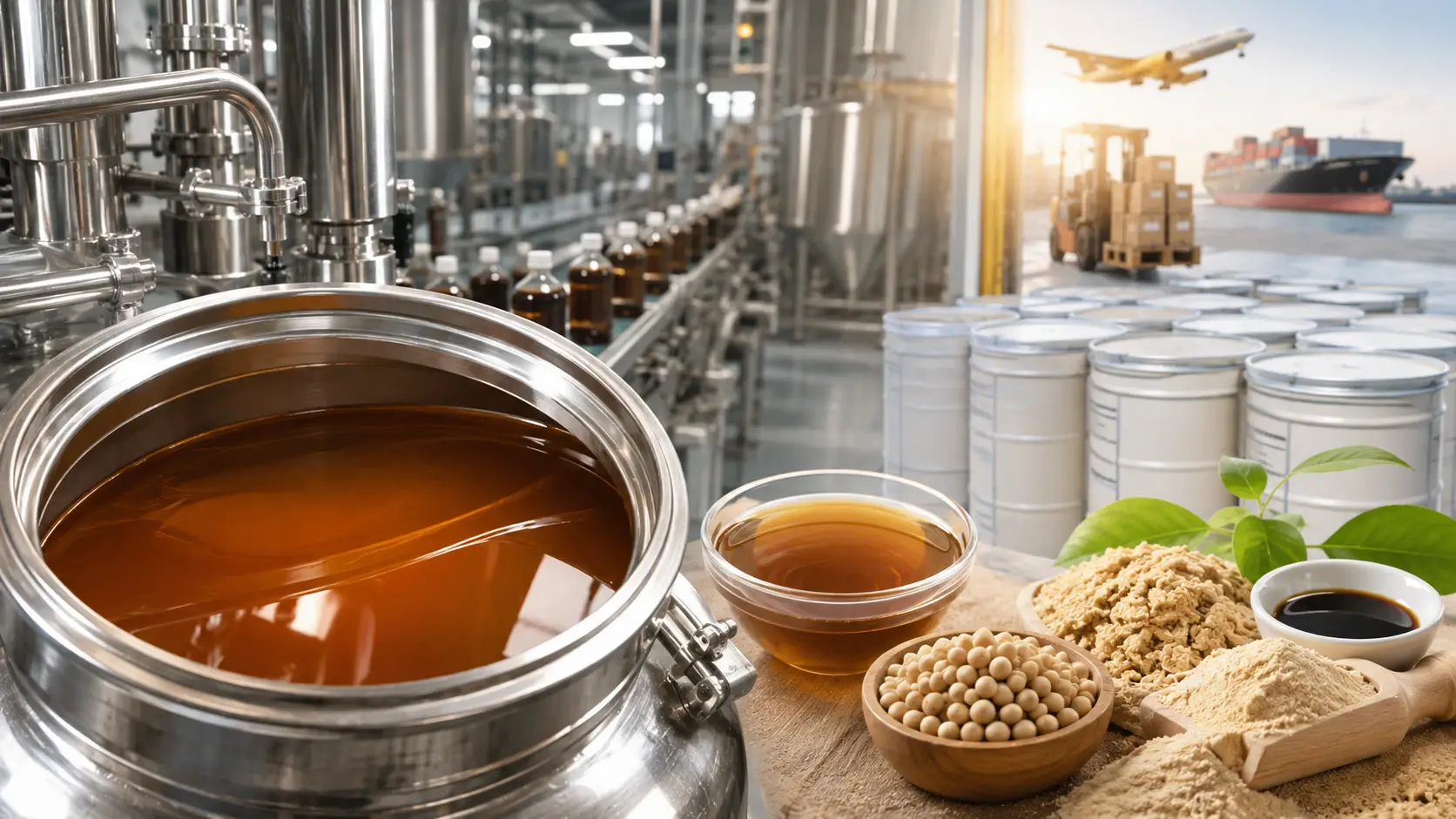
Understanding Hydrolysed Vegetable Protein Liquid in B2B Supply Chains
Food Applications Driving Procurement Demand
Quality and Specification Considerations for Buyers
Supplier Selection and Sourcing Strategy
Logistics, Storage, and Supply Continuity
Regulatory and Documentation Considerations
Procurement Outlook for Hydrolysed Vegetable Protein Liquid
Conclusion: Building a Reliable HVP Liquid Supply Chain
Sources
Hydrolysed Vegetable Protein Liquid is a plant-derived protein hydrolysate used as a functional food ingredient, particularly where manufacturers require flavor-enhancing characteristics in liquid formulations. Hydrolysis breaks proteins into smaller compounds, creating an ingredient that can be incorporated into food systems according to the formulation requirements of the finished product. The U.S. FDA identifies hydrolyzed vegetable protein among food substances associated with technical effects including flavor enhancement and flavoring applications.
From a B2B supply-chain perspective, the product is therefore more than a conventional protein ingredient. Procurement teams may evaluate it according to consistency, intended food application, handling requirements, documentation, and compatibility with existing manufacturing processes. This makes supplier capability an important part of purchasing decisions, especially for food manufacturers that depend on repeatable ingredient performance.
Liquid delivery can also influence how buyers approach inventory planning. Instead of evaluating only the ingredient itself, procurement teams need to consider packaging, transportation, storage conditions, lead times, minimum order quantities, and replenishment schedules. A reliable supply structure can help manufacturers coordinate ingredient purchasing with production planning and reduce unnecessary interruptions.
For distributors and ingredient traders, Hydrolysed Vegetable Protein Liquid presents an opportunity to connect food manufacturers with qualified supply sources while matching product specifications to application requirements. The commercial value of sourcing is consequently linked to both product suitability and the supplier's ability to maintain dependable communication, documentation, and delivery performance.
One of the most commercially relevant characteristics of hydrolyzed vegetable protein is its association with flavor enhancement. FDA information lists hydrolyzed vegetable protein as a substance used for flavor enhancement and flavoring-related technical effects. This makes the ingredient relevant to food manufacturers developing savory formulations where flavor contribution and formulation efficiency are important procurement considerations.
The practical application should nevertheless be determined by the specification and regulatory status of the particular material being purchased. Buyers should not assume that every Hydrolysed Vegetable Protein Liquid grade has identical performance, composition, source, or permitted use. Technical documentation should therefore be reviewed alongside the intended application before commercial purchasing.
Hydrolysed vegetable proteins can be relevant to processed-food formulations where manufacturers need ingredients capable of contributing to the overall sensory profile. Food producers may therefore evaluate the ingredient for use in sauces, seasonings, savory preparations, and other formulated foods, subject to the specific grade and applicable regulations.
For procurement teams, this application diversity means that sourcing requirements should begin with the finished-product objective rather than simply the ingredient name. A buyer should define the required food application, technical specification, formulation conditions, packaging format, and target market before comparing suppliers. This approach reduces the risk of purchasing a technically unsuitable material simply because it matches a generic product description.
Quality evaluation should start with a clear specification sheet and supporting documentation. Buyers may need information covering composition, physical characteristics, microbiological parameters, handling requirements, batch consistency, and other quality criteria relevant to the intended application. The precise specification should be agreed between buyer and supplier rather than inferred from the product name alone.
Documentation is particularly important for ingredients entering regulated food-production environments. Codex guidance emphasizes that vegetable protein ingredients intended for food use should be appropriate for their intended purpose and that relevant ingredient information should be properly declared. Consequently, procurement teams should treat documentation as an integral part of supplier qualification rather than as an administrative step after purchase.
For manufacturers, batch-to-batch consistency can have a direct impact on production planning and formulation control. Changes in ingredient characteristics can affect how a liquid ingredient behaves during processing or how it contributes to the finished formulation. A dependable supplier should therefore be able to communicate product specifications clearly and maintain an appropriate quality-control system.
Buyers can strengthen sourcing decisions by requesting representative technical documentation, confirming the applicable grade, and clarifying whether samples can be evaluated before larger-volume procurement. Establishing these controls early helps procurement, quality, technical, and production teams work from the same specification and reduces avoidable discrepancies during scale-up.
Selecting a Hydrolysed Vegetable Protein Liquid supplier requires a broader assessment than comparing quoted prices. Buyers should examine product specifications, supply capability, responsiveness, documentation, packaging options, commercial terms, and experience serving food-industry customers. The strongest supplier relationship is generally one that combines suitable product quality with dependable execution.
A B2B marketplace can simplify this process by helping buyers identify potential suppliers and compare commercially relevant information in one sourcing environment. For international procurement, the ability to communicate product requirements clearly is especially important because different markets may apply different food-ingredient requirements.
Price remains important, but the lowest initial quotation does not necessarily represent the lowest procurement cost. Buyers should consider the total commercial equation, including order size, freight, delivery schedule, documentation, payment terms, quality requirements, and potential costs associated with supply interruptions. A structured supplier comparison can reveal meaningful differences beyond the headline product price.
For distributors and food manufacturers, establishing a repeat-order framework can further improve purchasing efficiency. Once the appropriate grade and supplier have been qualified, procurement teams can define forecast requirements, reorder points, documentation expectations, and communication procedures. This converts one-time sourcing into a more predictable supply relationship.
Because Hydrolysed Vegetable Protein Liquid is supplied in liquid form, logistics planning should account for the selected packaging format and the supplier's recommended handling conditions. Buyers should confirm packaging suitability, transport requirements, shelf-life information, and storage instructions before finalizing an order.
International buyers should also coordinate documentation with logistics planning. Commercial invoices, packing information, certificates or technical documents where applicable, and shipment details can influence customs and receiving procedures. Clear coordination between supplier, logistics provider, and buyer can help prevent documentation-related delays.
Supply continuity is particularly relevant to food manufacturers operating scheduled production. Procurement teams can manage risk by maintaining appropriate supplier communication, forecasting consumption, and aligning replenishment timing with expected production requirements. The objective is not simply to hold more inventory, but to create visibility across purchasing and manufacturing activities.
For suppliers and distributors, dependable fulfillment can become a competitive differentiator. Consistent communication about production availability, lead times, order confirmation, and shipment status allows buyers to make better production decisions. A supply-chain approach therefore connects product sourcing with operational reliability rather than treating procurement as an isolated transaction.
Regulatory review should be performed according to the destination market and the specific application. The FDA's food-substance database identifies hydrolyzed vegetable protein and lists associated technical effects, while also providing regulatory references that buyers can use as a starting point for evaluating the ingredient. The applicable requirements should always be verified for the precise product, formulation, and market.
International buyers should also pay attention to contaminant and food-safety requirements that may apply to hydrolysed vegetable protein. For example, European Union legislation establishes a maximum level for 3-monochloropropanediol (3-MCPD) in hydrolysed vegetable protein. This illustrates why regulatory documentation should be considered part of supplier qualification.
A commercial sourcing process may require technical specifications, certificates of analysis, safety or food-safety documentation, product declarations, and other documents depending on the destination market and customer's requirements. Buyers should establish the documentation package before shipment rather than discovering requirements after goods have been dispatched.
This is especially relevant for international B2B marketplaces because a product suitable for one market may require additional verification before entering another. Trade documentation, regulatory information, labeling requirements, and customer-specific specifications should therefore be coordinated between the buyer and supplier before the purchase order is finalized.
The procurement outlook for Hydrolysed Vegetable Protein Liquid is closely connected to the continuing need for functional food ingredients that can fit into processed-food formulations. FDA food-ingredient information recognizes hydrolyzed vegetable protein in connection with flavor-enhancing applications, supporting its relevance as a commercial ingredient category.
For buyers, future sourcing decisions are likely to remain centered on practical procurement fundamentals: consistent quality, appropriate specifications, regulatory suitability, dependable delivery, and competitive commercial terms. These factors matter because ingredient procurement ultimately affects manufacturing continuity and finished-product consistency.
The opportunity for B2B suppliers lies in making the sourcing process more transparent and technically aligned with buyer requirements. Suppliers that provide clear specifications, responsive communication, suitable documentation, and dependable fulfillment can create stronger relationships with food manufacturers and distributors.
For procurement teams, the priority is to identify suppliers capable of supporting both immediate purchasing requirements and longer-term supply planning. A structured approach to qualification, sampling, documentation, commercial comparison, and delivery monitoring can make Hydrolysed Vegetable Protein Liquid procurement more efficient and reduce avoidable supply-chain uncertainty.
Hydrolysed Vegetable Protein Liquid occupies a relevant position within the B2B food-ingredient supply chain because of its association with flavor-enhancing and food-formulation applications. Its commercial value, however, depends on more than the ingredient's basic identity. Specification control, regulatory suitability, documentation, logistics, and supplier reliability all influence whether a source can support consistent industrial procurement.
For buyers, the most effective sourcing strategy is to begin with the intended application and establish a clear technical and commercial specification before comparing suppliers. This creates a common basis for procurement, quality assurance, technical evaluation, logistics planning, and supplier negotiations.
Tradeasia International can support businesses seeking a more structured approach to international chemical and ingredient sourcing by connecting procurement requirements with B2B supply opportunities. Through Tradeasia, Chemtradeasia, and Tradechem Marketplace, buyers can explore supplier relationships and organize sourcing around their specific product, documentation, and commercial requirements.
For food manufacturers, distributors, and procurement teams evaluating Hydrolysed Vegetable Protein Liquid, the next step is to align the required grade and application with a suitable supply partner, then validate specifications and documentation before committing to commercial volumes. This approach supports a more reliable and transparent supply chain while keeping purchasing decisions focused on long-term operational requirements.
We're committed to your privacy. Tradeasia uses the information you provide to us to contact you about our relevant content, products, and services. For more information, check out our privacy policy.


 English
 Indonesian
 简体字
简体字
 العربية
 Español
 Français
 Português
 日本語
日本語
 한국어
한국어
 Tiếng Việt



















