Explore our network of country and industry based websites to access localized information, product offerings, and business services across our group.
Log in to start sending quotation requests for any product.
Don't have an account? Sign Up Here
Home Modified Tapioca Starch Procurement: A Guide for Global Buyers
Trade Insights | Supply Chain | 25 August 2026
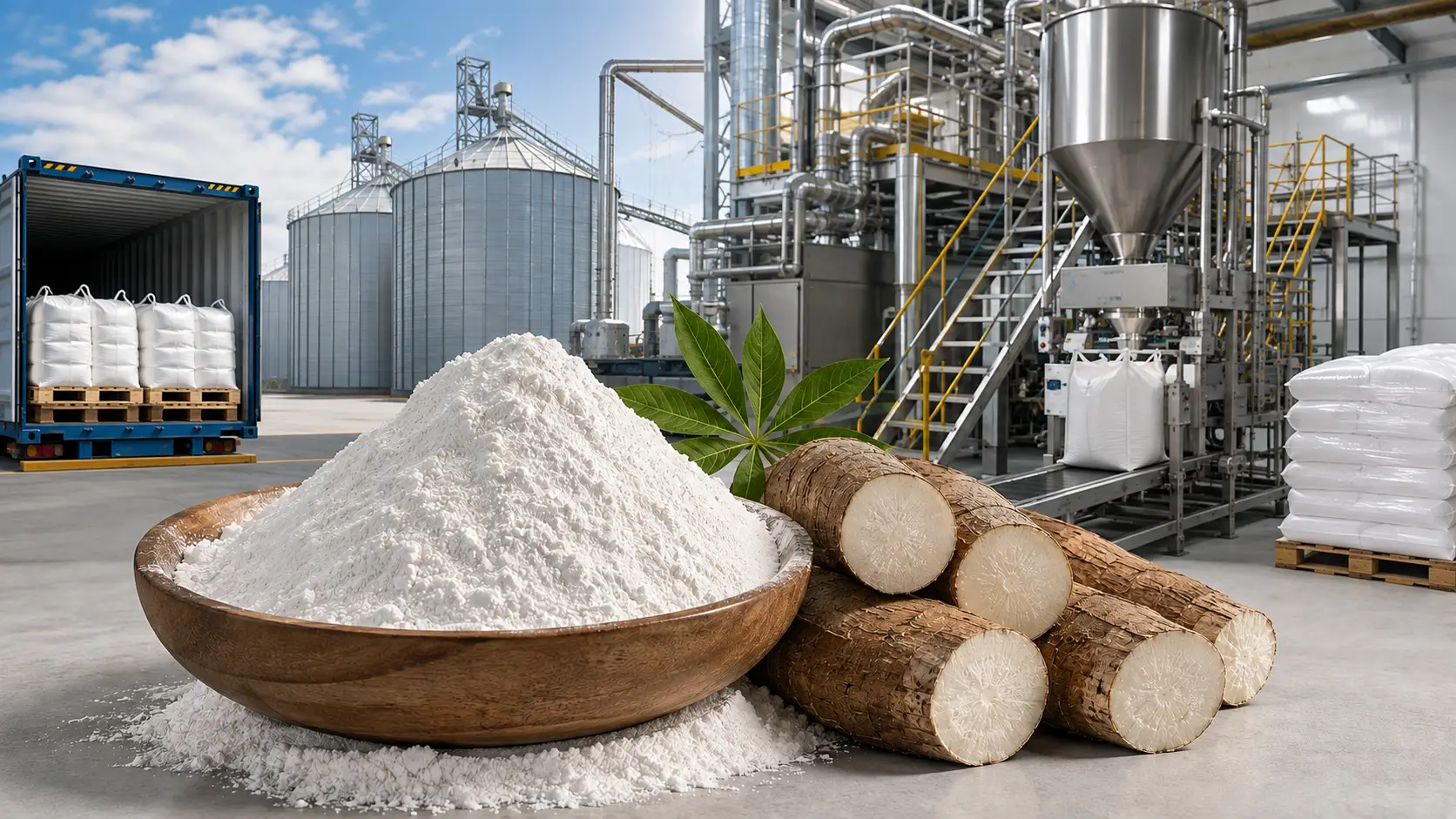
Modified Tapioca Starch in the Global Supply Chain
Raw Material and Processing Considerations
Modification and Functional Performance
Applications and Industrial Demand
B2B Buyers and Procurement Requirements
Supplier Qualification and Documentation
Logistics, Distribution, and Supply Continuity
Strategic Sourcing and Conclusion
Sources
Modified tapioca starch occupies a specialized position within the starch and food-ingredient supply chain. Unlike a commodity material purchased only on basic composition, buyers typically evaluate modified starch according to its intended function, processing behavior, specification, regulatory status, and consistency. This makes the commercial supply chain closely connected to technical qualification and application requirements.
Tapioca starch originates from cassava and can enter the B2B market as a functional ingredient after appropriate processing and modification. Regulatory terminology can differ by market and modification method, so buyers should distinguish the source material from the specific modified-starch designation required for the finished application. The U.S. FDA, for example, separately identifies tapioca starch and food starch-modified within its food-substance inventory.
The commercial pathway generally involves raw-material sourcing, starch extraction, modification or functional treatment, quality control, packing, export handling, distribution, and final industrial use. Each stage can influence the buyer's assessment of consistency and suitability. For procurement teams, the objective is therefore not simply to locate available material but to establish a dependable connection between specification and application.
A B2B marketplace can support this process by connecting qualified buyers with suppliers while making product specifications and commercial requirements easier to compare. For modified tapioca starch, effective sourcing should focus on repeatability, documentation, intended use, shipment capability, and communication between technical and purchasing teams.
The supply chain begins with cassava as the agricultural raw material from which tapioca starch is produced. The quality of the resulting starch base is important because downstream modification does not eliminate the need for controlled raw-material and processing conditions. Industrial buyers therefore benefit from understanding the origin and processing route behind the supplied material.
For international procurement, the source of the starch should be connected to a clear product specification. Buyers may need information covering identity, physical characteristics, analytical parameters, packaging, storage conditions, and intended application. This provides a practical foundation for comparing suppliers without relying solely on price.
Consistency becomes especially important when modified tapioca starch is incorporated into repeat-production formulations. A food manufacturer or ingredient distributor needs material that behaves predictably from shipment to shipment so that formulation and production parameters remain manageable.
The supply chain should therefore connect production controls with commercial documentation. A supplier capable of clearly communicating specifications, manufacturing information, quality-control procedures, and batch-related documentation can reduce uncertainty during qualification. This is particularly relevant for buyers purchasing across borders or establishing a recurring supply program.
Modification changes selected characteristics of starch so that the material can perform differently from an unmodified starch in a targeted application. Codex materials describe modified food starches as starches whose original characteristics have been modified through physical, enzymatic, and/or chemical treatment, depending on the process involved.
For buyers, this means the term “modified tapioca starch” should not automatically be treated as a single universal specification. The exact modification route and resulting functionality matter. Procurement teams should align the requested product with the technical purpose for which it will be used rather than selecting a material based only on the broad product name.
Functional performance is central to B2B sourcing because different starch treatments can be associated with different technical roles. FDA's food-substance inventory identifies modified food starch in connection with functions including stabilizing or thickening, emulsification-related functions, humectancy, and other specified technical effects.
Consequently, buyers should communicate the required functionality during supplier inquiries. Application conditions, processing environment, formulation requirements, regulatory market, and desired product behavior can all affect which modified tapioca starch specification is appropriate. A technically aligned inquiry can shorten supplier qualification and reduce the risk of purchasing a material that is unsuitable for the intended process.
Modified tapioca starch is primarily relevant to B2B food-ingredient supply chains where starch functionality contributes to product formulation or processing performance. Depending on the specific modification and regulatory status, modified food starches can serve functions such as stabilization and thickening. FDA documentation also recognizes modified food starch as a food-additive category under specified regulatory provisions.
This creates demand from manufacturers and ingredient formulators that require more than a basic carbohydrate ingredient. Buyers can evaluate modified tapioca starch according to how effectively it supports the desired formulation, processing behavior, texture, stability, or other defined technical requirement. The application therefore becomes a central part of supplier selection.
Application-led purchasing changes the way buyers approach the market. Instead of asking only for “modified tapioca starch,” a procurement team can provide the supplier with the product type, intended food application, processing conditions, required functionality, target market, and documentation expectations.
This approach allows suppliers to recommend or quote against a more precise specification. It also helps distributors maintain a clearer product portfolio because each material can be positioned according to its technical role and intended customer segment rather than being treated as a generic starch product.
Potential B2B buyers include food manufacturers, ingredient distributors, formulation companies, processors, and procurement organizations that require functional starch ingredients. Their purchasing priorities can differ according to production scale, application, regulatory market, packaging needs, and supply frequency.
Large industrial buyers are often particularly focused on supply continuity and specification consistency, while distributors may place greater emphasis on product documentation, commercial flexibility, packaging, and market coverage. Understanding these differences helps suppliers structure more relevant offers and helps buyers compare quotations more effectively.
A professional procurement process should evaluate product identity, technical specification, intended application, regulatory documentation, quality-control information, packaging, minimum order requirements, lead time, shipment terms, and supplier responsiveness. These factors can be more important to long-term purchasing performance than an isolated quotation.
Regulatory review is also application- and market-specific. FDA identifies food starch-modified under specified provisions, while Codex's GSFA database separately lists categories of modified starches such as acid-treated, alkaline-treated, bleached, oxidized, and enzyme-treated starches. Buyers should therefore verify the precise modification and applicable requirements before commercial approval.
Supplier qualification should begin with a clear technical inquiry. Buyers can request the product specification, applicable quality documentation, manufacturing information, packaging details, and samples where application testing is required. The objective is to determine whether the supplier can consistently provide the required grade rather than simply confirm that a product is available.
A qualified supplier should also be able to communicate clearly about product identification and intended use. For modified starch, terminology matters because different modification methods can have different regulatory and functional implications. FDA guidance notes that starches from sources other than corn should be identified in a way that indicates their source, including “tapioca starch.”
Documentation is an essential component of international B2B sourcing. Depending on the destination and application, buyers may need specifications, certificates of analysis, safety or technical documentation, origin information, labeling information, and other compliance records required by the importing market.
A strong procurement process should verify that documentation corresponds to the exact commercial material being supplied. This prevents a common sourcing problem in which a technically acceptable product is accompanied by documentation that does not fully match the grade, modification, intended use, or destination-market requirements.
Once a supplier has passed technical and commercial qualification, logistics becomes the next major supply-chain consideration. Modified tapioca starch is normally handled as a dry powdered ingredient, making packaging integrity, moisture protection, storage conditions, and transport coordination important parts of the purchasing process.
International buyers should align shipment planning with production schedules and inventory requirements. Lead time, order frequency, packaging format, destination requirements, customs documentation, and distributor availability can all influence the practical reliability of the supply program.
Supply continuity is especially important for manufacturers using starch as a functional component in recurring formulations. An unexpected interruption can create formulation, production, or customer-service challenges even when the material itself represents only one component of the finished product.
For this reason, procurement teams can benefit from establishing predictable ordering cycles and maintaining communication with suppliers about forecasts and replenishment requirements. A B2B marketplace can provide an additional sourcing channel by helping buyers identify alternative suppliers and compare commercial options when supply conditions change.
The strongest modified tapioca starch sourcing strategy connects technical requirements with commercial execution. Buyers should define the required modification, application, specification, regulatory destination, packaging, order quantity, and delivery expectations before requesting quotations. This creates a more transparent basis for supplier comparison.
Price remains a commercial consideration, but it should be evaluated alongside consistency, documentation, logistics capability, responsiveness, and supply continuity. Because modified starch is an application-oriented ingredient, the lowest initial quotation may not represent the most economical choice if the material creates additional qualification or production risks.
For suppliers, presenting modified tapioca starch through a professional B2B marketplace creates an opportunity to communicate product positioning, applications, specifications, documentation, and supply capabilities to buyers with defined procurement needs. For buyers, the same environment can simplify supplier discovery and initial commercial evaluation.
Tradeasia International can support this type of B2B sourcing process by connecting industrial buyers and suppliers within a structured chemical and ingredient marketplace environment. For modified tapioca starch, the most valuable sourcing relationship is ultimately one built around clear specifications, reliable communication, appropriate documentation, and dependable supply rather than a single transaction.
We're committed to your privacy. Tradeasia uses the information you provide to us to contact you about our relevant content, products, and services. For more information, check out our privacy policy.


 English
 Indonesian
 简体字
简体字
 العربية
 Español
 Français
 Português
 日本語
日本語
 한국어
한국어
 Tiếng Việt



















