Explore our network of country and industry based websites to access localized information, product offerings, and business services across our group.
Log in to start sending quotation requests for any product.
Don't have an account? Sign Up Here
Home Native Tapioca Starch: B2B Sourcing and Supply Chain Insights
Trade Insights | Supply Chain | 25 August 2026

Native Tapioca Starch in the Global Supply Chain
Cassava Origin and Upstream Supply
Processing and Quality Control
Logistics and International Distribution
Key Applications and Downstream Demand
Buyer and Supplier Considerations
B2B Procurement Strategy and Market Outlook
Conclusion
Sources
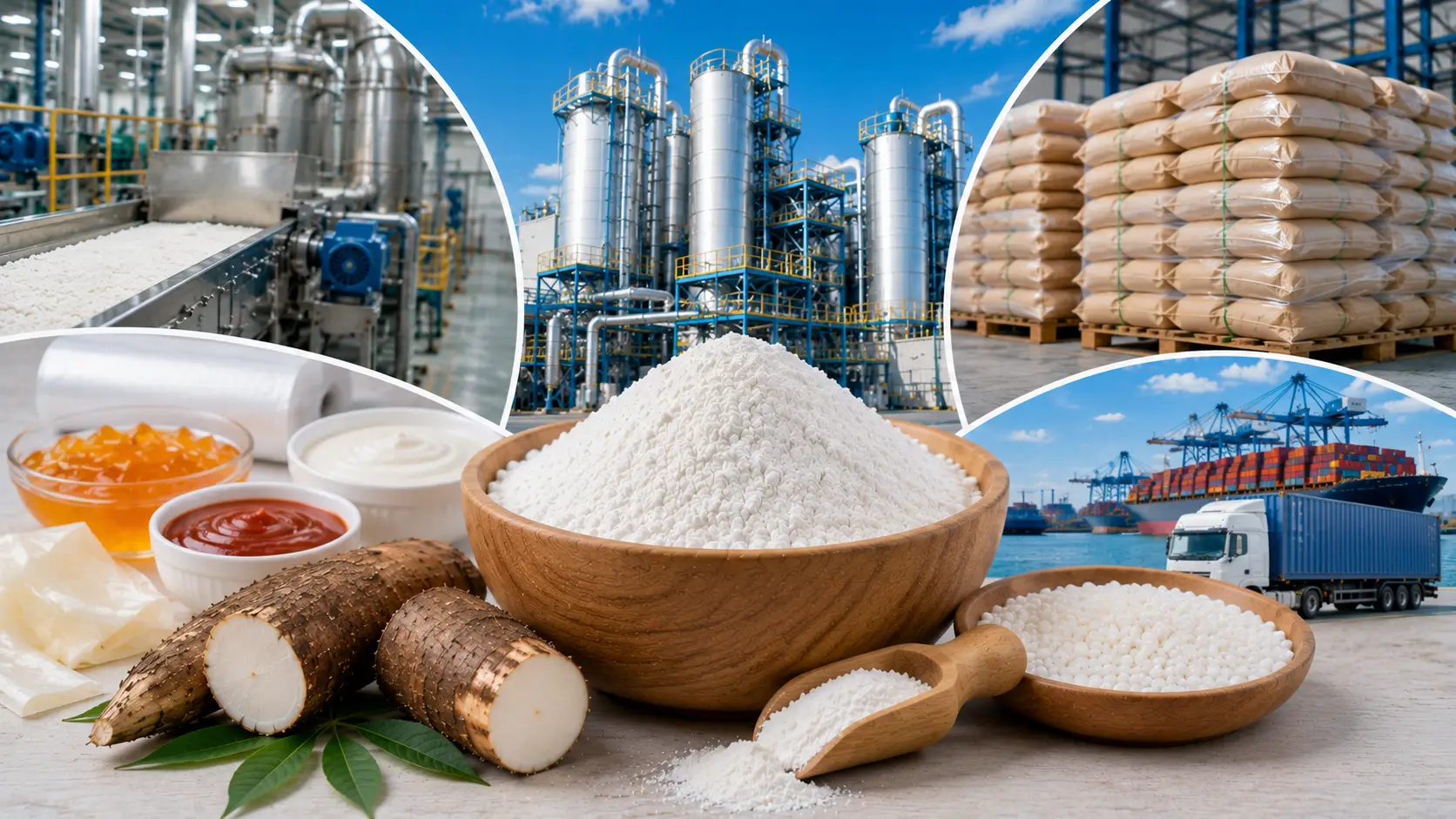
Native tapioca starch is produced from cassava roots and serves as a versatile starch ingredient across food and selected industrial value chains. Unlike modified starches, native tapioca starch represents the unmodified starch material obtained through processing, making its supply chain closely connected to agricultural production and starch-processing capacity.
For B2B buyers, this agricultural connection makes sourcing more than a simple product-ordering exercise. Availability, specification consistency, processing capability, documentation, packaging, and shipment planning can all influence the commercial suitability of a supplier. As a result, procurement teams increasingly need visibility across the full supply chain rather than focusing only on the final product.
Native starch is used for functions such as thickening, texturizing, gelling, binding, moisture retention, and stabilization. These characteristics support applications ranging from bakery and sauces to processed foods and other formulations.
Consequently, manufacturers purchasing native tapioca starch need a supply partner capable of connecting product requirements with dependable sourcing and logistics. For distributors and importers, reliable supply also supports inventory planning, customer fulfillment, and continuity across multiple downstream markets.
The native tapioca starch supply chain begins with cassava cultivation. Cassava roots contain the starch reserve from which tapioca starch is extracted, linking commercial starch availability directly to agricultural production and regional processing infrastructure.
This structure creates a distinctive upstream supply chain because cassava is an agricultural raw material rather than a purely industrial feedstock. Buyers therefore benefit from understanding supplier origin, processing location, harvest-related considerations, and the producer's ability to maintain consistent raw-material access over the purchasing period.
For international procurement, origin diversification can become an important risk-management consideration. Buyers may evaluate suppliers from established cassava-producing regions while comparing product specifications, shipment capability, documentation, and commercial terms.
A diversified sourcing approach can also help distributors and manufacturers reduce dependence on a single supply route. Instead of selecting a supplier based only on quoted price, procurement teams can assess the supplier's ability to support recurring orders, communicate specifications clearly, and coordinate export documentation.
Cassava is processed to separate starch from the root material, producing a refined starch ingredient suitable for subsequent commercial applications. The processing chain and equipment used can vary considerably between producers, making supplier capability an important consideration when evaluating sources.
For B2B purchasing, the objective is therefore not simply to identify a product called native tapioca starch, but to establish whether the supplied material consistently meets the buyer's technical and application requirements. This is particularly important where starch functionality influences finished-product texture, viscosity, binding, or processing behavior.
Supplier qualification can include review of technical specifications, analytical documentation, agreed testing methods, packaging requirements, and product samples. Buyers may also need documentation appropriate to their destination market and intended application.
A specification-led purchasing process helps procurement teams compare suppliers on a like-for-like basis. It also reduces the risk that apparently similar starch products perform differently during production because of variations in agreed technical parameters or processing characteristics.
After processing, native tapioca starch enters domestic and international distribution channels serving manufacturers, distributors, and industrial users. Commercial supply may involve standard bags, larger bulk formats, or other packaging configurations depending on the supplier and buyer's requirements.
International shipments require coordination between supplier production, packaging, documentation, freight arrangements, destination requirements, and buyer inventory schedules. For importers, dependable logistics can be as important as the product itself because delays may affect manufacturing schedules and customer commitments.
Forward procurement planning can help buyers manage fluctuations in demand and avoid unnecessary dependence on last-minute purchasing. Forecasting monthly or quarterly requirements gives suppliers greater visibility and allows buyers to evaluate shipment schedules and replenishment requirements earlier.
For distributors, inventory strategy is particularly relevant when serving multiple customers with different production cycles. A dependable supply arrangement can support more predictable stock management while reducing the operational pressure created by unexpected shortages or shipment delays.
Native tapioca starch is widely relevant to food applications because of its thickening, gelling, texturizing, moisture-retention, and stabilizing functions. Commercial applications include bakery products, sauces, soups, dressings, dairy-related formulations, snacks, confectionery, and processed foods.
Its neutral taste and useful textural characteristics can make tapioca starch attractive where manufacturers want functionality without substantially changing the sensory profile of the finished product. These characteristics also contribute to its role in formulations where texture and consistency are important purchasing criteria.
Beyond food, tapioca starch can participate in industrial value chains including paper and textile processing and adhesive-related applications. Research literature identifies paper manufacturing and textiles as significant industrial users of starch, while tapioca starch has also been studied for adhesive applications.
The industrial buyer's priorities can differ from those of a food manufacturer. Process performance, viscosity behavior, consistency, handling characteristics, and commercial economics may become central to supplier selection. Therefore, application-specific qualification remains important before establishing a recurring supply contract.
Procurement teams typically need to evaluate more than product availability when purchasing native tapioca starch. Application suitability, technical specifications, quality documentation, origin, packaging, minimum order quantities, lead times, shipping terms, and supplier responsiveness can all affect the overall purchasing decision.
A professional supplier evaluation should begin with the buyer's intended application and required specification. Once these requirements are defined, suppliers can be compared based on their ability to meet the technical and commercial conditions rather than on price alone.
Long-term sourcing relationships can provide advantages when buyer requirements are recurring and volumes are predictable. Clear communication regarding specifications, shipment schedules, documentation, packaging, and commercial terms can reduce friction throughout the procurement cycle.
For international buyers, a B2B marketplace or trading partner can add value by connecting demand with qualified supply options and coordinating commercial discussions. This is especially useful for manufacturers and distributors seeking dependable access to imported starch ingredients.
Native tapioca starch procurement is increasingly suited to a strategic sourcing approach in which buyers consider total supply reliability rather than focusing exclusively on spot prices. Agricultural exposure, processing capacity, logistics, documentation, and downstream demand all influence the commercial supply environment.
A strategic buyer can therefore establish approved suppliers, define technical specifications in advance, maintain appropriate inventory coverage, and monitor market conditions. This approach can improve purchasing predictability while supporting continuity for production operations.
Digital B2B platforms are also becoming increasingly relevant to industrial procurement because they allow buyers to discover products, compare suppliers, communicate requirements, and initiate international sourcing more efficiently. For native tapioca starch, this model can connect food manufacturers, industrial users, distributors, and importers with suppliers serving different markets.
Tradeasia International can support this procurement model by connecting international buyers with chemical and ingredient supply opportunities across global markets. For companies evaluating native tapioca starch, the focus should remain on specification alignment, supplier qualification, documentation, logistics, and long-term commercial reliability.
Native tapioca starch sits at the intersection of agriculture, food manufacturing, industrial processing, international logistics, and B2B procurement. Its commercial value comes not only from its functional characteristics but also from the ability of suppliers and buyers to maintain consistent quality and dependable movement from origin to destination.
For manufacturers, distributors, and importers, a strong sourcing strategy combines application knowledge with supplier qualification, specification control, logistics planning, and transparent commercial communication. Working with an experienced B2B trading and sourcing partner such as Tradeasia International can help businesses evaluate supply options and develop procurement relationships suited to their market requirements.
https://www.tradeasia.com/
https://www.chemtradeasia.com/
https://www.tradechem.com/
We're committed to your privacy. Tradeasia uses the information you provide to us to contact you about our relevant content, products, and services. For more information, check out our privacy policy.


 English
 Indonesian
 简体字
简体字
 العربية
 Español
 Français
 Português
 日本語
日本語
 한국어
한국어
 Tiếng Việt