Explore our network of country and industry based websites to access localized information, product offerings, and business services across our group.
Log in to start sending quotation requests for any product.
Don't have an account? Sign Up Here
Home Pea Starch Procurement and Global B2B Supply Trends
Trade Insights | Supply Chain | 25 August 2026
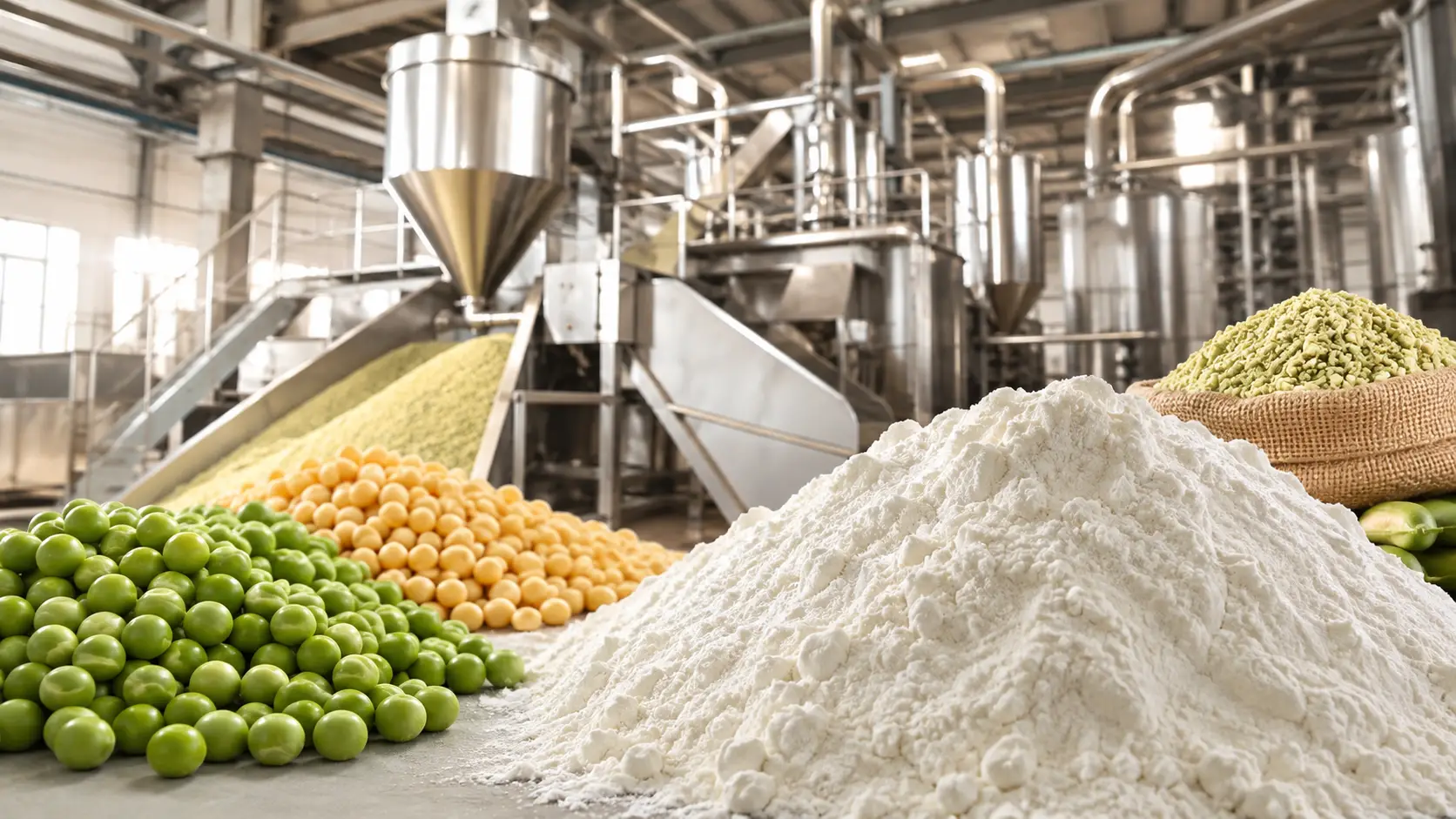
Pea Starch in the Global Supply Chain
Raw Material and Pea Processing
Starch Separation and Production
Food Industry Applications
Supply Chain and Trade Considerations
B2B Buyer and Procurement Priorities
Sourcing Strategy for Pea Starch
Conclusion: Building Reliable Pea Starch Supply
Sources
Pea starch is a plant-derived starch obtained through the processing and fractionation of peas. From a B2B perspective, its importance is closely connected to the wider pulse-processing supply chain, where peas can be separated into commercially useful starch, protein, and fiber fractions. USDA reporting identifies deep processing into these fractions as an important outlet for yellow peas.
The commercial value of pea starch therefore extends beyond the starch ingredient itself. Efficient pea processing can create several saleable product streams, allowing processors to serve food, ingredient, and other industrial markets while improving utilization of the underlying agricultural raw material.
Pea starch is particularly relevant to buyers seeking plant-based starch alternatives for formulated foods. Its supply chain begins with agricultural production and continues through drying, milling, fractionation, purification, quality control, packaging, storage, and international distribution.
For procurement teams, understanding this chain is important because raw-material availability and processing capacity can influence consistency, lead times, and commercial sourcing conditions. USDA reporting has also identified instability in pea supply as a challenge for processors in some markets.
The first stage of the supply chain is the availability of suitable peas. Agricultural production, seasonal conditions, crop yields, and regional cultivation patterns can influence the amount of raw material entering processing facilities. These factors consequently affect downstream availability of pea-derived ingredients.
Processing generally involves preparing peas for separation into their principal components. Research from USDA Agricultural Research Service has described dry milling and air classification approaches for separating protein-rich and starch-rich fractions from field peas.
For commercial processors, the efficiency of fractionation is strategically important because starch is one component of a broader value chain rather than an isolated agricultural product. The economics of pea processing can depend on creating sufficient value from starch-rich and other co-products.
This creates opportunities for integrated processors and ingredient suppliers that can connect agricultural sourcing with standardized downstream ingredient production. A reliable supply model therefore depends on both raw-material procurement and efficient processing infrastructure.
Once peas are processed, starch can be separated from other fractions and prepared for ingredient applications. The exact production configuration may vary by processor, but commercial quality management generally needs to address purity, consistency, moisture, particle characteristics, and suitability for the intended end use.
Starch functionality is central to its commercial value. USDA research describes starch as an ingredient capable of contributing to viscosity, texture, binding, adhesion, film formation, and moisture retention, with performance depending on the botanical source and functional characteristics of the starch.
For buyers, this means product selection should not rely solely on the name “pea starch.” Technical specifications and application requirements should be matched before purchase, particularly where the ingredient will be incorporated into standardized food formulations.
Codex also recognizes starch from peas among plant sources included within the starch food category, while noting that native starch is separated using processes specific to the raw material.
One established application for pea starch is noodle production. USDA reporting identifies pea starch as an ingredient used to produce vermicelli, including the Chinese product commonly known as “Fen Si.”
This application demonstrates how pea starch can move from an agricultural raw material into a specialized food-ingredient supply chain. Buyers serving noodle manufacturers may therefore evaluate pea starch based on processing performance, consistency, and suitability for the required finished-product characteristics.
The broader starch category is important across processed foods because starch can provide functional properties such as thickening and texture control. These characteristics create potential relevance for food manufacturers developing formulations where starch performance is an important processing consideration.
For B2B suppliers, application-oriented sourcing is therefore more effective than treating pea starch as a generic commodity. Matching the ingredient specification with the customer's formulation, processing conditions, and quality requirements can support more reliable procurement decisions.
Pea starch supply is connected to agricultural conditions because the ingredient depends on pea availability. USDA market reporting has highlighted how weather events and changes in pea production can affect processor supply and pricing conditions.
Processing capacity is another important consideration. Even when peas are available, downstream starch supply depends on facilities capable of efficiently separating and preparing the starch fraction for commercial use. This makes processor capability a significant part of B2B sourcing assessment.
International buyers should consequently evaluate more than nominal availability. Lead time, production continuity, documentation, packaging, storage conditions, and logistics capabilities can all affect the practical reliability of a supply arrangement.
For distributors and manufacturers, diversification across qualified suppliers can also help reduce exposure to interruptions in agricultural or processing supply. A structured procurement approach can make pea starch sourcing more resilient as demand develops across food-ingredient markets.
Food manufacturers generally need to evaluate technical specifications before selecting a starch supplier. Depending on the application, procurement teams may consider purity, moisture, microbiological requirements, particle characteristics, packaging format, and functional performance.
Price is important, but it should be evaluated alongside consistency and supply reliability. A lower purchase price may have limited commercial value if inconsistent specifications create production problems or additional quality-control requirements.
B2B buyers should also assess supplier responsiveness, documentation, minimum order quantities, delivery capability, and the ability to support repeat procurement. These factors become increasingly important when pea starch is incorporated into standardized manufacturing processes.
A marketplace-based sourcing model can help buyers compare suppliers and communicate specifications more efficiently. For distributors, it can also provide access to broader sourcing opportunities without relying exclusively on a single supply channel.
A practical sourcing strategy begins with supplier qualification. Buyers should verify product specifications, intended application suitability, quality documentation, packaging requirements, and commercial terms before establishing a recurring purchasing relationship.
Supply continuity should be considered alongside product quality. Because pea starch is connected to agricultural and processing conditions, buyers benefit from understanding the supplier's sourcing structure and production capabilities rather than evaluating only the finished ingredient.
The broader pea-processing economy also creates opportunities for suppliers to improve value utilization. USDA research has highlighted the importance of finding higher-value uses for starch-rich fractions generated during pea protein processing, demonstrating the connection between protein production economics and starch utilization.
For international procurement teams, the strongest sourcing strategy combines qualified suppliers, clear technical specifications, transparent commercial communication, and dependable logistics. This approach can support more predictable purchasing as demand for pea-derived ingredients develops.
Pea starch represents an important value stream within the broader pea-processing supply chain. Its commercial role connects agricultural production with fractionation, ingredient manufacturing, food processing, distribution, and international B2B trade.
For buyers, the opportunity lies in securing a consistent ingredient that matches application requirements while maintaining commercially practical sourcing arrangements. For suppliers and distributors, the focus is on connecting reliable pea-starch production with food manufacturers and ingredient buyers seeking dependable supply.
As global food manufacturers continue evaluating plant-derived ingredients and specialized starches, supply-chain transparency and application-focused procurement become increasingly relevant.
Tradeasia International and its B2B marketplace ecosystem can serve as a commercial connection point for buyers and suppliers evaluating pea starch sourcing opportunities, helping procurement teams approach international ingredient trade with a clearer focus on specifications, supply relationships, and market requirements.
We're committed to your privacy. Tradeasia uses the information you provide to us to contact you about our relevant content, products, and services. For more information, check out our privacy policy.


 English
 Indonesian
 简体字
简体字
 العربية
 Español
 Français
 Português
 日本語
日本語
 한국어
한국어
 Tiếng Việt



















